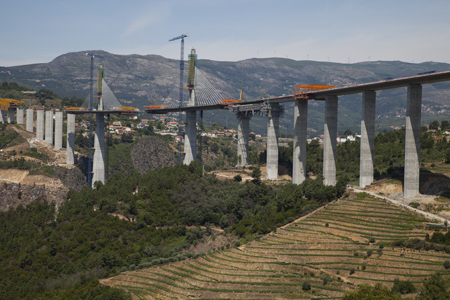
A major bridge which is being built in the north of Portugal will be the most striking structure on the Auto-Estrada Transmontana. This motorway is nearly 140km long in total and will connect the cities of Vila Real and Bragança, taking the great northern highway linking Oporto to the Spanish border one step closer to completion.
The impressive topography of the mountains at Trás-os-Montes and the deep valley formed by the River Corgo passing through Vila Real make this project quite extraordinary. The 42-span Corgo Viaduct is 2,796m long overall and consists of three distinct sections; this division is for structural reasons, as well as to accommodate different construction methodologies.
There are two approach structures - the 855m-long, 15-span western viaduct and the 1,167m-long 20-span eastern viaduct. At the centre is a seven-span viaduct which is 768m long in total and incorporates a central cable-stayed span of 300m. In cross-section, the viaduct consists of a 10m wide, 3.5m high box girder concreted in-situ and an upper slab generally 25.3m wide, but which increases to 28m in the cable-stayed section to allow for installation of stay cable anchorages.
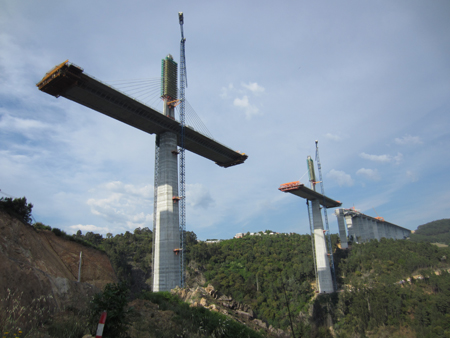
The overhanging width of the upper slab is supported by prefabricated concrete struts. The challenge of constructing the deck on top of piers which rise to a height of 113m was solved by using launching girders for both approach viaducts. The equipment used on each viaduct has different characteristics and employs a different construction methodology. The launching system used on the eastern viaduct comprised of underslung trusses which were able to offer so-called ‘organic’ behaviour.
This was achieved by the presence of exterior steel tensioning cables which enabled deflections to be adjusted during concreting (Bd&e issue no 67). The box girder section was built in two phases, with the bottom slab and webs being poured in the first phase, followed by the upper slab.
The launching system used on the western viaduct consisted of overhead beams with hydraulically-controlled internal formwork, which allowed concreting of the box girder section to take place in a single phase. This launching girder was adjustable and, in the initial spans was required to create a plan curve with a 700m radius.
On both viaducts, once the central box had been built, the upper slabs were widened and struts were installed using a cantilever form traveller. Internal bonded post- tensioning was a requirement on all spans. The standard 60m-long spans used BBR VT CMI 2706 post-tensioning tendons, arranged with eight tendons in total in the webs and a further eight in the upper slab. In some of the segments, tendons of varying sizes – with 4, 7, 12, 15 and 19 strands – were used to allow maximum efficiency to be achieved from the reinforced concrete section.
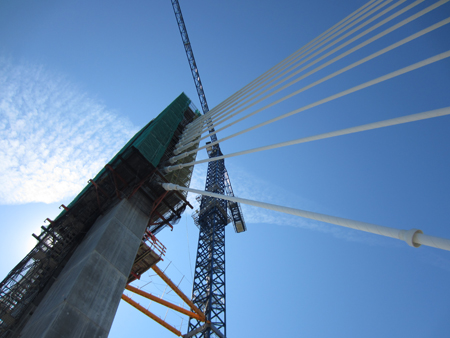
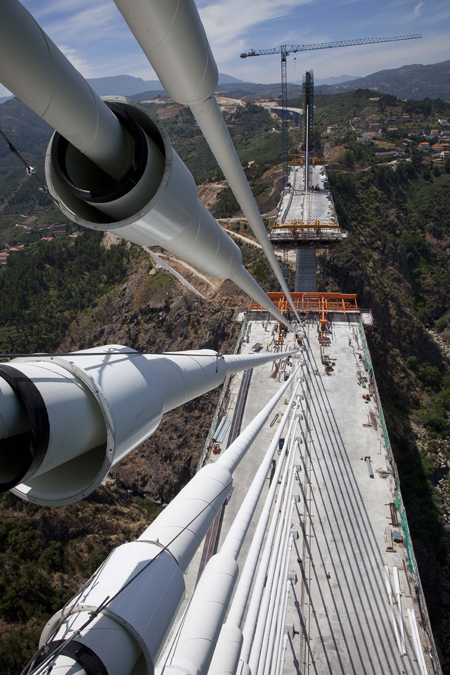
The central viaduct consists of seven spans with the main cable-stayed span of 300m being flanked by side spans of 126m, 60m and 48m on each side. The use of a cable-stayed span was essential because of the difficulty in accessing the sheer banks and sloping terrain next to the river in order to build any additional piers. The towers rise 63m above the deck on top of the 130m-high piers, with the lowest point of the valley a further 70m below the pier foundations.
By the end of the project, BBR PTE will have installed 88 stay cables – 22 pairs per tower – with the longest cable measuring 159m. BBR stay cables are being used, ranging from 42 to 69 strands, resulting in a total of 660t of steel strands being used.
The key element which distinguishes the stay cable system is the use of the BBR Saddle, which is the latest technology from the firm. Not only does it retain the advantages of traditional saddles, for example enabling the tower to be designed with more slender dimensions, but it also offers additional advantages such as preventing saddle fatigue and eliminating the risk of different forces being introduced into each stay cable, even in the same pair. A total of 44 saddles featuring a monotube configuration were installed on this structure. The three cable-stayed spans were built using a cantilever form-traveller which concretes a 28m deck width and 6m long segments in one phase, with one stay installed per segment.
The concreting of each pair of segments was only completed after tensioning of the 30 BBR VT CMI 0406 transverse tendons, the 96 longitudinal post-tensioning bars and the pair of stays on the preceding segments. The installation of stay cable pairs at each tower was carried out simultaneously using the strand-by-strand method, and there was just one strand difference between the stays on the two sides. HDPE duct and strand preparation and installation fitted perfectly with the demanding seven-day working cycle between concrete pours.
The bridge is being built for owner Estradas de Portugal by main contractor Caet XXI which is a consortium of FCC Construccion, Ramlho Rosa Cobetar and Soares da Costa. The designer is LCW Consult and the post-tensioning and stay cable contractor is BBR.
Technical insight
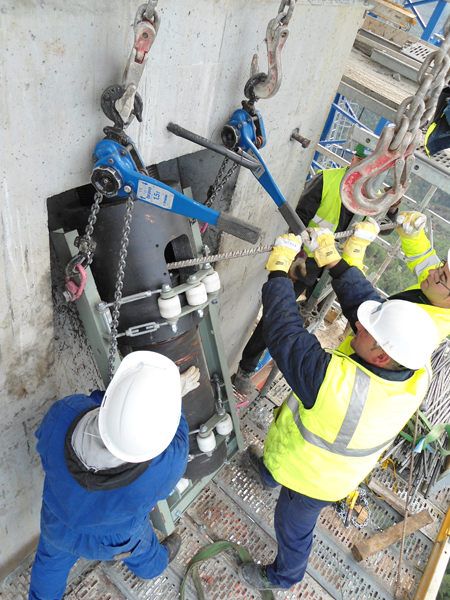
The standard BBR Monotube Saddle configuration consists of a parallel arrangement of individual guide systems surrounded by a high-strength grout – all enclosed in a curved smooth steel pipe. Seven-wire HDPE-sheathed steel prestressing strands – factory-fabricated and filled with corrosion protection material – are inserted through the guide system and connect the coupler heads placed at each side of the tower.
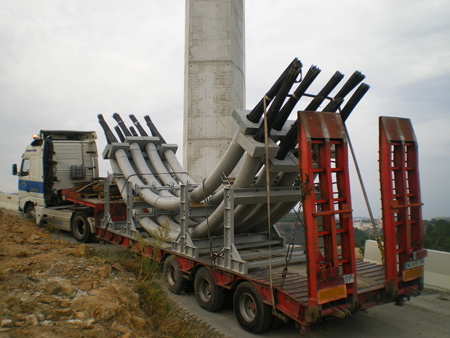
While the high-strength grout provides a stiff environment, strands are fully replaceable as there is no bonded connection between the guide system and the external HDPE of the strands. The minimum radius of this saddle configuration is 2m. Alternatively, a bundle of bare strands either bonded or unbonded to the tower might also be used if permitted at the place of use, and this is known as the BBR Bundle Saddle. The minimum radius of this saddle configuration depends on the degree of filling and maximum contact pressure permitted by the relevant national standards.
Juan Linero is special projects manager at BBR PTE and Juan Maier is senior product manager at BBR VT International