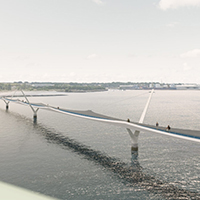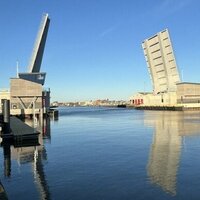
But work being carried out on the site at Laroin is the first site application of a major new development for specialist contractor Freyssinet. The central span of the bridge will be supported by cables made of carbon fibre rods, and which are being fabricated on site.
The technology that is being used on this small-scale project is expected to have much wider applications, particularly in the offshore industry. Freyssinet initially designed its carbon fibre cables with tension-leg platforms in mind; as oil companies seek to exploit fields in deeper and deeper waters, the use of steel anchor cables becomes impossible as they will break under their own weight. In theory, carbon fibre cables should not suffer this problem.
As Freyssinet scientific director Jean-Philippe Fuzier explains, however, the difficulty is not in developing cables that are strong enough to carry the required loads, but in designing anchors that can grip the rods without breaking them, the elastic modulus of carbon fibre composite being lower than that of steel.
The fact that this new technology is being showcased on a small footbridge in France is the result of a series of happy circumstances for Freyssinet. The local council proposed a bridge here to provide access to a new waterpark that is to be developed in worked-out gravel pits. The mayor of Laroin was keen on the idea of having a bridge which would use new technology, but the clinching factor may well have been that the carbon fibre manufacturer Soficar, with whom Freyssinet had developed the product, was headquartered in the area. Hence the client could support local industry at the same time as promoting new technology.
In common with many new technologies, particularly in the advanced composites sector, these carbon fibre cables are not yet competitive with the existing steel cables. The additional cost has been divided between the three parties - the city council, Soficar and Freyssinet. Fuzier is convinced that it will not be long before carbon fibre cables are widely used; he points to the prevalence of carbon fibre plates in strengthening work, only a few years after the technology was first used on bridges. "Bolted steel plates are no longer used for this," he says. "You will always find advanced composites being used for this now."
One of the steps to enabling this change in practice is to prove that site assembly is possible. Anchorages for advanced composite cables have been made up before, says Fuzier, but in a laboratory rather than under site conditions.
The Laroin footbridge has a main span of just 100m which is supported by eight pairs of cables from two inverted V-shaped towers. These sixteen stays vary in length from 20m to 45m, and are composed of 14 or 21 number 6mm diameter carbon fibre composite rods, protected by an HDPE sheath. Back stays for the bridge are standard steel cables - one from each tower - made of 19T15 steel strands, and anchored in a concrete anchor block fixed down by ground anchors. The superstructure is made of steel girders with a precast concrete deck, and the towers, which are just over 20m high, are steel.
Freyssinet technical division research & development engineer Rene-Louis Geffroy explains that many aspects of the cable and its anchorage are similar to the company's existing products. "The anchorage has a jaw rather like a normal anchorage," explains Geffroy, "but although it has to grip the rods firmly, we have to be careful not to damage them transversely." Hence instead of the jaw 'biting' into the cable to prevent it from moving, there is a layer of cushioning between the jaw and the rods.
The anchorage is injected with petroleum wax and contains a 'stuffing box', just like a standard Freyssinet cable anchorage, but in this case the waterproofing measures are there to protect the wedge, not the cables, since the carbon fibre rods do not corrode.
Construction of the bridge has been carried out using temporary cables, a method similar to that which Freyssinet adopted for its recent Deux Lions Footbridge project in Tours. Once the concrete abutments had been built, the steel towers were erected and tied down using bolts. Temporary steel units were installed on each leg of the tower to support saddles for two steel ropes which were slung between the banks and tied back to the anchor blocks. These temporary cables enabled the deck to be launched before the stays were erected, and meant that no heavy lifting equipment was necessary to erect the deck units.
Eight steel elements, each 14m long, form the main structural basis of the deck. They were launched from each bank - four units being assembled on each side and pulled out to the centre, supported by rolling cross-beams running on wheels on the temporary cables. Once all four units had been launched to the final position, the back stay and the main span cables could be erected and adjusted. Launching then began from the other side of the river.
When Bd&e visited the site, all eight deck units were in place and all cables were installed on one side. Installation of the other cables was under way and the entire project was due for completion at the end of this month (May).
Freyssinet also intends to use the temporary cables to install the precast deck panels and handrails of the bridge. They will need to be moved so that they are located inside the plane of the permanent cables, but will provide the most efficient way of erecting the panels, Geffroy says.
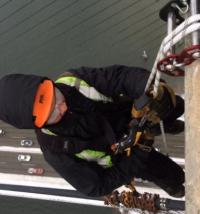
Stays for the bridge have been manufactured on site, representing a major advance for this technology. The carbon fibre rods were delivered to the site on a reel, and were drawn out and cut to length before being bundled into groups of seven and arranged within the HDPE sheath. Anchorages were also assembled on site, many of the elements being similar to units for standard cables. This extends not only to the waterproofing protection of the anchorage, but also the arrangements for adjusting the lengths of the stays to meet the required profile.