

The danger that cable-stayed bridges can pose to the bird population has been very much in the news of late, most notably in its impact on plans for the Peace Bridge expansion project. Helena Russell investigates the issue of avian strikes
Last year objections by environmental agencies in both the USA and Canada resulted in plans for the new Peace Bridge over the Niagara River being sent back to the drawing board once more. The agencies claimed that the two-tower design with its 173m-high structure would pose an unacceptable risk to the region's bird population, and that it could not go ahead in its proposed form. Given the concerns that were raised, the Peace Bridge authority said that it would seek an alternative solution with lower towers, although local politicians are still pressing for a 'landmark' structure.
The fact that the design of a major bridge has had to be thrown out as a result of objections over its potential hazard to birds is unprecedented. There's no question that the Peace Bridge authority acted wisely in acknowledging the problem and seeking a solution, even in the face of political unrest. But the situation created an underlying feeling of uneasiness among the bridge engineering community. Was this just a new environmental trend thrown up to create another hurdle for designers of large bridges? Was there any basis for the claim that cable-stayed bridges posed a threat to birds? Surely birds were able to fly around bridge cables, otherwise why were they not constantly hitting other objects?
The example that is most familiar is avian strikes on windows. Few people have not experienced the shock of seeing a bird fly directly into a window - at best coming off slightly dazed, at worst ending up dead. But it is easy to understand why birds make this mistake - they see the sky reflected in the glass and think that it is real. Buildings with mirror glass or with trees growing close to the windows are the worst offenders, and guidelines are now available to architects which offer advice on best practice in avoiding avian casualties.
The danger posed by cable stays is something altogether new and largely unrecognised by engineers - why would birds fly directly into cables rather than swerving to avoid them? And why has this risk only just been recognised when cable-stayed bridges have been around for several decades - and suspension bridges for significantly longer?
The reason, explains Al Manville of the US Fish & Wildlife Service, is that the danger is created by a combination of factors, including the height of the bridge and the presence and number of the cables. In the case of the Peace Bridge, for example, the original concept design would not necessarily face any objections at all if it were proposed for a different location. But the fact that the bridge will cross a major route for migratory birds, in a location plagued by poor weather, and is also proposed to have significant night lighting, would create what Manville calls 'perfect storm' conditions for birds.
"There is a high history of fog at this location," he says, "and our main concern is that in low visibility, the presence of birds combined with the bridge lighting would be a fatal combination."
Manville is the USFWS's senior wildlife biologist on bird strike, bycatch, policy and international issues at the division of migratory bird management, and he is responsible for ensuring that the 'take' of birds protected by the Migratory Bird Treaty Act is minimised as far as possible. The act implements legislation for four treaties, the first of which was signed with Great Britain for Canada in 1916.
He says: "While I can appreciate the scepticism among bridge designers and engineers about the likelihood of problems to migratory birds, this is not a perceived issue but a real one. Not all bridges and not all bridge locations are alike; the Peace Bridge, for example, has some potential wintering problems with migratory birds and the Niagara River is a globally-important bird area. Our greatest concern arises when inclement weather, heavy bird presence, and lighting/cable conditions are present that together could result in a significant bird kill/mass mortality event."
Tim Sullivan is the FWS field officer working on the Peace Bridge project; he agrees that the problem is very site specific. "The Niagara River is very confined at this point," he says, "and observations of birds meeting bridges show that in almost all cases the birds will increase their flying height to try and go over rather than under bridges." Its location between two of the Great Lakes is also significant as they attract lots of water birds as well as wintering and migrating birds. There is also the suggestion that local birds may suffer as they will have to pass the bridge several times going from nesting grounds to feeding grounds. The extra energy they will use to fly over the bridge could have an adverse affect on them over the long term.
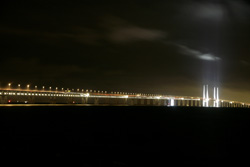
Ecologists' fears of the dangers are not unfounded - the opening of the Öresund bridge between Denmark and Sweden in 2000 sparked concern among wildlife experts following an incident in which a large number of dead or dying birds was found on the bridge deck. In common with the Peace Bridge, the Öresund crossing includes a large cable-stayed bridge which crosses an important migratory route for birds, and is also prone to poor weather. The cable-stayed bridge has four towers each 203m high, which are floodlit at night.
Most of the birds were found on or close to the cable-stayed bridge, and the number of dead birds was estimated at about a thousand, a large percentage of which were song thrushes. The incident sparked a lot of discussion about the risk of similar incidents occuring in the future, as a result of which the bridge owner Öresundsbro Konsortium decided to fund a study by Lund University to assess this risk.
This research was set to be the first major investigation of the danger that bridges - specifically cable-stayed bridges - posed to birds, and offered an excellent opportunity to try and understand how birds behaved when they encountered large bridges. Öresundsbro Konsortium wanted to know how migratory birds in particular reacted when they met the bridge, how the risk of strikes varied for different types of birds, particularly those which migrate at night, establish what weather conditions were critical for different types of birds and estimate the annual mortality among vulnerable bird groups, that was caused by the Öresund Bridge.
One particular aspect that they wanted to investigate was lighting ' to evaluate what impact floodlighting of the bridge had on the number of deaths, and whether the risk could be significantly reduced by turning the lights off in specific weather conditions.
During the study period in autumn 2001, dead birds were collected on the bridge during daily patrols. Visual counts of migrating birds were carried out during the main migration period of September and October, and radar records were analysed to try and establish the migration intensity, flight direction and flight speed, although this radar could not record small birds such as passerines.
Among the almost 300 dead birds found during the monitoring period, 96% were migrants and 73% of casualties were night-migrants. Most of the birds were collected during October, and there was a concentration on two days which were characterised by reduced visibility at night and during the early morning.
Observers also noted that bird reactions to the bridge were divided between those birds which were local to t