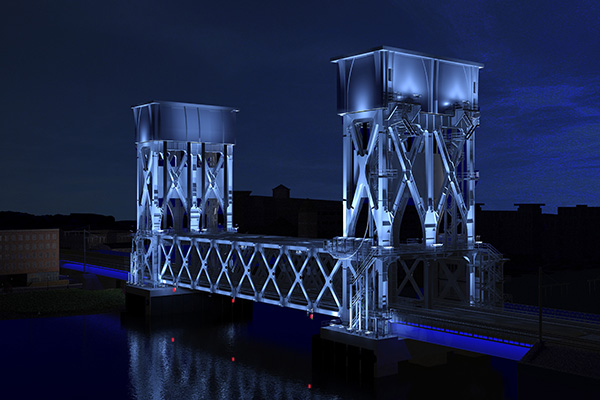
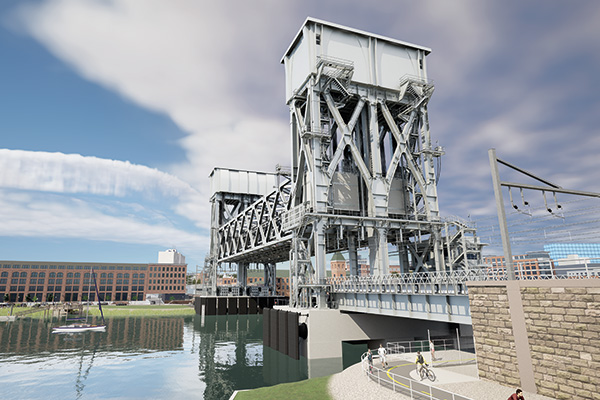
Render of the replacement Norwalk River Bridge in the city of Norwalk, Connecticut (all images courtesy of HNTB)
High levels of rail traffic, neighbouring historical buildings, sensitive cultural resource sites, a thriving shellfish industry and a community proud of a redeveloped downtown neighbourhood are all influencing factors in a multi-layered billion-dollar project in Norwalk, around 70km north-east of New York. Operational since 1896, the existing 172m-long structure across the Norwalk River comprises a deck truss swing bridge with three approach deck truss fixed spans. The existing moveable section provides navigable channels 17.7m and 16m wide in the open position.
Known locally as the Walk Bridge and officially as the Norwalk River Railroad Bridge, the structure is one of the oldest moveable rail bridges in the region. It is also one that has increasingly shown its age for more than a decade through repeated operational issues and service disruptions with deep ramifications. The bridge carries four tracks of the New Haven Line on the heaviest commuter rail corridor in the USA, the Northeast Corridor between Boston and Washington DC. The New Haven Line is owned by the State of Connecticut and operated by the MTA (Metro-North Railroad) in New York City. It constitutes around 70km of rail that each day carries around 200 trains and approximately 125,000 passengers travelling to/from NYC between 5.30am and 11.30pm.
The existing structure is to be replaced by a crossing with 44m-high towers that will lift two new 73m-long parallel spans by approximately 18m. These two spans will function independently to provide redundancy and operational flexibility in the event of a track outage or other future maintenance.
The project is being undertaken for the Connecticut Department of Transportation and the Federal Transit Administration by a joint venture comprising Cianbro and Middlesex under the state’s first use of the Construction Manager/General Contractor (CMGC) project delivery vehicle. HNTB is the engineer of record for the replacement bridge and is also responsible for environmental documentation and permitting. WSP is providing program management, construction engineering and inspection services. The federal government is delivering 80% of the Walk Bridge’s funding, with the remainder coming from the state.
The construction programme did not start as a replacement; rather it was originally envisioned as a rehabilitation of the Walk Bridge. In fact, it had been awarded as such to HNTB when, in July 2014, the bridge became wedged in the open position, resulting in considerable commuter delays. When eventually the bridge was closed, a public outcry demanded it remained that way, which created a conflict with the needs of river traffic. Consequently, the Governor of Connecticut issued an emergency declaration that marked the beginning of a bridge replacement programme. “HNTB was already working on the rehabilitation design but hadn’t implemented these measures yet. We were still in analysis mode of what we should do to make improvements, to improve the reliability of the span, and to lengthen the service life of the structure. And we pivoted from considering rehabilitation to considering replacement options,” remembers Christian J Brown, vice president and moveable and rail bridge practice lead at HNTB.
The design team was then faced with maintaining a continued level of rail service whilst replacing a critical transportation link located in a densely populated urban setting surrounded by infrastructure. “On the west side of the bridge there are two historic properties that literally are within feet of the existing railroad. These site constraints were critical in developing replacement alternatives while also generating great interest in understanding how construction activity would impact those facilities. Much field work was done to look for vibratory impacts that may be induced to those facilities, and detailed surveys of the buildings were completed to plan for those types of situations.
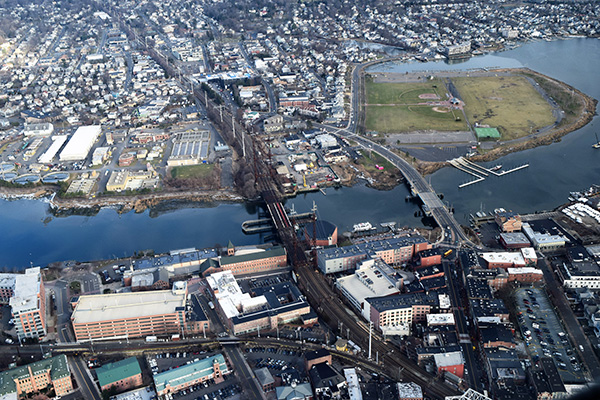
The existing Norwalk River Bridge is located in a highly congested area
“During our environmental field reviews we also encountered a sensitive cultural resource site whose historic remnants were discovered on the south-east side of the project, a matter that had to be dealt with very carefully in a collaborative process with the federal agencies and the key stakeholders, so that the construction adjacent to this area avoided impacts to the culturally sensitive site,” says Brown.
In addition, there were strong environmental regulatory requirements due to Norwalk Harbour’s reputation as a source of shellfish: “There were concerns that construction in the river would stir up riverbed contaminants that could potentially destroy or cause great harm to these commercial interests. That caught the eye of all of the regulatory agencies, so there was a great need to come up with innovative construction techniques that would – particularly for the substructure – limit those potential environmental impacts, get everybody on the same page, and get those regulatory and construction permits in place to move the project forward.”
Brown highlights that there is also much community pride around the redevelopment of the Sono District in Norwalk, meaning that aesthetics also have a part to play in a project heavily focussed on construction speed and constructability. “One of the participants from the public actually had a great statement when he said that doing this project is similar to trying to change the tyre of your car while you’re driving 65 miles an hour down the highway.”
On top of all these external factors is that this is the first project that Connecticut DoT has attempted to deliver using the Construction Manager General Contractor delivery method, “So we have that layer of complexity and new challenges, not just for our team, but for the Department and for the contractor.” However, Brown comments that having the contractor on board is a great benefit, particularly in regards to mitigating construction risk and developing construction means and methods. “As engineers, we always like to think that we can figure out the construction complexities, but when you get the experience of a seasoned contractor on board that can provide that constructability input that can really influence and refine for the betterment of the project, it brings real value to the project.”
Bearing in mind the severe limitations and requirements associated with the project, it may be surprising to hear that 70 potential alternative designs for the Walk Bridge replacement were considered during the project’s conceptual phase. “I know that sounds like a lot, but they were essentially different permutations of similar structure types with a focus on constructability and maintaining rail traffic. And they all kind of focused on where we were putting new substructure, what type of span lengths and what type of movable span would result from those different pier placements, because each iteration of those alternatives had a different construction sequencing approach.”
The desired structure had to be amenable to accelerated bridge construction methods: the typology that was finally settled upon was a vertical lift span. It was selected mainly because it would enable the new foundations to be built outside the footprint of the existing navigation channel without disrupting the swing span’s operation during construction. “That was a primary feature of that design decision, allowing for the most construction to advance before we even impacted the railroad and before we impacted waterway traffic. At some point during the project, all modes of transportation have to get impacted to a certain degree, but they’re impacted very briefly and that was the primary focus. From the railroad standpoint, we wanted to have impacts limited to Friday at midnight till Monday at 05:00 am.”
As opposed to the existing swing span’s deck-truss design, the new lifting bridge will be a through-truss, which will increase the 4.9m clearance beneath the crossing by around 3m, thus potentially reducing the number of times the span will need to be raised. “There were limitations on what we could do to the profile of the existing track. We couldn’t raise it a lot because of everything that’s going on at the track approaches,” comments Brown.
The foundations for the lift-span towers are being built under the existing structure, behind the existing piers, and they will support the lift towers at either side of the existing railroad. “So we’re basically building this bridge right on top of the existing bridge while we’re still maintaining all that traffic.”
The close proximity of the existing bridge means that the towers are founded by 3.6m drilled shafts located at each corner of the rectangular pier footings. Supplemental foundation support is provided by clusters of micro-piles in the centre portion of the new piers. “We only have 16ft of headroom from the low chord to the water so we need low clearance equipment to get in there, so we couldn’t put a drilled shaft in the middle.” As the depth of the river decreases significantly outside the navigational channel, construction access will be via temporary work platforms located on either side of the existing approach spans.
One of the most eye-catching aspects of the planned construction process is the partial demolition of the swing span. The existing movable portion was an engineering marvel in its own right when it was constructed in the late 19th century by supporting all four railroad tracks with a single structure. This unique configuration contributed greatly to the overall construction challenges. Half of the swing span is to be longitudinally deconstructed in order to leave room for the first lift span, whose footprint encroaches on the existing swing span by approximately 4.6m. “The unique thing about the structure of the movable span is that it’s a single structure for all four tracks. The approach spans are different in that the structure is isolated to individual tracks, but the swing span carries all four tracks. And this was a challenge,” says Brown. “Once we’re left with the two-track swing span, the first lift span can get floated in, and then we shift traffic over to the new structure and then we remove the remaining portion of the swing span that was left in place.”
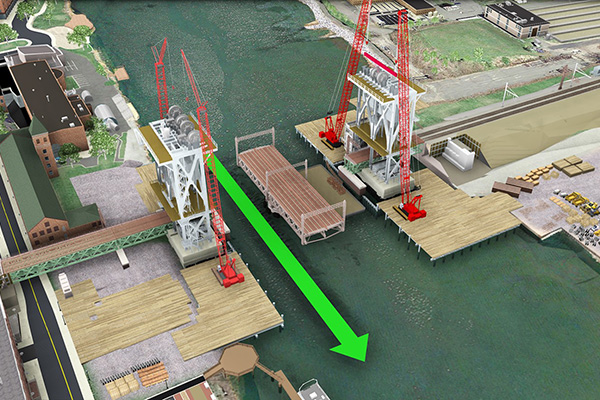
Construction staging: new pier construction
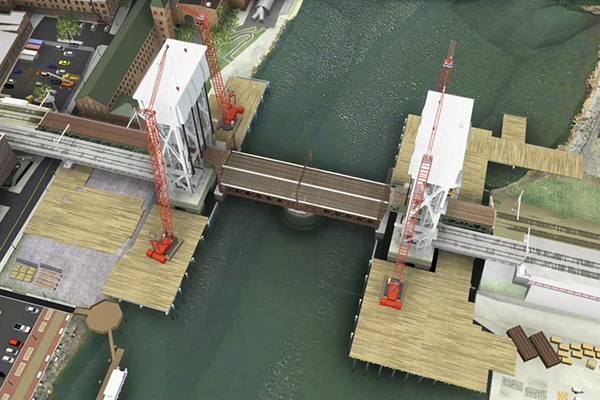
Construction staging: new side spans
Although the New Haven Line consists of four tracks, much of the new bridge’s superstructure construction requires the closing of two tracks at a time while still maintaining the same level of railroad service. The switch from four tracks to two has been made possible thanks to the CP243 Interlocking Project, a new 1km-long four-track interlocking system located on the New Haven Line that will allow trains to switch tracks on their approach to the construction site.
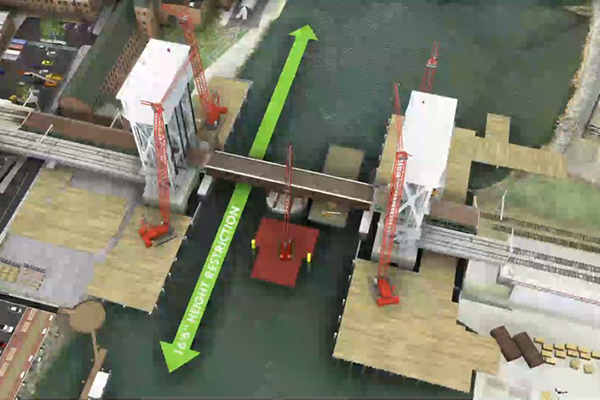 Construction staging: swing span removal, step one
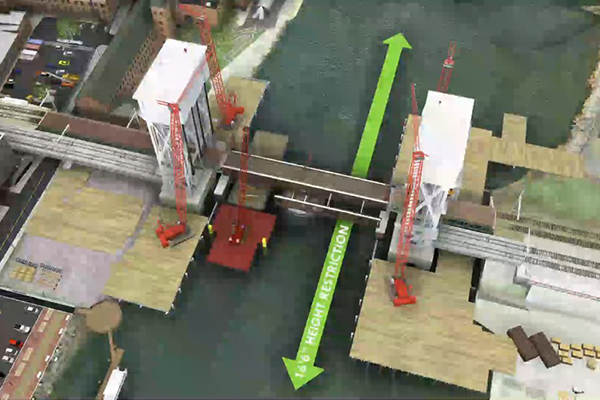
Construction staging: swing span removal, step two
Once the lifting towers are in place and the existing four tracks reduced to two tracks, the unused fixed approach spans will be replaced with steel deck girders and precast concrete deck panels featuring ultra high performance concrete closure pores, the latter selected for speed of construction and long-term durability. The approach spans feature a ballast deck while the lift span’s rails will be supported on ties only. The first lift span is planned to be installed and connected during the winter months, when there is limited navigation traffic, in an operation expected to take 60 days.
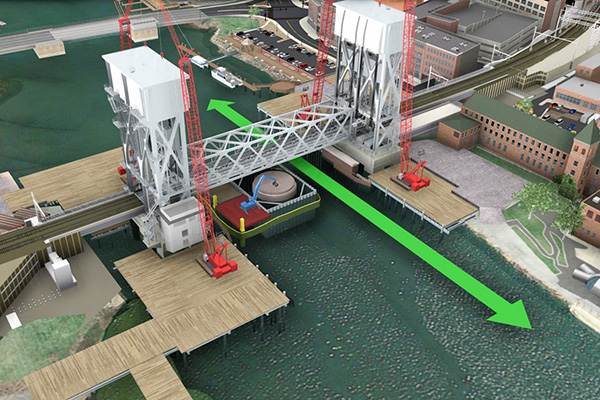
Construction staging: removal of pivot pier
Once the first new lift span and its approach spans are in place and operational, the remaining half of the existing swing portion and the approach spans will be deconstructed; the new approach spans built; and the second lift span floated in. “So we have to raise the lift span to get the new span underneath it, and then it pivots around to its final position. So now we’ve got all four tracks in. And once this last span is in place, we can resume the four-track railroad.”
In theory, the two independent lift spans could be installed in a single operation, but the fabrication time expected for each through-truss led the team to split it into two. “But I wouldn’t be surprised if during construction that both of those get installed at the same time because we are going through an early procurement measure to secure the material for both the spans and the equipment, including the operating equipment, machinery, brakes, etc.”
The intention to longitudinally deconstruct half the swing span and retain it in an operational state raises many questions. A series of accelerometers and strain gauges have been in place on the existing span for two years, establishing baseline response characteristics of the existing spans to live load and environmental changes such as tides and temperature. “We want to know the behaviour of this span that was built in 1896 with some questionable understanding of the material properties of steel and pier elements. We’re going to be running trains on this side only, meanwhile, half the truss is gone. We want to know how this structure is responding because it’s been happy for 127 years in its current configuration. And then when we start to deconstruct this, we have a way to measure the behaviour during this interim phase. Because, again, while this is going on, you’re going to have trains operating on this, and we have to know instantaneously if there is something that we need to take a look at, slow trains down or take some corrective action.”
It must be noted that, at this time, the half-span section will likely be taking on an increased amount of daily rail traffic: “And the remaining fatigue life on that old structure is of paramount concern, so we want to be able to predict that, which is where structural health monitoring will come into play. We’re introducing an eccentric load now onto this pivot pier – where previously the load was balanced – and we’re removing half of its dead load. We want to know how that timber pile-supported pivot pier responds to a change in its dead load conditions as well.”
To facilitate the financial oversight of the complex works, Connecticut Department of Transportation has divided the circa US$1-billion project into smaller CMGC construction packages. “Each package will have its own interim GMP that the contractor will get awarded as the work advances. Unzipping the project into these smaller packages allows the DoT to better manage their cash flow, manage smaller construction sizes, contract sizes, and still move the project forward.” The largest package is Package A, which includes construction of the micro-tunnel (more on this below) and the lift span piers.
The choice of CMGC as the delivery method has brought some changes to the plans, says Brown, as well as provided confirmation of the design. “The process has refined the design and matched it to the contractor’s means and methods. For example, we made some changes to elements of the bridge piers to take in their suggestions to use precast formwork rather than traditional formwork for portions of the pier. So we use precast segments that would then be filled with concrete and then the precast just stays in place. They have offered valuable input and confirmation of the design concept through this effort.”
A total of 25 different technical disciplines have participated on this project and the current site works revolve around another important part of the puzzle, the construction of a new utility micro-tunnel across the river. Above the existing bridge are two steel towers carrying electric lines and these are to be relocated underground. The micro-tunnel was selected because it posed the least environmental concerns in terms of disturbing the river bottom’s contaminated soil.
As regards timing, the construction of the micro-tunnel, piers, temporary platforms and wetland mitigation began in May this year and is expected to take two years, after which another two years will be spent on lift-span tower construction and lift-span assembly. With steel fabrication for the spans and lift towers expected to take as much as 22 months, CTDoT plans to issue an early procurement package later this year. “Maintaining rail traffic does sort of slow down the construction efficiency because safety is paramount and we don’t stop train traffic because the contractor wants to do a certain construction operation. And so all those hold periods get built into the schedule, which results in that six year construction timeline,” concludes Brown.
The entire project is anticipated to complete in the summer of 2029.
Client: Federal Transit Administration, Connecticut Department of Transportation
Contractor: Cianbro-Middlesex Joint Venture
Engineer of record: HNTB
The through-truss lift spans can be operated individually