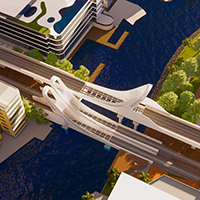
While both the new structure and its predecessor are swing bridges, building and installing the replacement was not simply a case of swapping like with like. This was because growing footfall meant that the client – the V&A Waterfront – required a wider pedestrian bridge to more effectively accommodate the hundreds of thousands of people crossing it every month. The 1.24km2 mixed-use waterfront in the Table Bay Harbour area serves as a popular destination, drawing around 24 million visitors a year, with significant development work also being undertaken at other locations around the site. This not only affected the bridge’s design but also presented an operational challenge to the stakeholders involved in the project, including contractor Stefanutti Stocks.
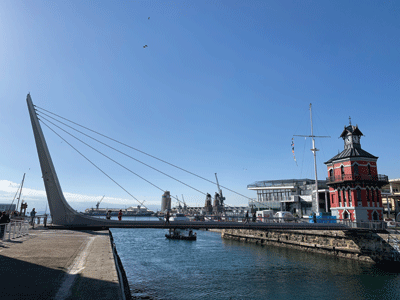
The new bridge is located at the most visited destination in South Africa
As structural engineers and design team lead for the project, SMEC South Africa teamed up with COA Architects and Eadon Consulting to work through various typological options for the new link. Among those considered were a bascule and lift bridge; however, it was deemed that a swing bridge would still be the best solution in terms of the time and electrical energy needed to operate it. The two main goals during the bridge’s design were to create a new 42m-long structure that was able to match its predecessor in terms of being able open and close in 90 seconds and 100 seconds, respectively, but with the capacity to allow more pedestrians to cross at any one time. Other specifications included the bridge being able to operate in wind speeds of up to 60km/h and withstand impact by a vessel from either direction, in which case it should swing free in a way that would protect the mechanical equipment. Also specified was that the full 31m width of the cut be unobstructed for the passage of vessels, for whom vertical clearance should be infinite.
To accommodate a larger number of pedestrians, the new deck is significantly wider, measuring 4.5m, compared to the original’s 2m. The lower part of the deck is a steel girder framework bolted to a 0.5m-wide central steel spine beam. The latter protrudes almost 0.5m above most of the length of the upper part of the deck, which is made of timber. The spine beam and 14.5m-tall mast angled at -20° from the vertical are both fabricated steelwork and are bolted together at the pivot point.
Due to the new deck being more than double the width of the old one, SMEC South Africa decided not to use the same structural support techniques as the old bridge. While the previous design used backstays attached to bearings on a rotating mast, the larger size and heavier loads of its replacement would have made the construction of backstays and anchor blocks much more difficult, particularly given the limited space available on the quayside and the many buildings in close proximity to the bridge. As a result, the new design employs a slew bearing which rotates a cable-stayed deck attached to a mast. Four, 28mm full-locked coil steel cable-stays supplied by Redaelli fan out from the top of the mast to the spine beam. The longest of these measures 35m, while the shortest is 19m. According to Redaelli, since the environment is particularly aggressive, it used a zinc aluminium alloy called Galfan to protect the cables, which have a minimum breaking load of 775kN.
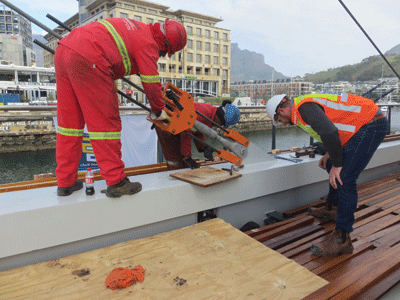
Four steel stay cables connect the mast to the spine beam
“We wanted to avoid using backstays to limit the amount of land-based works as much as possible,” John Anderson, general functions manager for the structures team at SMEC South Africa, says. “Most of the new bridge components could be made in a fabrication yard, welded together on Jetty 2 a couple of hundred metres from the bridge’s final position and moved to the installation point,” he adds.
With this solution settled upon, SMEC South Africa also needed to consider the donut pile ring that would house the slew bearing as well as electrical systems needed to swing the bridge. Following geotechnical investigations at the site, there was concern that the piling works might unsettle the 19th century quay wall, a packed stone wall perched on the edge of a rock shelf. Other considerations were the vibrations felt in adjacent buildings, cormorants nesting nearby, and the health and safety of pedestrians using the old swing bridge. Therefore, to reduce the magnitude and duration of the vibrations, a 100mm diameter pilot hole was rotary cored using a Boart Longyear DB520 drilling rig to act as a guide hole for a larger diameter pile bit. Following this, the hole was grouted to improve its integrity before boring with an Odex drill system for the eight 8m-long, 600mm-diameter steel-cased piles. A steel slew bearing adaptor ring was stressed down onto the concrete pile cap and connected to the slew bearing using 66 bolts.
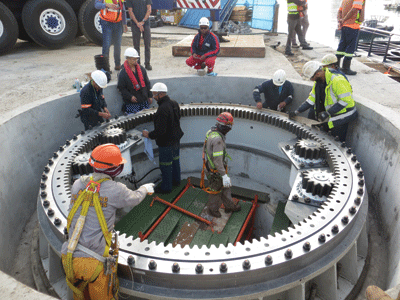
The slew bearing adaptor and slew bearing were joined by 66 bolts
The existing bridge remained operational during these works, with the centre of its pivot 6.3m west of the corresponding point on the new bridge. However, to allow space for the construction of the new structure’s abutments, the docking point for the original bridge needed to be moved further up the quay. A temporary nosing and abutment were built at the docking point to allow for this, which meant that the angle of rotation was reduced from 90° to 80°.
“We had to reanalyse the existing bridge for being slightly out of alignment as the backstays were no longer in line with the front stays. We also limited the loading on the bridge from 5kPa to 3kPa during that period for this reason,” says Anderson.
On 21 May, the lifting team of Teemane Cranes set about removing the original footbridge. “For the removal of the old bridge, we had to improvise as we could not be provided with the full drawing or installation guide,” says Riaan Geldenhuys, director at Teemane Cranes. “We had three days to remove the old structure and went over by half a day, which was due to the bridge being so close to the sea water, and the salt did not have a good effect on the steelwork.” The team dismantled the structure into several sections: two backstays, the mast, two tension rods, the deck, and two abutments.
While the old bridge was being removed, Teemane Cranes also assisted in installing the slew bearing onto the donut pile cap. The following day, on 24 May, the loading phase of the new bridge from Jetty 2 onto a barge was undertaken. As the team were not able to use lifting lugs on the structure, the decision was taken to sling around the deck and ring beam, where there were four main I-beams capable of carrying the imposed load. The original rigging study and lifting plan were formulated for a bridge weighing 54t. However, Stefanutti Stocks decided to hold off on the installation of the wooden deck until the bridge was installed, meaning the bridge was 10t lighter when lifting. Thoughts then turned to ensuring the bridge would be level on the sling, which was made more challenging by the fact that its centre of gravity was within 10m of the slew ring, creating 90mm of structural flexibility in the deck.
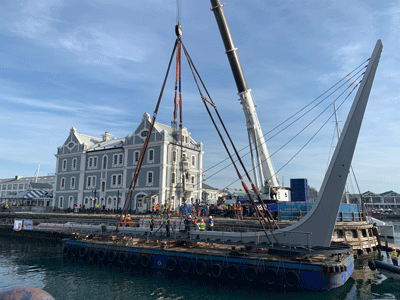
Construction took place only metres away from the existing bridge in operation
Another challenge was that the barge transferring the bridge to the installation position could not position itself in a way that would allow the team to lift straight up, slew the crane 180° and place it on the barge. To accommodate this, the bridge was turned in mid-air while the crane was slewing.
For the installation phase, several factors were taken into consideration in formulating a strategy, in particular the logistical challenges at the point of installation, where the team had an area of roughly 12m by 17m in which to operate the crane and only one access road. A LTM1400-7.1 Liebherr crane was used with an outrigger footprint of 12m by 12m. “We had to consider turning circles; tyre pressures; the bearing pressures of the crane outriggers against the allowable pressure provided; and spectators, meaning that ample staff were needed to assist and guide the cranes and auxiliary vehicles moving equipment and counterweights in and out,” Geldenhuys remarks. The maximum allowable pressure on the quayside was 200kPa.
As of 10:30 am on 25 May the bridge was hanging level in mid-air and lowered into its final position at 4:30 pm that day.
Given the heavy footfall on the waterfront, the entire project was scheduled to ensure that works were undertaken during the quieter months of the South African autumn and winter. A ferry service shuttled passengers across the cut between 21 May, when the old bridge was removed, and 21 June, when its replacement opened to the public. The new bridge was officially unveiled at an opening ceremony on 11 July.