The possibility of a new bridge over the Cataraqui River in the Canadian city of Kingston, halfway between Toronto and Montreal, had been the subject of discussions for over 50 years. When the US$144.3 million of funding was finally secured in February 2018, with equal parts coming from municipal, provincial and federal governments, Kingston hit the ground running and selected Peter Kiewit Sons, Hatch and Systra International Bridge Technologies as the preferred proponents for the design and construction of the crossing.
The new 1.2km-long bridge consists of a two-lane vehicular roadway, a multi-use path on the south side of the bridge – separated from the roadway with a traffic barrier – and two observation points. The bridge provides a much needed third connection between communities on the east and west sides of the river. At this location, the Cataraqui River forms part of the Rideau Canal, a Unesco World Heritage Site, National Historic Site of Canada, Canadian Heritage River, and a federally regulated navigable waterway.
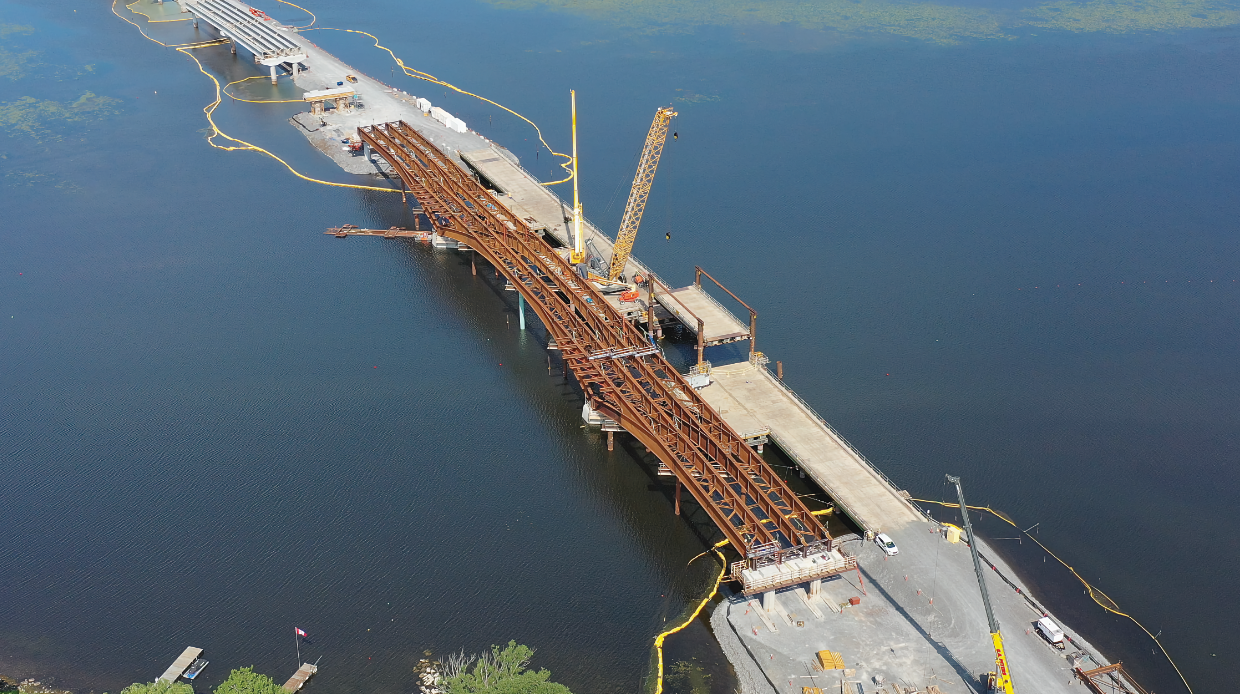 Construction of the Kingston Third Crossing is taking place over the Unesco-protected Rideau Canal (Aerosnapper, Kingston)
To deliver the project on time and within budget, the City of Kingston chose to use an Integrated Project Delivery (IPD) model, a first for a bridge project in North America. Typically under an IPD model, the budget is set and the city, contractor and designers work together to deliver the project within the budget. All parties agree to share the risks and to share any savings that can be achieved. This novel approach creates a more cohesive partnership between all members of the IPD team, with shared risk and reward for all aspects of the project. It encourages each member of the team to use their expertise to create value by continually identifying and evaluating cost-saving ideas throughout the validation, detailed design and construction phases.
The IPD Team for the Kingston Third Crossing has been working in close collaboration with its trade partners Bauer Foundations Canada Inc for the foundations and Walters Group Inc for the steel structure, and is supplemented by specialised industry experts Brownlie Ernst and Marks (BEAM) as bridge architects, Tourney Consulting Group (bridge durability), Tulloch (geotechnical and pavement), Moon-Matz (electrical), Vertechs Designs (landscaping), and Bergmann Associates (steel erection).
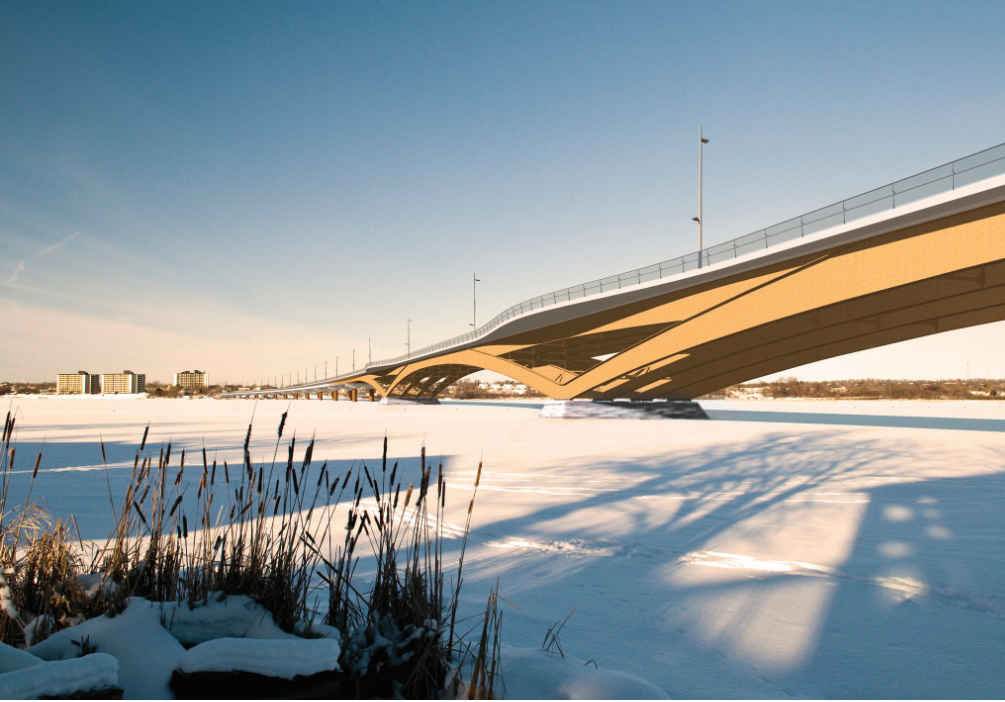 A structure lower and lighter than the original EA bridge design was proposed and adopted (rendering by BEAM Architects)
A preliminary concept design was developed in 2013 and approved by the Ontario Ministry of the Environment and Climate Change in an environmental assessment (EA). This was used as the reference design for the IPD process. The reference design proposed the use of 18 approach spans made up of variable depth steel I-girders, and a 117m-long main span consisting of a tied arch sitting on V-shaped reinforced concrete piers.
When the IPD team conducted a design validation of the reference design, several improvements were identified. The construction access was changed from full length trestle to a temporary rock causeway combined with a trestle bridge and lift span – the latter a requirement to keep the Rideau Canal navigable between spring and autumn. This approach presented challenges to obtaining the required permits and approvals from the federal and provincial environmental and heritage regulating agencies, which required consultation with indigenous and surrounding residential communities.
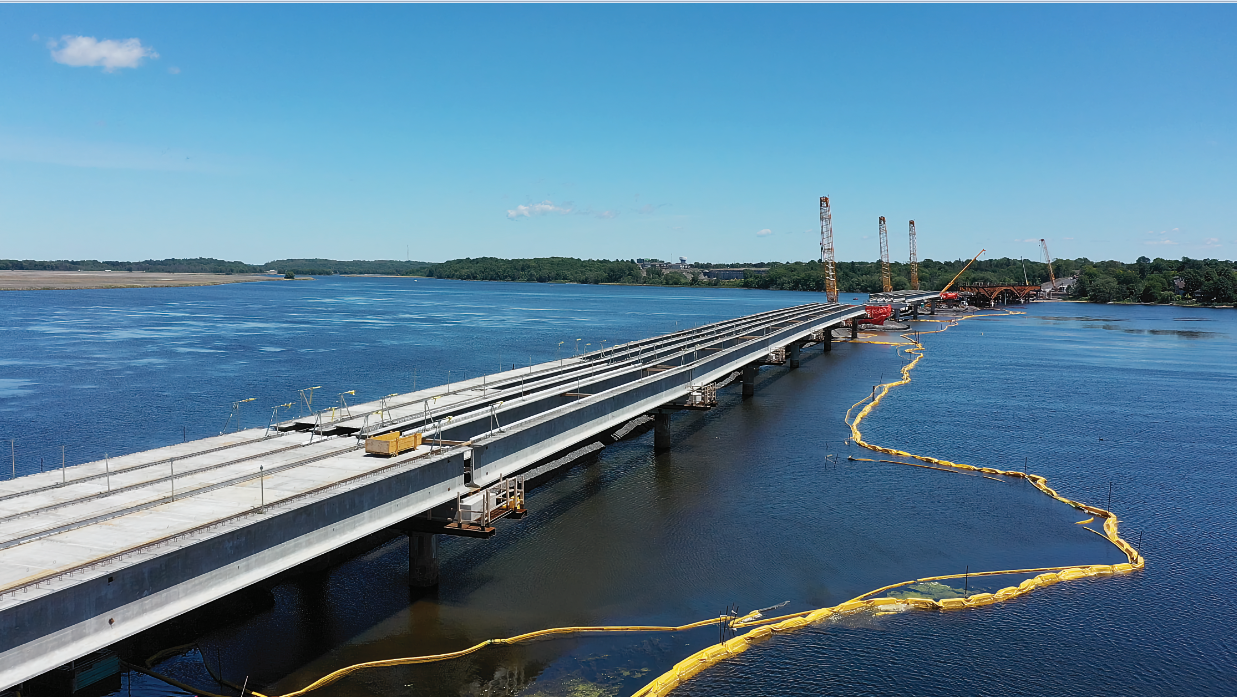 The superstructure of the approaches consists of precast, prestressed I-girders topped with cast-in-place concrete (Aerosnapper, Kingston)
Bridge design review considerations for the preferred design focused on reducing the permanent bridge in-water footprint – as well as the visual impact – by proposing a bridge that was lower and lighter than the EA’s bridge design. The proposal still ensured that the preferred design would comply with bridge design standards, codes and requirements; satisfy the federal regulating agencies design guidelines; and optimise capital expenditures by reducing material costs and construction effort.
The proposal suggested changing the approach bridge superstructure from steel to concrete, due to rapidly increasing steel prices caused by the combination of 2018/19 steel tariffs and supply constraints. The main changes in geometry included lowering the bridge profile, which reduced the maximum height of the piers by approximately 6m, and changing the main bridge section from an ‘above-deck arch’ to a ‘below-deck arch’.
During the detailed design phase, through collaboration with the contractor and owner, Hatch and Systra-IBT conducted bridge optimisation through structural analyses, significantly reducing quantities with estimated cost savings of U$9.6 million. In accordance with the approved environmental assessment, the bridge was designed for a minimum 100-year design life, exceeding the 75-year design life requirement of the Canadian Highway Bridge Design Code. The longer service life will provide long-term environmental and economic benefits.
As a durable solution, the steel girders of the navigation span are made of atmospheric corrosion resistant steel, which provides a low-maintenance solution that fits in very well with the surrounding landscape. This also creates a strong visual contrast between the main span structure and the approaches, helping highlight the signature section of the bridge.
The final structural configuration consists of a permanent crossing with 17 west approach spans, 48m in length, and two east approach spans 43m long. Five Nebraska University I-type precast prestressed concrete girders form each span, topped with a cast-in-place concrete slab. The prestressed concrete girders used are the tallest and longest ever built in Ontario.
 Erection of the bridge’s steel arch sections was completed in June (Paul Wash Commercial Photography)
The signature portion of the crossing is made of three spans of 71m, 95m and 62m in length. Beneath the bridge deck, four variable depth steel I-girders form an arch shape that presents as delta frames over the central piers. Each delta frame is made up of inclined arch legs connected at the top with a tie member. The arch spans sit on pier caps located close to the high water level of the river, giving the impression that the bridge is skipping across the surface.
The 21 piers are typically supported by two 1.6m outer-diameter, steel-cased reinforced-concrete shafts drilled into the bedrock at the base of the river. The shafts support a reinforcement concrete pier cap. On the approach spans, the reinforced concrete pier cap sits well above the level of the water, while – at the main span – central skewed pier caps sit just above the level of the water. This arrangement provides the required clearance for the river activities, but also maintains a lower overall profile that fits well with the surrounding landscape.
The west abutment consists of reinforced concrete with wingwalls and a mechanically stabilised earth (MSE) wall on the south side, founded on ten 0.9m-diameter caissons that are bedrock-socketed. The east abutment is reinforced concrete with wingwalls and MSE walls to the rear, founded directly on the bedrock. A vertical profile with a 0.67% grade runs from a high point located approximately at the center of the navigation channel span down to the abutments, allowing stormwater on the bridge deck to drain to on-land stormwater management facilities.
The construction works for the new bridge began at the end of 2019 with the preparation of the shorelines, a phase that incorporated a number of environmental precautions to protect the natural environment and native animals. This included the installation of turtle fencing, tree zoning protection, wildlife crossings, bat habitat, a turbidity curtain and more.
A temporary causeway made up of engineered soil has been installed, running from the west and east shores of the river to the limits of the main spans. A temporary steel trestle with a movable section that can be raised over the navigational channel has also been installed, adjacent to the main spans, to allow passage for construction equipment, while maintaining navigation when needed.
With direct access from both shores, the construction teams are proceeding with installation of the permanent structure on both fronts, working inwards towards the main span. The causeway has eliminated the need for barges and dredging, allowing construction to continue at a rapid pace by drilling the pier shafts from the causeway.
After coring and installation of the drilled shafts and pier caps, the approach concrete girders were erected one at a time using two cranes. For the main span, skewed pile caps located close to the top surface of the water were cast within precast concrete shell elements that acted as the form for the final pier cap. This ensured the placement of reinforcement and concrete for the pier cap could be achieved without having to work in the water. It also increased the speed of construction and reduced the complexity associated with placing the pier caps so close to the river.
The main span steel structure was recently installed using both the final piers and temporary bents as supports. The bent supports provided a means to position the elements for alignment ahead of fit-up of bolted splices. These supports were gradually removed as erected elements were connected and the cross-frame and lateral bracing were installed. The east and west sides of the main span were erected independently, which allowed for parallel work flows that reduced the overall construction time. Once all the segments had been erected and spliced, the east portion was jacked towards the west segment to close the gap at the center of the central span and enable alignment for the closure splice.
The entire bridge uses partial-depth prestressed precast panels with a cast-in-place (CIP) deck topping. The use of partial depth precast panels simplifies the placement of the deck by eliminating the majority of temporary works typically required for deck placement. These panels span between two lines of supports on the girder flanges and feature transversal prestressed strands. After installing the precast panels on the deck, the reinforcement is placed on top of the panels in both longitudinal and transverse directions. The use of a CIP topping ensures that the correct plan and elevation profile of the bridge is achieved, and also limits the need for variations in thickness of the wearing surface. This improves the long-term durability of the bridge by making wearing surface replacement easier and by preventing local depressions in the deck where water can accumulate under the wearing surface.
Construction is approximately 60% complete, with bridge substructure works finished in July this year and erection of the main bridge section’s steel arch a month earlier. Approach span superstructure work is under way, with more than half of the NU girders installed. On-shore utility relocation, road reconstruction and embankments construction are now taking place, and construction completion is anticipated in the fall of 2022.
Consistent with the IPD approach, BIM was implemented during design development to enable a better visual understanding of the project’s concepts and scope, lower risk and cost, accelerate schedule, and minimise errors. It improved design efficiency and productivity in the context of the spatial challenges presented by proximity to archeological sites on the shorelines, as well as in terms of the structure’s complex alignment and geometry. The models were also used to assess and resolve conflicts and improve the functionality and aesthetics of the bridge, leading to deliverables with improved overall integrated design. BIM was used during the consultation and permit-approval process to showcase – in 3D and from any point of view – the low profile and aesthetic features of the future bridge.
The fit-up of all the different steel elements was ensured through extensive 3D modelling and detailing carried out by the fabricator detailer. This included the use of CNC machines that positioned holes and gussets at the exact locations required to provide the steel dead-load fit. Although the main girder segments were trial assembled in the shop, cross-frames and lateral bracing were exempt. Nevertheless, no fit-up issues were encountered during erection due to the precise detailing work.
With its site location over the Unesco-protected Rideau Canal, architectural qualities and extended design life, the Kingston Third Crossing will be a landmark achievement for the City of Kingston and for Canada n
Edouard Renneville is senior bridge engineer and Rami Mansour bridge engineer, both at Systra IBT. Majella Anson-Cartwright is assistant design manager, Hatch