30 years of safety, quality and people at New York State Department of Transportation
By Brenda Crudele, 47, director, structures design bureau & structures specialty engineering bureau, NYSDOT
Three decades ago, I was at the very beginning of my engineering career. I felt extremely fortunate because I was approaching the end of high school and starting my college search at a time when computers and the internet were becoming mainstream for everyone. Professors expected us to be able to perform calculations by hand to learn the theory, but they also wanted us to learn how to carry out complex analysis and simulations with the computer. It really was the best of both worlds because today one can’t get by without using software, while understanding theory continues to be an absolute must. In 2000, I obtained my bachelor’s degree in civil engineering from Clarkson University, and in 2002, I obtained my master’s in structural engineering from Lehigh University.
By the spring of 2002, I considered myself educated and highly employable. At that time, I was interviewed by the New York State Department of Transportation’s Office of Structures. I was impressed with their design work and excited to receive a job offer to work as a junior engineer. I was assigned a bridge to design within my first week, and my career was on its way.
It was an exciting time in engineering, as the federal government had mandated a change in the required design specification for bridges. The last edition of the AASHTO Standard Specification for Highway Bridges had just been published, and AASHTO was transitioning to the modern Load and Resistance Factor Design (LRFD) code that was based on probability and reliability theory. It incorporated modern live loads and traffic patterns and provided uniform reliability across structural components and failure modes.
Engineers can sometimes struggle to understand why change is necessary, but because I had never designed in the old code, this transition was not problematic for the younger me. My first bridge was designed with the new LRFD code, which turned out to be a good lesson to remember later in my career when addressing change: leaning on more inexperienced staff can be beneficial when pushing innovation in the workplace.
One of the most impactful material changes at NYSDOT has been the adoption of Ultra High-Performance Concrete (UHPC) in accelerated bridge construction and rehabilitation projects. UHPC is a cementitious material with superior compressive strength, durability and tensile ductility compared to traditional concrete. These characteristics are achieved by replacing coarse aggregates with fibres and other fine materials to form a dense, homogeneous structure.
In 2009, NYSDOT completed two demonstration projects that pioneered the use of UHPC for closure pours between precast decks and other precast elements, allowing decks to be replaced in a short timeframe. The first involved the superstructure replacement of Route 31 over Canandaigua, a precast deck bulb-tee system with UHPC joints, which marked the first field application of UHPC joints in bridge construction not only in New York, but also in the US. The second trial project was the construction of a 127ft (38.7m) single-span steel girder bridge near Oneonta using a precast concrete deck with UHPC joints.
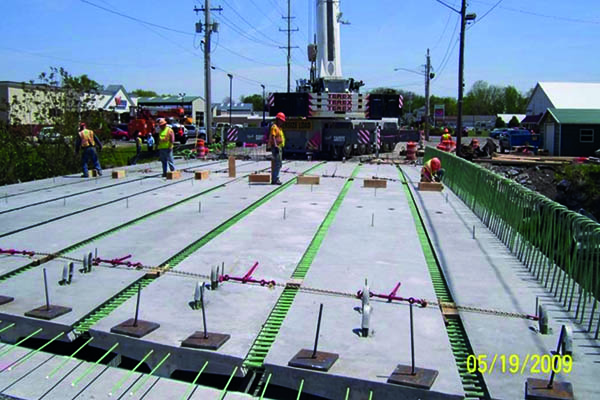 The first application of UHPC joints in US bridge construction took place in 2009 on Route 31 over Canandaigua Creek
Prefabricated components were used in both projects, resulting in a considerable reduction of construction time compared to a conventional cast-in-place method. The two projects met or exceeded the Department’s goals in the speed of construction as well as the performance of the final product. At their conclusion, areas for further improvements were identified which led to an accelerated bridge construction time in the order of days, rather than the traditional weeks or months. Further development paved the way for the deployment of UHPC link slabs, aimed at eliminating bridge joints and enhancing the durability of existing structures. Protecting bridges from New York’s harsh winter climate and the corrosive effects of road salts is essential for extending service life. By eliminating joints – either through design or rehabilitation – bridges can achieve longer lifespans and reduced lifecycle costs.
After installing the first UHPC link slab in the country in 2013, NYSDOT further developed the technology and has since been a leader in its implementation and refinement, using it on over a hundred bridges and contributing to its wider adoption in the US. The use of UHPC at NYSDOT has since become standard practice for closure pours connecting precast elements, link slabs, girder-end repairs, steel-splice repairs and overlays. NYSDOT continues to pursue innovative uses of UHPC as needs arise.
Another major milestone in project delivery for NYSDOT came in 2011, when New York State legislation enabled the use of design-build procurement. The first project delivered with this method was an emergency bridge replacement caused by damage from Hurricane Irene. This was followed by several others, including the Kosciuszko Bridge Replacement, a mega-project launched in 2014. Design-build was used to fast-track a new cable-stayed bridge that would replace an original 1939 structure which had become a severe traffic bottleneck and was structurally outdated for the volume it carried. Since the introduction of design-build, NYSDOT has advanced over 60 projects using this procurement method – most have been high-value undertakings with significant impact on the travelling public.
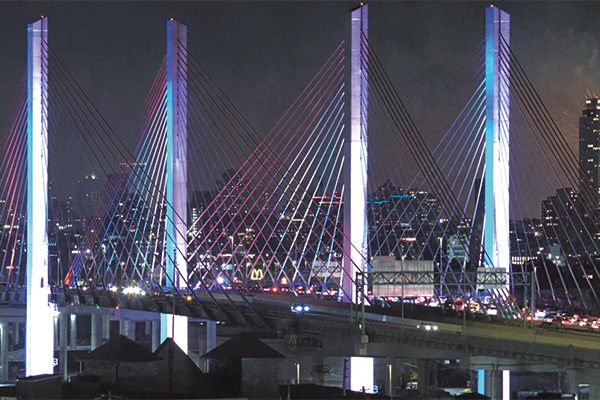 The Kosciuszko Bridge replacement was one of the first design-build projects carried out by New York State DOT following 2011 state legislation
One cannot write an article about change in the last 30 years without discussing digital delivery (DD) and building information modelling (BIM). In the late 90s, NYSDOT used computer-aided design and drafting (CADD) software products and had successfully made the transition to computer drafting. Then, during the 2000s, forward thinking drafting and engineering professionals promoted the ability and usefulness of 3D modelling for the creation of contract plans. In 2010, NYSDOT added the bridge model management (BMM) concept to the NYSDOT Bridge Manual.
BMM is a standardised method for creating and using CADD models in 2D and 3D throughout the lifecycle of a bridge design project. It serves as a system for organising electronic data to ensure consistency and reliability in design, detailing and construction. This approach allows for the creation of 2D contract plans using a single source of truth, either 2D or 3D graphic model, for each bridge component.
BMM was the early beginning of digital delivery and models that serve as the legal documents at NYSDOT. The goal is to create a modern, data-centric approach to infrastructure projects that uses digital information models and a connected data environment to streamline the flow of information from design through to construction and then to asset management. Instead of relying on traditional PDF plans or siloed data systems, this method creates a single, accessible source of bridge data that evolves throughout the bridge’s lifecycle.
Although still in its early stages, NYSDOT has taken a leading role in advancing digital delivery. The initiative began in 2018 with the establishment of the Digital Delivery Committee, composed of staff from across the agency – including design, structures, construction, contracts and legal departments. The Committee began by benchmarking practices from other states, identifying key challenges specific to NYSDOT, and setting clear goals for implementation. With executive approval, the team proceeded to launch the first pilot projects, marking a significant step toward modernising project delivery.
Digital delivery requires a fundamental shift in workflow processes, which can pose significant challenges for DOTs. The difficulty is twofold: on one hand, individual staff members may resist change if they don’t perceive a direct benefit to their specific responsibilities; on the other, the agency as a whole must invest substantial time and effort into developing a new workflow that delivers value across all stakeholder groups.
Change is not positive if it is done simply for change’s sake, but well thought out transformation can prove immensely beneficial. The goals for implementing the first digital delivery project were clearly defined. These included using electronic files as the legal document, increasing efficiency in data exchanges throughout the lifecycle of projects and bridge assets, reducing or eliminating the need for data re-entry, enhancing data integrity, lowering both initial and long-term costs, improving the accuracy of contract plans, and guiding the future direction of bridge technology and software development.
It quickly became clear that developing the required standards and workflows for digital delivery at NYSDOT would take time and could only be improved through experience. It also became clear that the only way to get that experience was to dive in and employ the process on a real-life project.
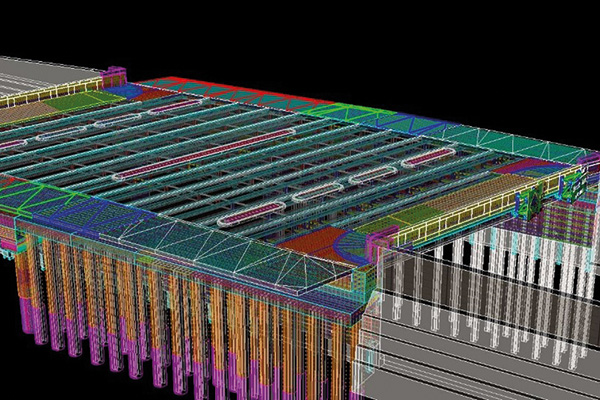
NYSDOT did just that, embarking on two pilot projects using digital delivery and model as the legal document. The final design for the first project, which involved replacing a Route 28 bridge over Esopus Creek in the Catskill Mountains, began in late 2018. Construction started in early 2020 and was completed in 2021. NYSDOT used 100% in-house design staff for this project. The final design for the second project, the replacement of the East 138th Street Bridge (Bd&e issue 106) over the Major Deegan Expressway in New York City, was initiated in March 2020 and construction commenced in the summer of 2021. Choosing these unique and challenging projects for digital delivery not only exposed the true benefits of 3D modelling but also provided NYSDOT with valuable lessons for future projects.
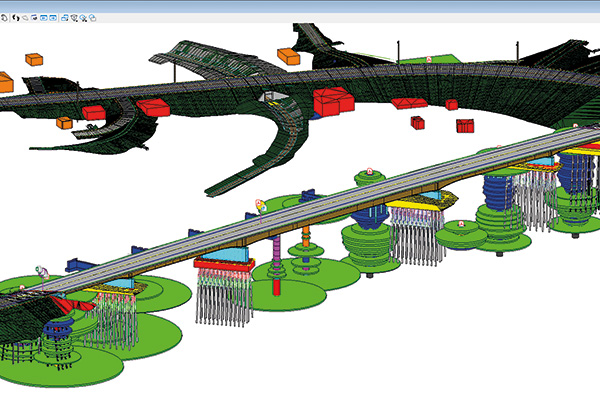
Two pilot projects were carried out by NYSDOT using digital delivery and model as the legal document: the Route 28 Bridge replacement over Esopus Creek (above) and the East 138th Street Bridge over the Major Deegan Expressway in New York City (below)
I have had the great pleasure of being involved in hundreds of bridge projects over my 23-year career at NYSDOT. I have designed bridges, managed large bridge rehabilitation and replacements programmes (including accelerated bridge replacements), and have worked alongside the United States’ best bridge professionals at NYSDOT. Considering the enormous amount of change that has occurred in that time, I would like to conclude with three things that have not changed from a bridge owner’s perspective: NYSDOT has always been – and continues to remain – focused on safety, quality and its people.
The safety of our staff and the travelling public is paramount to our mission. The challenges NYSDOT staff encounter drives them to develop innovative solutions, in turn increasing the quality of our infrastructure. In the next 30 years, we will continue to pursue innovation and success by focusing on safety, quality and our people.
A glimpse into the future of bridge maintenance
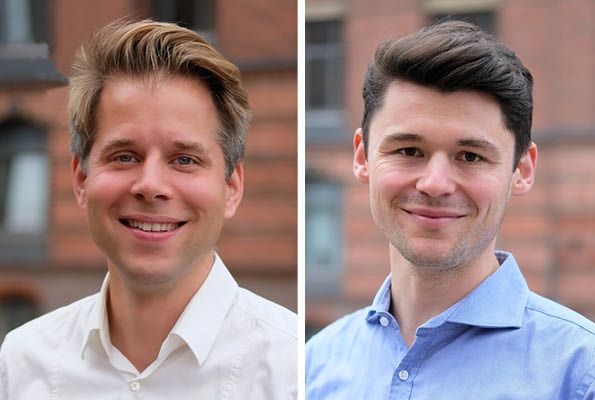
By Felix Scholz (left), 44, head of engineering services and consulting, Hamburg Port Authority, and program lead, BIM.Hamburg and Niklas Schwarz (right), 35 project lead, Digital Twin Main Port Route, Hamburg Port Authority
A reliable and efficient infrastructure is a cornerstone of a well-functioning economy. Infrastructure operators face considerable challenges, particularly due to ageing assets and steadily increasing traffic volumes. At the same time, the construction sector accounts for approximately 40% of global CO2 emissions. In light of accelerating climate change, there is growing pressure to maintain infrastructure in a sustainable and environmentally responsible manner. To lower CO2 emissions, prolonging the lifespan of infrastructure is a reasonable and effective approach. However, the safety and availability of the infrastructure must continue to be ensured – and this with the most sustainable and cost-effective maintenance possible. In our opinion, this is the key question in the maintenance of bridges and other engineering structures today: How can we prolong the lifespan of infrastructure without compromising its safety and availability? And which technologies, methods and innovations can help us achieve this goal?
Furthermore, infrastructure maintenance is confronted with further challenges: Young people are significantly less likely to choose a career in infrastructure maintenance. Positions may even remain vacant for several months. On the other hand, the existing workforce is ageing and often fears that digital methods may threaten their professional existence. To address this, a cultural transformation driven by empathetic communication is essential – paving the way for the purposeful adoption of innovative methodologies and technologies to enhance infrastructure maintenance. The aim is to support and relieve existing staff in their work, allowing them to focus on their core tasks.
In cooperation with the Federal Ministry of Transport, BIM.Hamburg, and the Hamburg Port Authority, we have launched the Digital Twin Main Port Route project. In this project, we are developing digital twins for three bridges and one road section along the main port corridor and integrating them into an overarching system-level twin.
The core goal of the digital twin is to consolidate all the information needed to obtain an objective overview of the structure’s condition and thereby develop an appropriate maintenance strategy. Key information includes structural and material data as well as condition assessments. The most important data in the Digital Twin Main Port Route is related to inspection, monitoring and diagnostics results, along with calculations such as the load-bearing index. To achieve this, we are developing digital twin software with our partner MKP. The software will enable the integration of bridges and road sections with minimal effort using IFC import functionality.
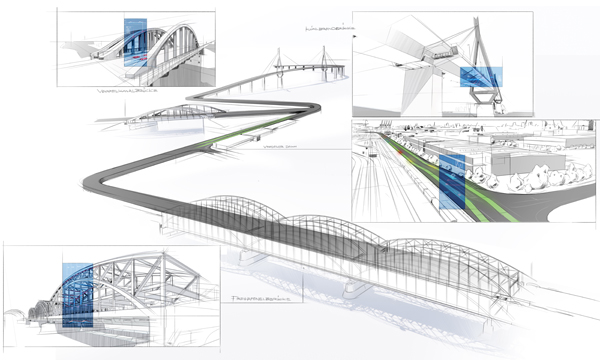 The Digital Twin Main Port Route project integrates digital models of three bridges and one road section into a unified system twin for Hamburg’s Main Port Route (HPA).
A common misunderstanding is to regard a simple 3D model or even BIM model as a digital twin. This is not the case. A digital twin is based on a BIM model, but it is connected to the real world via monitoring, and regularly updated. It enables bidirectional information flow between the physical and digital twin.
In our understanding, BIM is the structural backbone of digital twins. It provides the building’s structure and allows all relevant information – such as documents, damage reports, monitoring and diagnostics – to be precisely located within the bridge model.
An important part of the Digital Twin Main Port Route is the digitalisation of bridge inspection, which is a human-based manual process. Specialised engineers inspect the surface of the bridge, photograph damage and make a record of it by marking it on a printed plan. After that they transfer the information in an outdated platform in the office. To improve this process, we are developing software with our partner m2ing that enables a digital, mobile, model-based inspection workflow. With this solution, inspectors only need to use their tablet or smartphone to record defects, take photos, and mark the location directly on-site – significantly reducing post-processing in the office.
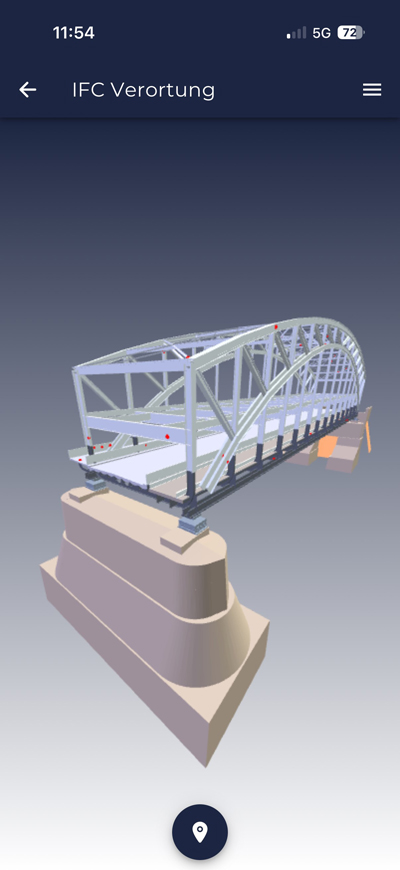
Model-based bridge inspection at the Free Port Elbe Bridge in Hamburg. Damage is recorded directly in the BIM model using a smartphone (HPA)
Beyond the Digital Twin Main Port Route project, the Hamburg Port Authority is exploring several innovative approaches to improve inspections. We believe sensors must become mobile, and we are actively researching and deploying drones and robots. In addition, we are developing AI systems to detect cracks and other damage on bridges, quay walls and other structures.
Based on experience in our projects, we are optimistic about the future of infrastructure maintenance. We believe it will become more efficient and sustainable through digital tools that support and relieve staff – tools so intuitive and helpful that even the most digitally hesitant will embrace them.
We will develop digital twins at varying levels of detail for our infrastructure assets. Inspections and maintenance will be BIM-based, eliminating the need to search for damage like detectives, as all relevant information will be embedded in the BIM model, potentially even integrated automatically.
AI will optimise our processes and communication, drastically reducing time spent searching for documents or specific data. Drones will assist inspections, not replacing humans but enhancing efficiency. Robots will take over tasks in areas that are too dangerous or inaccessible for people. Digital tools will never replace humans in maintenance, but they will enable us to work more efficiently and focus on what truly matters. They will help us manage more tasks with fewer personnel, without compromising quality.
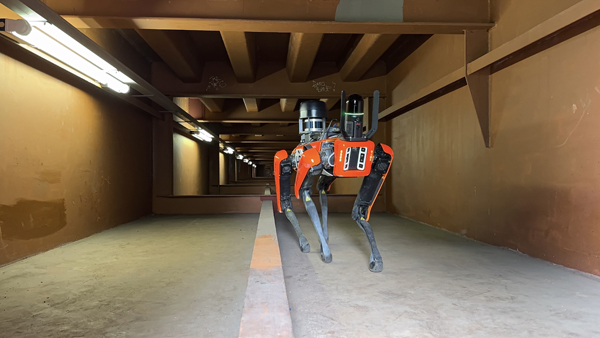 Spot the robot dog conducting an inspection of Argentina Bridge in the Port of Hamburg (HPA)
We are confident that innovative maintenance strategies will significantly reduce CO2 emissions in the construction sector by extending the lifespan of infrastructure. The greatest challenge will be integrating people into this digital transformation. It represents a cultural shift comparable to the industrial revolution. Processes and job roles are evolving – a tremendous opportunity, but one that must be communicated and managed with care. Only when the workforce is truly convinced can digital solutions reach their full potential.
Designing for 200 years: doubling the lifespan of the Øresund Bridge
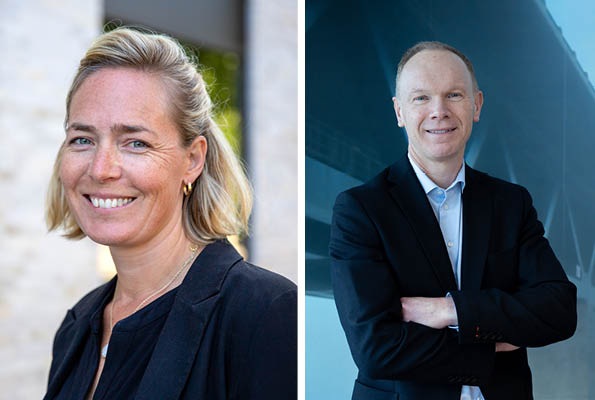 By Jeanette Birkholm (left), 42 , property director, Øresund Bridge and Bengt Hergart (right), 59, head of digitalisation and IT, Øresund Bridge
When the Øresund Bridge was designed in the 1990s, engineers expected it to last a century. Now, as it marks its 25th anniversary, research shows the bridge could remain in service for twice as long: 200 years. This is our 25th anniversary gift to the bridge builders of tomorrow. Our vision is to pass on an even better bridge to the next generation.
Steel and concrete remain indispensable to bridge construction, and both are among the most carbon-intensive materials we use. Infrastructure also occupies land and marine space that may hold ecological or visual value. That’s why infrastructure is often viewed as a climate burden. But it doesn’t have to be. The Øresund Bridge shows how thoughtful engineering can create assets that both serve society and enhance their environment.
When Denmark and Sweden signed their agreement in 1991 to build a fixed link across the Øresund Strait, the word ‘sustainability’ did not appear in the treaty. Yet environmental concerns dominated the early debate. Looking back, the project’s designers made decisions that proved remarkably forward-looking.
In the middle of the Øresund, a man-made island – Peberholm – was created. Instead of hindering water flow, it has become a haven for biodiversity. The island is classified as a Natura 2000 area, one of Europe’s strictest environmental protections. Today, the island’s vegetation absorbs twice as much CO2 as the bridge’s operations emit.
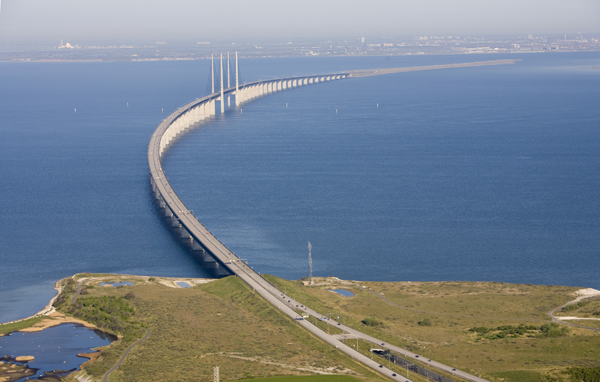 As the bridge reached its 25th anniversary, research confirmed that its service life could be extended to 200 years with appropriate maintenance (Drago Prvulovic)
Since the opening in 2000, we have systematically reduced the bridge’s environmental footprint. Through efficiency measures and the elimination of unnecessary systems, energy consumption has been cut by half. More recently, 10,000m2 of solar panels were installed on Peberholm between the motorway and the railway. On sunny days, the solar park produces more electricity than the bridge consumes. Next, we are exploring battery storage solutions, which would allow us to support the regional grid during peak demand.
And why stop there? Could we install small wind turbines along the bridge? It’s almost always windy, and the infrastructure is already there. Could the mussels growing on the pylons be converted into biogas? Could wave energy beneath the bridge be harnessed with generators? The technology exists – and the infrastructure is already in place. At the Øresund Bridge, we want to inspire and prove that it’s possible to think differently.
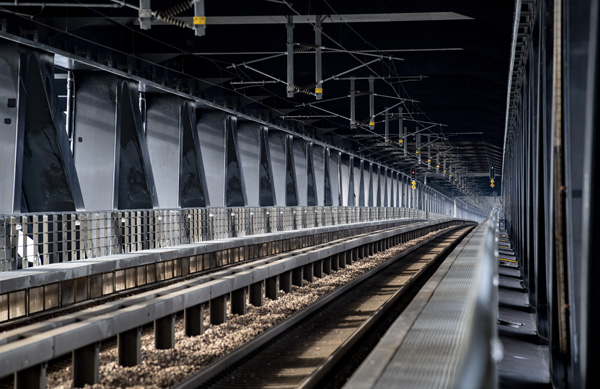 Since 2024, all bridge rail traffic has operated on renewable electricity (Johan Nilsson)
Some might object: What about the traffic? Since 2024, all rail traffic across the bridge has operated on 100% renewable electricity. Today, 1,600km by train emits roughly the same as 1km by a fossil-fuelled car. Road traffic is also changing fast. The share of electric vehicles among bridge users has risen by 175% – from 7% in early 2023 to 19.3% in September 2025. We track these figures continuously to understand how mobility patterns evolve.
The most sustainable thing we can do is to ensure that the Øresund Bridge remains in service far longer than originally planned. That means future generations won’t need to spend new resources building a replacement – at least not until more environmentally friendly methods exist. In 2021, the Øresund Bridge Consortium partnered with Lund University to study how the bridge’s lifespan could be doubled. Routine maintenance such as resurfacing and lighting replacement is straightforward, but the structural components, such as the main span’s steel truss, require more sophisticated strategies.
Just in time for the bridge’s 25th anniversary, research confirms that with the right measures, the Øresund Bridge’s lifespan can be doubled to 200 years. This is a concrete example of how infrastructure can contribute to the green transition.
The Extend project, led by Sebastian Thöns and Ivar Björnsson at Lund University’s Division of Structural Engineering, demonstrates that the bridge can be safely and efficiently operated until the year 2200. Researchers have identified the key elements that define the structure’s service life and proposed targeted actions to extend them. These include monitoring, inspection and fatigue management of critical details. The next step is to establish pilot projects for sensor-based monitoring and to optimise the bridge’s long-term maintenance strategies.
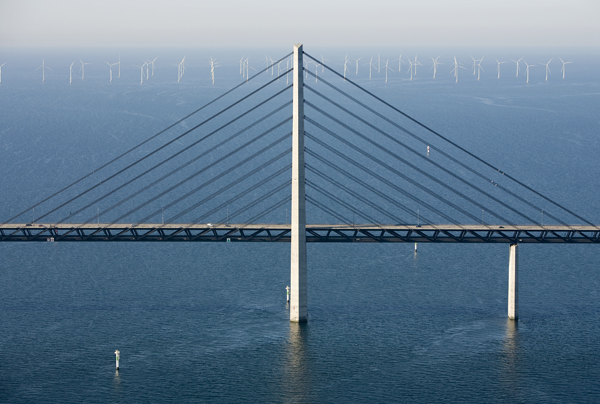 Researchers at Lund University have identified the key elements that define the service life of Øresund Bridge (Drago Prvulovic)
With smart solutions and new technology, we can take meaningful steps toward extending the life of what connects us across the Øresund region. It’s not only technically possible – it’s a way to take responsibility for the future.