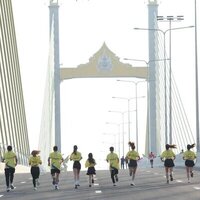

A second link to Incheon International Airport is intended to stimulate creation of a new city south of Seoul. Report and photographs by Iain Masterton
On the southern outskirts of the South Korean capital of Seoul, a brand new city is being planned. This hugely ambitious, US$12 billion development is aimed at creating a high technology international business destination that the Korean government hopes will become the major trading and commercial hub in north east Asia.
New Songdo City, located just outside Incheon City, will be built on 1300 hectares of reclaimed land and has been designated a free economic zone in an attempt to attract industry and multinational headquarters to the city. Currently, however, there is no fast, direct access from the proposed city to Incheon International Airport, which is located across a 12km wide sea strait on Yeongjong Island. Airport-bound traffic must instead head north along congested roads into Seoul and cross the Yeongjong Grand Bridge, which is the only fixed link to the island.
Hence a new direct highway link was needed that would provide a direct connection between New Songdo City and Yeongjong Island and construction of this mammoth undertaking started in July 2005.
The US$1.4 billion Incheon Bridge is a 12km-long tolled road crossing and includes the construction of what will be Korea's longest cable-stayed bridge. Because the bridge crosses a busy navigation channel leading to the ports of Incheon City, it will have an 800m-long main span that will rank it as the fifth longest in the world.
The bridge is being built as a BOT project by Koda Development, an Amec-led concessionaire that is providing the finance and project management for the bridge. This is a significant business development success for UK-based Amec, which claims to be the first foreign investor to lead a major privately financed project in Korea.
Koda Development will operate and maintain the bridge for a 30 year concession period before handing the bridge back to the owner, the Korean government. Design and construction of the crossing is being undertaken by the Samsung Corporation which is formed of a group of seven Korean contractors.
Detailed design of the bridges is being undertaken by Chodai and local company Seo-Yeong Engineering and the Halcrow-Arup-Dasan JV has been appointed as the contractor's checking engineer. In accordance with Korean law, a further independent check is being undertaken by local company Yooshin Engineering.
Although the cable-stayed bridge is the focal point and symbol of the whole project, 8.7km of the crossing comprises concrete box girder viaducts built at a low level in shallow water over tidal mud flats. In deeper water near to the main bridge, seven box girder approach spans, with an overall length of 1.8km, rise up on either side to meet the cable-stayed bridge which spans the deep water navigation channel.
The cable-stayed bridge deck will provide a 74m-high navigable clearance to sea level to allow the bridge to accommodate vessels of up to 100,000 tonnes heading to and from Incheon Port.
The bridge has an unusual five-span arrangement. On either side of the central 800m span there are two side spans of 260m and 80m. The reason for this lies in a late design change for the bridge that added 100m to the original 700m main span length.
To counteract the additional uplift loads on the side spans imposed by the extra 100m of central span, tie-down piers had to be designed. These were located 260m from the pylons and resulted in the rather short 80m end spans in the final design of the bridge now under construction. Uplift at the reaction piers will be counteracted by a combination of concrete dead weight cast inside the box girder and by tie-down cables.
The bridge has a 33.4m-wide, 3m-deep orthotropic steel box girder deck and is supported by twin planes of stay cables formed with preformed parallel wire strands.
The contractor intends to erect the deck using tried and tested balanced cantilever construction techniques. This will involve the use of derrick cranes to lift deck segments that will be delivered to site by barges.
The elegant concrete diamond-shaped piers taper inwards at the base to improve aesthetics and also minimise the size of foundation footprint.
Foundations for the pylons are supported on cast-in place bored piles that are founded on rock deep beneath marine deposits up to 25m thick. The piles carry the loads in a combination of end bearing and skin friction. Foundations at all the piers are constructed using a sophisticated system of steel guide templates to ensure the bored piles are installed to the highest degree of accuracy.
In deeper water, where access by floating cranes is possible, the steel template is lowered into position and secured by driven pin piles. The template locates and guides the permanent steel pile casings, which are driven to toe into the weathered rock layers.
A rock socket is then bored beneath the casing and a pre-assembled reinforcement cage is lowered into the shaft with the cage extending into the rock socket all the way down to the base of the shaft prior to the pile being concreted.
Both the outer steel pile casings and reinforcement cages are being prefabricated in the main precasting yard located on the mainland near Incheon City. Fabrication of the rebar cages is being carried out using ingenious machines that automatically thread spiral reinforcement onto the vertical steel. The only workers required during this process are welders who spot-weld the spiral reinforcement to the vertical steel as the cage is slowly rotated and moved along a jig.
When Bd&e visited the project the enormous reinforcement cages in the pylon pilecaps were being readied for concreting. "We will construct the pilecaps in three stages", says Amec engineering manager Jeremy Truebridge.
"The pilecap will be poured in two separate lifts of 4,400m3 and 3,500m3 respectively and we expect each pour to take at least 24 hours. The top tapered pilecap pedestal will be poured last and this will require another 1800m3 of concrete," he says.
All this concrete obviously has to come from somewhere and the problem of how to produce such huge quantities in the middle of the sea might at first appear to be a major obstacle to the whole project. However the solution to the problem was solved by sourcing the concrete from a fleet of floating batching plants that are moored beside the bridge pylons.
"We are operating a total of seven batching plants and they are each capable of producing 50m3 per hour," explains Truebridge. Because of the number of large container vessels using the shipping channel, a sophisticated pylon protection design had to be developed to prevent damage to the bridge from ship collisions.
Consultant Cowi was responsible for designing a system of dolphins that could absorb the impact from ships weighing up to 100,000 tonnes. The engineers came up with a scheme in which all bridge piers within 800m of the main shipping channel will be protected by large dolphins up to 30m in diameter. The dolphins are designed to be sacrificial structures that will deform and move to dissipate the energy of a collision.
They will be built inside steel cellular cofferdams backfilled with an energy-absorbing granular fill and topped by a reinforced concrete cap to tie the structures together.
The approach bridges that are being built in pairs on either side of the cable-stayed bridge comprise precast segmental box girders with variable depth. They are 15.7m wide and have a maximum span length of 145m. Each sup