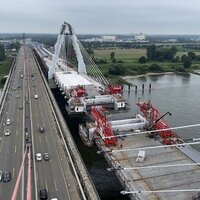
Construction of one of the most important crossings on the St Petersburg Ring Road, the Neva River cable-stayed bridge, is now well under way and due for completion in November this year. Approximately 40% of the cables had been erected when Bd&e went to press at the end of January, with 16 pairs erected on one tower, and six pairs on the second tower.
The twin pylon structure has a cable-stayed span with a main span of 382m and two back spans each of 174m long. The deck is supported by a total of 112 stay cables in 56 pairs - 28 pairs on each pylon. Both the deck and the pylons are made of steel. During construction, the deck segments are fabricated by bolting together several elements to create a 24.9m-wide, 2.4m-deep and 12m-long double box girder segment that weighs 120t. There are two pylons which are also built of segments of varying sizes and geometries, also bolted together to construct the pylon to a full height of 124m.
Pylons are A-shaped and taper from 6m wide at the top to 30m at deck level, reducing gradually again to width of 20m at the foot of the structure. The base is secured to a pad footing that measures 25m by 12.5m and is supported by 50 piles of 1.5m diameter extending to depths of up to 25m. The pylon dimensions and its form were preferred over other options because it allows for the possibility of using the same angle for all stay-cables, in contrast to a Y-shaped pylon - plus it also results in greater transversal stiffness when compared with H-shaped pylons.
Erection sequence of the deck at each of the two pylons is independent and two different methods are being used. At one pylon, the erection is being carried out using the typical balanced-cantilever method, while the other involved supporting the completed back span on temporary structures after which the erection of the main span segments was carried out. A pair of stay cables anchored above deck level along the edges of the segment was used as support for each main span segment. For every pair of main span stay cables there is a pair of back span stay cables to counteract the induced overturning moment.
VSL's single strand installation stay cable system is being used on the structure, and consists of 445,000m of galvanised strands individually greased and coated with a high-density polyethylene sheath. The strands used are in accordance to the EN10138 standard; they are seven wire 15.7mm diameter, Grade 1770 N/mm2. Each strand is placed inside a coloured high-density polyethylene pipe composed of a black inner coat with a co-extruded outside coloured layer. The stay cable sizes on this bridge vary from 13 to 91 strands.
The pylon construction was constrained to a very short and difficult period and coincided with the winter period. Because of the specific difficulties associated with casting concrete in very cold weather, particularly during the severe low temperatures of a Russian winter, it was not surprising that the decision was taken to use Russian grade steel 10XCHD as the basic material. This decision was taken despite the fact that it would lead to higher costs and result in the bridge having lower aerodynamic characteristics.
The construction schedule also had an influence on the design of the bridge girder. Detailed research of cable-stayed bridges with 450m spans shows that the most advantageous material for girders is reinforced concrete, for both aerodynamic and economic reasons. However, the chosen design was two 6m wide, 2.5m high steel box shape girders with an orthotropic plate connecting them. The cross-section of the girder is represented by eight elements: four boxes and four orthotropic plates.
The size of the orthotropic T-shape ribs is 300mm high connected by plates and 22mm diameter high quality bolts. In addition, the girder will be equipped with a windshield on the outside edge. Stelpant-Pu-Zink system, produced by German manufacturer Steelpaint, is used for corrosion protetcion. This primer corresponds to German code Sa 2 DIN 55928.
An extensive dynamic and aeroelastic wind analysis was carried out for the bridge taking into account the varying atmospheric and temperature changes possible at this location. Normal conditions and winter conditions had to be analysed. Wind speeds for the in-service bridge of up to 42m/s at deck level were found to cause buffeting effects within acceptable design limits. Flutter was found to be unlikely.
Design of the bridge was carried out by the Design Institute Giprostroymost in St. Petersburg, working for the Authority for Construction of the St. Petersburg Ring Road. The main construction contract for the structure was awarded by the client Authority for Construction of the St. Petersburg Ring Road to Mostootryad 19 in April 2001. Mostootriad 19 in turn sublet the subcontract for the supply of the stay cable system and technical assistance for the installation of stays to VSL Switzerland. Installation of the stays started in August last year and is due to be completed by summer 2004. The construction progress has now demonstrated the efficiency of the VSL stay system, more particularly in low temperature environment.
Igor Koljushev is chief engineer for JSC Institute Giprostroymost and Justin Campbell is project manager for VSL Switzerland.