
To the south of the Indian metropolis of Mumbai, construction work is proceeding apace on the Bandra-Worli Sealink project. With its 500m-long main span and striking architectural design, the main bridge ranks as one of the most spectacular construction projects on the Indian subcontinent.
The contracting joint venture of Hindustan Construction Company and China Harbour Construction Company is using Doka automatic climbing formwork SKE100 to construct the statically-demanding bridge towers. The system, which can be adapted to varying cross-sections and angles of inclination, has several different platform levels, permitting the reinforcement steel to be placed a casting section ahead of the pouring operations. Its wide working platforms, enclosed on all sides, and the fact that the climbing scaffold is anchored to the concrete at all times, together ensure maximum on-site safety - even in high wind speeds.
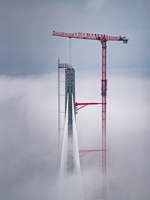
The bridge project is part of an approximately 40km-long urban motorway that is currently under construction, and consists of two similar cable-stayed bridges: a 150m-long bridge over the Worli Channel, and the main bridge, with its 500m-long main span, over the Bandra Channel. The design of this spectacular bridge project is the work of consultant Dar Al-Handasah. The main bridge has two, four-legged pylons which are inclined towards one another; their geometry and exacting surface quality requirements make them a formwork-technology challenge of the first order. The joint venture is creating these 129m-tall towers using Top 50 large-area formwork raised by 48 Doka SKE100 self-climbing units. The four smaller towers of the adjacent cable-stayed bridges, which have a similar shape, are being built using 24 SKE 100 units.
The two towers of the main bridge are inclined towards one another at an angle of nearly 10o, merging at a height of 98m into a single tower top. In addition, the individual solid cross-sections taper towards the top of the tower. Very stringent stipulations have been made regarding the surface finish of the tower shafts, which is characterised by slender trapezoidal grooves. In order to obtain flawless architectural surfaces, a largely non-tied formwork solution is required for the shafts, hence the fresh-concrete pressure is transferred by means of a hoop tensile system. Tying is only permitted in the horizontal - that is, circumferential - section joints.
The formwork for the towers, the cross-section of which is semi-circular, consists of two parts: the straight part is formed using Top 50 large-area formwork, while for the radial part, a special surface appearance with vertical ribs is required. To accomplish this, the joint venture is using a segmented, profiled custom steel formwork from Doka. The segmentation and low overall height of the formwork makes for safe, fast removal. The first step in the removal operation is for each of the curved formwork segments to be retracted from the concrete by turning a spindle. This prevents the delicate concrete ribs from breaking off when the formwork is stripped. Once this is completed, the entire gang-form can then be retracted by hand. In this way, cost-effective construction progress can be ensured in every phase of the forming operations, despite the complex structure geometry and the stringent surface design specifications.
At 98m height, the four inclined tower legs meet, and form a single, strikingly-dimensioned, tower top. This final section is characterised by a cloverleaf-shaped cross-section. Before they can be used to cast this distinctive component, the automatic climbers have to be adapted to the new cross-section. All the components of the self-climbing units used for the tower legs can be re-used here, minimising quantities required. A new set of formwork can be configured swiftly and safely for the new cross-section. Fielding the flexible, high-performing automatic climbing formwork SKE100 has helped the ambitious timetable to be faithfully fulfilled.
The Doka automatic climbing formwork SKE allows several automatic climbers to be combined, enabling construction operations to proceed swiftly and efficiently - even when dealing with tough requirements such as inclined structure members and complicated cross-sections. Each 3m-high concreting section can be carried out in only three days. The system's numerous advantages - such as its high adaptability to the changing component geometry, the way that the climbing scaffolds are anchored to the concrete at all times, and the fact that it allows all necessary modifications to be performed directly from the working platform - have kept construction moving ahead smoothly. "What has really convinced us is the high level of functionality, coupled with the superb quality of the results, and how easy these formwork solutions are to handle. We were able to use the custom solution for casting the extravagant surface finish right from the very first casting section, continuously and without any modifications," says Hindustan Construction Company planning manager Santosh Rai.