One of the key aspects of the construction engineering function for cable-stayed span erection is monitoring the forces in stay cables throughout bridge construction.
Verification that the stressing forces match those predicted by the design is an important element of the contractor's quality plan. As superstructure construction progresses, accumulation of dead load and redistribution of forces among stays occur, so in order to balance them and make adjustments in superstructure geometry, forces are periodically adjusted.
Construction Technology Laboratories has developed a new force measurement technique that simplifies the process of cable force verification and can reduce the number of stressing iterations. According to CTL, it is superior to the traditional lift-off method, which adapts heavy, cumbersome hydraulic cylinders with force capacity as high as 2000t or more and requires that the hydraulic jacks be suspended from each individual cable anchor system below the bridge deck. These jacks apply force to the cables until the anchor washers or wedges unseat or 'lift off'. The hydraulic jack pressure at the onset of lift off is then used to estimate the force. Forces are compared to design requirements and adjustments are made as necessary using the hydraulic jack.
However, adjustment to the force in any single cable results in changes to forces in all other cables due to interdependency of the cable force array. Hence at the end, the accurate account of final force array is unknown.
Use of the new technique developed by CTL, however, is claimed to offer contractors a cost-effective and safe alternative, and which is much quicker. The new system can provide a quick snapshot of the cable force array at any time during or after construction.
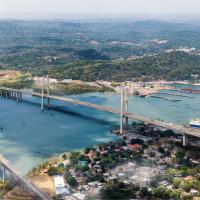
The Arthur J Ditommaso Memorial Bridge in Fitchburg, Massachusetts, has been built to replace the 5th Street Bridge, and was designed by consultant STV. The former bridge was found to be structurally deficient in 1994, as a result of which it was closed. Construction of the replacement bridge started in 1999 and it is expected to open later this year to provide additional capacity to cope with the increased traffic levels on other bridges across the Nashua River.
The new bridge is a twin pylon cable-stayed bridge with a main span of 108m and two side spans of 36m and 50m. The bridge deck cross-section consists of steel edge girders, a cast in situ concrete slab, steel cross-girders, one steel stringer along the centreline of the deck, and an 80mm bituminous overlay. The overall deck width is 13.6m with clear width of 9.8m. The bridge runs from east to west, its pylons are H-shaped, and stay cables are arranged in two planes, north and south, with a semi-harp configuration. There are a total of 52 stays in the bridge, each of which consists of greased-sheathed 15mm diameter, seven-wire strands inside a high density polyethylene pipe that will be filled with cement grout. The HDPE pipe is co-extruded with inner and outer helices and has a white coloured outer finish. Cable sizes range from 19 to 24 strands, and the anchorage system consists of socket, wedge-plate, and ring-nut.
Erection of the stay cables began last autumn, but had to be halted due to the harsh winter, and the grouting was postponed until warmer weather. At the beginning of this year, cable supplier Dywidag Systems International asked CTL to verify the cable forces before grouting of the cables began. CTL had already used its laser-based system successfully to measure cable forces for six cable-stayed bridges and five arch and suspension bridges, but this was the first time that construction-phase force measurement had been adopted.
Measuring the forces in the ungrouted cables of the new bridge in Fitchburg posed a challenge to the efficiency and accuracy of the force measurement technique, largely because the extent of contact between the sheathing pipe and the strand bundle in the cable was not accurately known. Furthermore, the cables near the pylons were quite short, only 10m from anchor to anchor.
To address the issue of possible lack of contact between strand bundles and the HDPE sheathing pipe, the force measurement team used manual excitation of the cables to verify usefulness of the recorded vibration time history data, which are used to compute cable forces. The concern was that potential rattling of strands inside the ungrouted cover pipe could generate background vibration or noises high enough to mask the fundamental frequency of the cables in the reduced data.
Reviewing the recorded data from these trials on site immediately showed that the fundamental frequency of each cable was free of significant noise and that measurements could proceed. The team also concluded that they could account for the effects of reduced cable length and uncertainty of boundary conditions on the short cables near the pylon by revising the error estimate for the test procedure.
CTL obtained the cable physical and geometric characteristics from bridge design drawings and the bridge contractor, JF White Contracting Company, before arriving on site. The force measurement for all 52 cables of the new bridge was accomplished in a single working day, and the report was submitted two days later. The process provided an accurate account of the force levels in the stay cables essential to both the cable manufacturer for initiation of the grouting process and the bridge designer for verification of forces in the analytical model calibrated with the estimated force array.
This laser-based force measurement technique software and equipment can be programmed to provide the force values within seconds of recording the cable vibration data at the bridge site. It gives the construction engineer a real-time force monitor for the cables being stressed, and more importantly, can very quickly reveal the resulting force changes in other cables of the bridge. Cable-stayed bridges are highly indeterminate structures, and force changes in one cable affect the forces in all other cables. This inter-dependency of forces in stay cables is a major reason for using multiple iterations in the cable stressing process.
SENSOR AND SENSIBILITY
Engineers at CTL initially conceived and developed this technology as a condition assessment method for cable-stayed bridges, in response to the needs of the US Federal Highway Administration. The concept relies on the use of a non-contacting laser sensor to measure vibration of a targeted cable from a long distance away, recording the cable's signature vibration characteristics. This record is then analysed to obtain the natural vibration frequency of the cable, which in turn is used for calculation of the existing tensile force.
CTL customised the laser equipment for this application, and tested it rigorously for verification in the laboratory and at bridge sites. The laser development team also formulated a sophisticated numerical process to more accurately translate the recorded vibration to the forces in cables. With this technique, from as far as 100m away one can target a cable with the laser beam and record the cable frequencies, then turn to the next cable, and continue the process for as many cables as can be targeted. The frequency information can be input into a computer and forces calculated with an error of less than 2%.
The innovation was regarded as so effective that it went into use for evaluation of in-service cable-stayed bridges long before the applied research report was submitted in 1999. Before being used on the Fitchburg Bridge, the technique was used successfully for cable and hanger force measurement of six cable-s