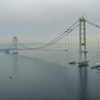
The aptly named Golden Bridge is a steel bridge project being undertaken by the City of Stockholm. At 140m long and 45m wide, the 3,400t structure now sits in the Slussen area of the city, awaiting a granular gold paint job and the completion of surrounding civil infrastructure works that comprise the broader New Slussen project.
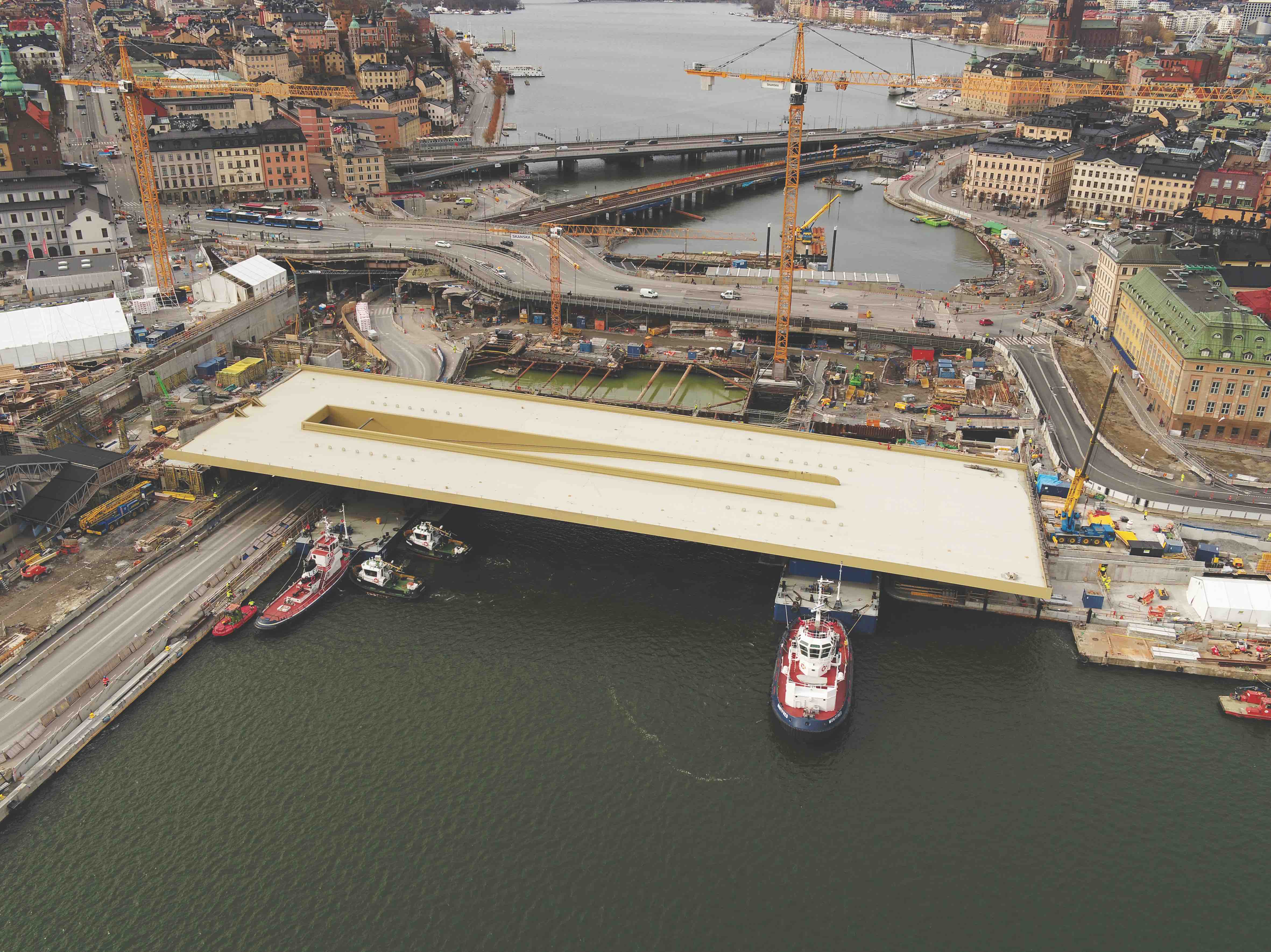 The bridge arrived in Stockholm on one of ten semi-submersible ships globally in March 2020 (Skanska)
The Slussen is a lock built in the centre of Stockholm in 1642 that separates the Baltic Sea from the freshwater lake Mälar. The current infrastructure was built in the 1930s, when there was a larger amount of water traffic to consider. As this has decreased, a desire to minimise the threat of flooding, improve the area’s credentials as a civic space and enhance transport connectivity, particularly for pedestrians and cyclists, has led to one of the largest urban transformation projects in the country.
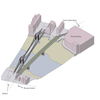
Golden Bridge is one of the main focal points of this redevelopment plan, which has been designed by Foster and Partners. While the crossing is a road and pedestrian bridge, its design takes into account its role as a public space, prioritising pedestrian and bicycle use over cars, with ample room on deck for users to stop and enjoy the views, as well as a dedicated mixed-use area beneath the bridge on either side of a sluice channel, which is being rebuilt. Downlights installed on the underside of the structure, which will have a clearance of 1-7m, will also boost the usability of the entire area around it. The variation in clearance is due to the bridge housing a central ramp, which will transfer traffic to and from the quayside beneath.
As part of the design-build contract won by Skanska, the client required that the bridge be installed as a single unit to expedite installation and reduce work on site. Since users will come in close proximity to the structure — on top and underneath — there were also specific requirements concerning weld quality. “We had to create some mock-ups of the kinds of welds we’d use for the visible welds, so we could get approval from the architect and client that this was good enough,” Markus Glaas, technical manager at Skanska, says.
The fact that aesthetics played such a big role means that the bridge is a lot stronger than it needs to be for the loads it will handle. “If we were to build a bridge that was optimised for road traffic, it would be much lighter. However, with thinner plates, you would have got some deflection from the welding, and you would have seen the internal stiffeners. Because the architect wanted the surfaces to be very flat, we used steel plates that were 80mm thick,” says Glaas.
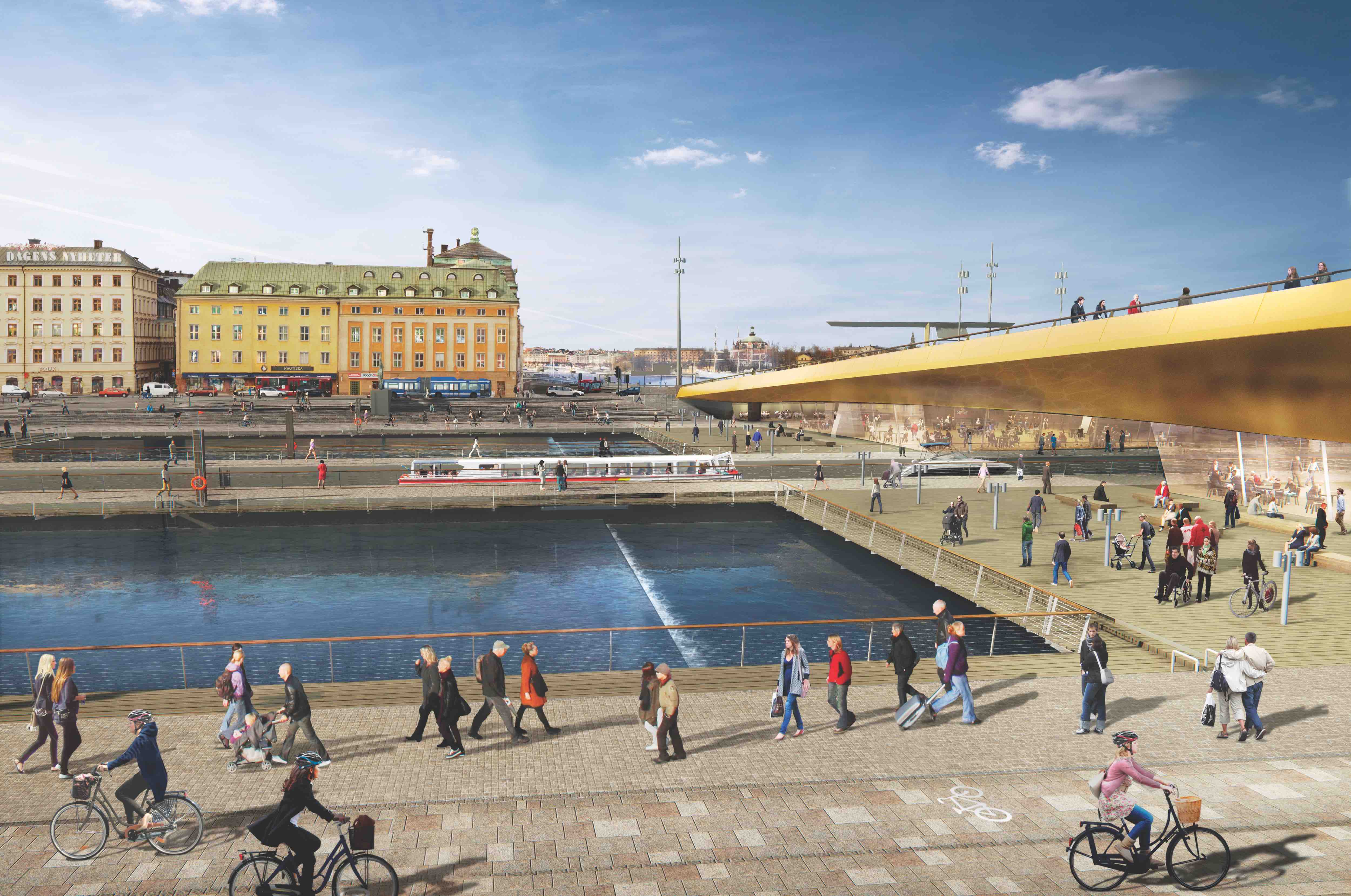 Foster and Partners designed the bridge and the broader New Slussen Project (Foster and Partners)
The delivery and installation methods for the single structure were also important areas of consideration during planning, as well as the workshop capacity of potential subcontractors. “We had to choose a methods of installation and delivery that would work well for us and suit the workshop of our chosen manufacturer,” Glaas says. “That was the biggest challenge during planning: to find the winning concept. We had to keep the design suitable for many different workshops and many different methods of installation because we could see there were benefits to choosing some methods over others, but were not sure about them in the early planning phases.”
Another significant challenge during design was to conduct a fire analysis on the structure, since it could be vulnerable to fires from vessels and the restaurants and cafes that will be beneath it.
In the end, Chinese manufacturer China Railway Shanhaiguan Bridge Group (CRSBG) was chosen as subcontractor based on its ability to manufacture and deliver the bridge in one piece within the time frame and quality required by the city, which included the use of S420 yield strength steel as a minimum. After the contract with CRSBG was signed in December 2017, a mock-up of one of the steel panels was produced for inspection by Skanska and the client. This was accepted and full steel production started in January 2019.
Panels for the bridge were cut and machine welded in Shanhaiguan District, in the city of Qinhuangdao, and were then assembled in a workshop at the Port of Zhongshan, 50km north of Macau: first into 72 sections, each measuring 17m by 6m, and then into eight pieces of 45m (the full width of the bridge) by 17m. To facilitate welding, the 72 elements were assembled into eight sections upside down. Once complete, the eight sections were righted and given five layers of paint before being welded together and lifted onto two barges using two cranes provided by CRSBG, each with a lifting capacity of 2,000t.
Due to width limitations for vessels in the channels of the Slussen area and restrictions in terms of vessel depth during low tide in the Port of Zhongsan, Skanska could not find any suitable barges to carry the bridge. As a result, Skanska also commissioned the Chinese subcontractor to build two barges to transport the bridge. These are 14.5m wide, 53m long and 5.8m high.
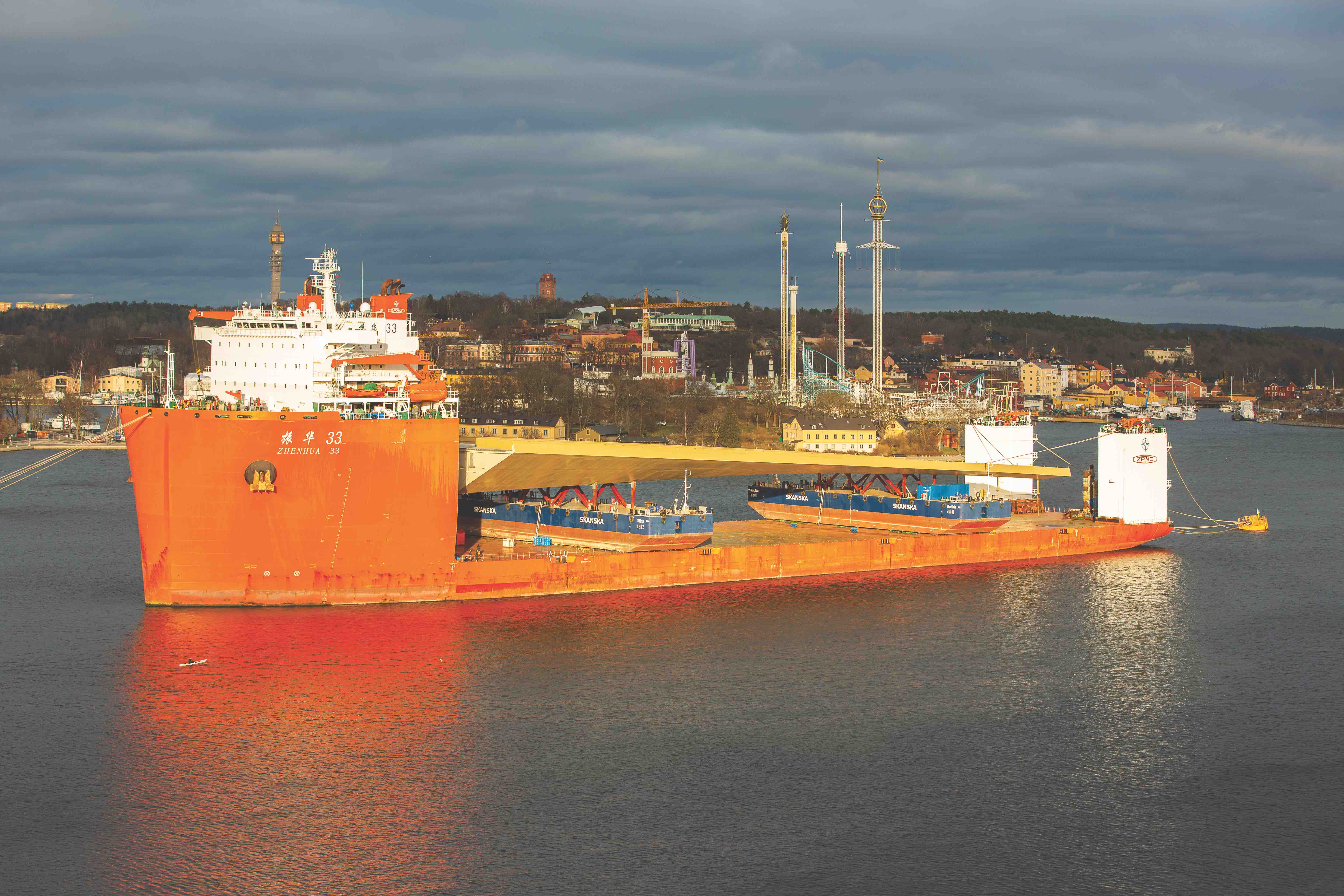 CRSBG built both the bridge and the barges used to set it in its final position in Sweden (Skanska)
The logistics plan involved carrying the bridge on the two barges from China to Stockholm by using one of ten semi-submersible ships available in the world. Once the bridge had been lifted by crane onto the barges in the water, the ship was submerged to a level that allowed them to be floated onboard — a method of loading and unloading typically used to transport large oil platforms.
In January 2020, the ship set off from China to Stockholm via the Suez Canal and Baltic Sea. The total journey took two months, with a delay of several weeks experienced due to severe weather in the Bay of Biscay. In Stockholm, unloading took place 500m from the concrete bridge supports. This was the reverse of the process at the Port of Zhongsan and, together with floating the barges into the correct position to set the bridge, took roughly eight hours.
“We had to stop traffic at the quayside to float in the bridge, so a specific weekend was set aside for that, but as soon as the bridge was above its final position, even though it was not lying directly on its supports, traffic could run again,” explains Glaas.
To set the structure in its final location, the barges were filled with around 3,600m3 of water pumped from the lake until the bridge was free of its temporary supports on the barges. Hydraulic cylinders and jacks were used to make final adjustments.
Currently, the project teams are working with the road surface on the deck, with the aim of opening to traffic in October 2020. The under-bridge area, as well as a new lock and sluice channel beneath the bridge, are scheduled for completion in 2024.
Work is also ongoing on installing and painting the bridge’s guardrails, which have been made to a specific design created by Foster and Partners. Since there were not any existing guardrail manufacturers that were able to produce the railings with the bespoke design required, they needed to be developed by Skanska and tested according to the relevant standards for traffic impacts of speeds of up to 70km/h. “Many parts of the project have been complex, from the production of the bridge in China to the specially designed barges and handrails,” Glaas highlights.
The most eye-catching aspect of the bridge — its granular gold paint job — is another bespoke component. “It is not a standard paint, so we had to run a lot of tests to see how it works, since it acts differently depending on the ambient temperature you apply it in.”
The top of the bridge has recently been painted, but Skanska is waiting for completion of the concreted area under the bridge on either side of the lock to paint the underside so that there is a better platform to work from.