
Ice accretion is a phenomenon which has afflicted many bridges in the northern hemisphere, particularly those supported by stay cables. Øresund Bridge in Denmark has closed numerous times because of the risk of falling ice, while the mechanical removal of ice using metal rings has been used on Port Mann Bridge in Canada. In November last year, images hit the headlines of brave workers clearing ice at a height of more than 300m on the cables of Russky Island Bridge in Russia after freezing rain.
The way the phenomenon manifests itself on Scotland’s Queensferry Crossing is somewhat unique: “What we’re experiencing here is not the same as on other structures in the northern hemisphere, such as in Scandinavia, Russia and North America,” says Chris Tracey, BEAR Scotland’s Unit Bridges Manager for South East Scotland. “They get icicles and hard glacial ice sticking to the stays. It can remain attached for days or even weeks until the temperature rises. We don’t have that; here, it accretes as wet snow, builds up to a critical mass and falls off.”
The cycle can occur in as little as 10-15 minutes, ie from ice accreting to falling off, so anticipating it is key to keeping operatives and users safe. To accurately predict when conditions could lead to an accretion event, BEAR Scotland, which is responsible for managing the bridge on behalf of Transport Scotland, uses data from the UK Meteorological Office. “There’s an algorithm that takes all the data they provide, and it gives us a black, red, amber, or green situation through the winter. It’s worked well, and we’ve never had an incident where we’ve had ice accretion and weren’t forecasting either a high or severe risk,” says Tracey.
The conditions can be forecast up to 72 hours ahead, and if there is a black (severe risk) or red (high risk) warning of an event in 24 hours, patrols are sent onto the bridge equipped with thermal binoculars to look for ice. While this has been a successful approach, there have been some false red warnings, and data gathering is ongoing to better understand the conditions that lead to icing of the cables, with the aim of preventing it if possible.
The main tools used to gather this data to date are six clusters of sensors installed prior to winter 2020: three are on the Queensferry Crossing tower tops, two at deck level and one on Forth Road Bridge. The instruments inform the management team of the weather conditions in real time and give a good indication if it is safe to reopen the crossing, while also allowing for on-site conditions to be compared with the weather forecasting to verify its accuracy.
 An eight-strong rope access crew has been cleaning the stays attached to the northernmost tower since the end of August, with the work set to last approximately eight weeks
Using the sensors, it has been observed that the convergence of a narrow range of parameters is required for ice to accumulate on the cables: a temperature of between 0°C and 1°C, a dew point of below +2°C trending towards 0°C, and relative humidity of >97%. “Wind speed is still to be determined. However, we believe that speeds between 20mph and 50mph from the west are critical.”
While ice accretion has been recorded on three occasions since 2019, and led to full bridge closure in each instance, the stay cables were fitted in 2015, meaning nearly four years passed without the phenomenon, unless it went unnoticed. With this in mind, the management team is keen to discover if the build-up of dirt on the stay cables in the years since their installation is contributing to the problem by providing something for the ice particles to bind to.
To test the theory, an eight-strong rope access crew has been cleaning the stays attached to the northernmost tower since the end of August, with the work set to last approximately eight weeks. Two personnel work on any one of the cables at a time, washing them by hand with soap and water. Ninety-six cables between 94m and 420m in length will be cleaned. “We’re only doing one tower because if we cleaned them all and got no ice accretion next year, we wouldn’t know if it was because of the cleaning or that the conditions weren’t right for ice to form,” explains Tracey.
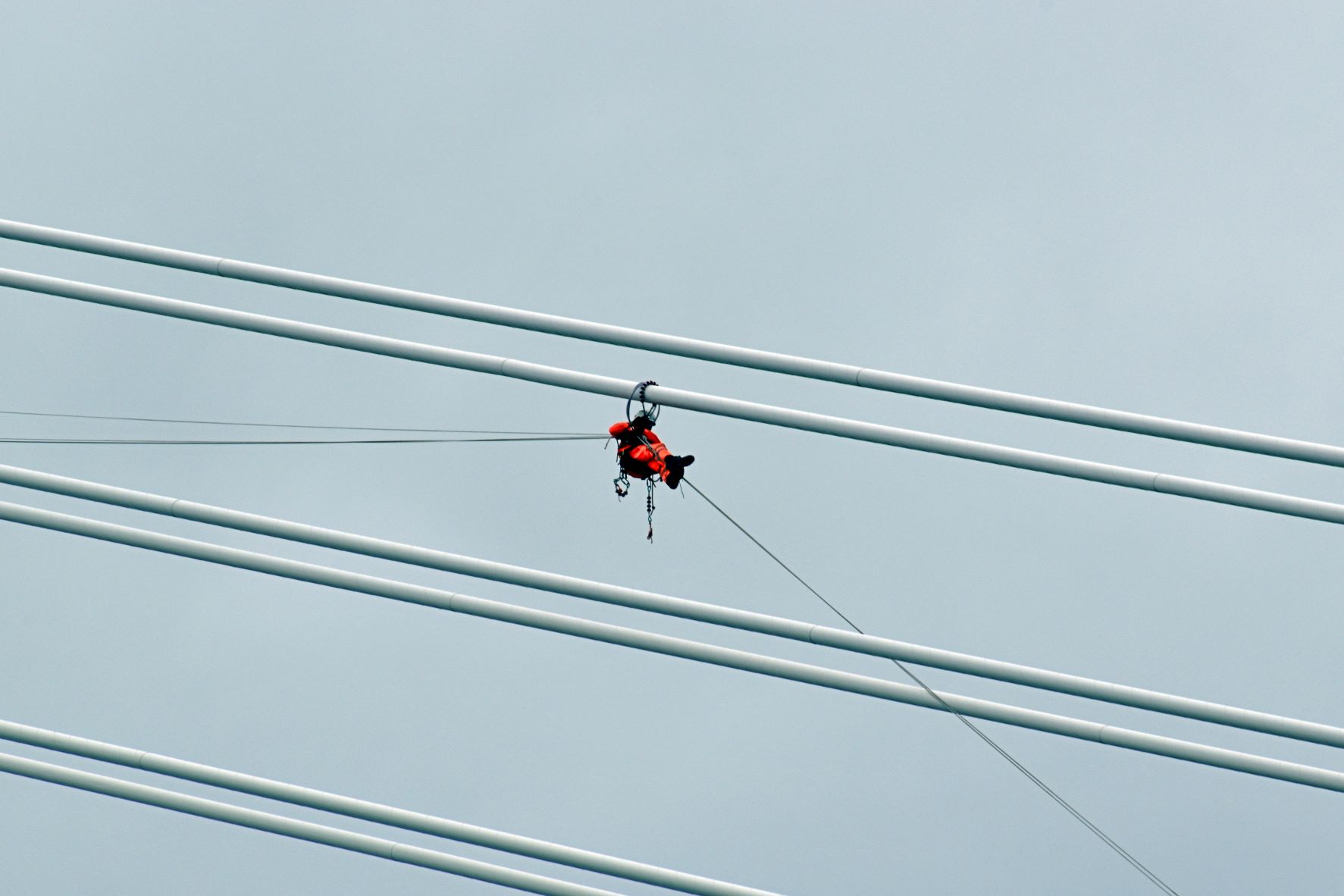 Ninety-six cables between 94m and 420m in length will be cleaned
To supplement the trial, laboratory testing will be conducted over five days in early December at the Jules Verne climatic wind tunnel, a research facility at the Scientific and Technical Centre for Building in Nantes, France. There, replicas of the cables and concrete tower will be subjected to the exact conditions causing ice accretion on the crossing. Clean and dirty stays will be tested to observe the differing effects on each, as well as stays coated with different de-icing compounds, including potassium acetate, which is already used to prevent ice forming on the deck surface in winter.
The de-icing compounds have been selected for testing from the full gamut of passive and active mitigation methods in use today. “We reviewed every piece of technology we’re aware of. Most of the mechanical and thermodynamic methods – including trace heating, rotating, vibrating, or any mesh on the outside of the stays – have all been discounted at the moment for various reasons.”
One of these is that to install a mechanical system on the 288 individual stays totalling over 70km in length would be hugely disruptive, especially since the bridge has only closed three times in four years due to ice accretion. Mechanical techniques used on bridges like Port Mann are also unsuitable due to the nature of the atmospheric icing witnessed on the Queensferry Crossing, in that the ice falls to the ground relatively quickly after it develops, negating any benefit from being able to remove it mechanically, which is an operation that would require the bridge to close anyway.
A range of different thermal applications also exist, whereby ice-prone surfaces are heated, but these are notoriously costly due to the amount of energy needed to power the electrical resistance heating systems they use, and therefore, like the mechanical methods, do not pass a cost-benefit analysis for the bridge and present reliability and maintenance issues.
Different surface profiles that prevent ice adhering to the cables have been designed on other structures vulnerable to ice accretion, but changing the sheaths at this stage would be complex, according to Tracey. “We’re not completely ruling these methods out, but they’re on the backburner as we believe that they will change the drag effect on the stays, so the vortices and wind effect would have to be seriously considered.”
As well as the de-icing compounds being tested in France, passive systems under study include hydrophobic and omniphobic coatings. The latter combine the power of hydrophobicity (resistance to water) with oleophobicity (resistance to liquid chemicals, organic solvents, and oils).
While there is the potential for the coatings to prevent ice forming, their efficacy over anything more than the short-term cannot be guaranteed on the high-density polyethylene sheaths. “We may find a compound that works, but could we find a way to bleed it onto the stays and cover the surface of the tower? We could spray it on with drones, but could we spray it with the traffic running? We might have to stop the traffic anyway, and there would also be environmental considerations,” Tracey highlights. “All of these things come into play, but with the trials we want to see in the first instance, do they work?”
To enhance future data gathering, nine optical and thermal cameras are being installed concurrently with the cable cleaning work. There will be three cameras on each tower looking down to the stays and the concrete face of the tower, where ice has also accumulated in the past. “The cameras will look down the western side of the of the tower and stays because that is the direction of the prevailing wind. Of the three ice accretion events that have happened since the bridge opened, they’ve all been on that side. The weather from the east comes from the continent and is drier.”
Another trial to be executed under this multifaceted programme will be of a cable cleaning machine developed by VSL, the original stay supplier. If the laboratory and on-site trials indicate dirt is facilitating ice accretion, the machine will be deployed to clean the cables in place of rope access technicians, reducing risk as well as time and financial costs.
The entire package of works will be peer-reviewed next year by a team comprising experts from Scandinavia, North America, and the original design team. “The brief is to look at the process to see if we have come to the right conclusions and whether we have missed anything,” Tracey says.
The fact that falling ice has never been noted on the Forth Road Bridge less than 400m away highlights the nuanced interplay between structural form, materials and meteorological conditions that the team needs to unpick. Nonetheless, doing so will be worthwhile if it leads to improvements to safety and even fewer closures. “The important thing is the safety of our operatives and bridge users,” Tracey adds. “All the inconvenience and hassle is secondary, but we do recognise it is inconvenient for the travelling public, because it tends to happen in the coldest part of the night at 2:00 or 3:00 am, and therefore the bridge is closed for the morning rush.”