Restrictions on space at the site of a railway crossing of the Oder Havel Canal in Henningsdorf meant that a new bridge span had to be built 500m from its final destination and installed using a combination of transportation methods. Heavy lift specialist ALE launched the 1100t railway bridge over the canal in a complex procedure that included a combination of land, rail and water transport.
“The initial challenge with this particular bridge was due to limitations at the installation site,” says ALE engineer Jan Antens. “Because of space issues at the quayside, the bridge had to be constructed 500m away from its final site on the canal, which meant the structure had to be moved before it could be launched.
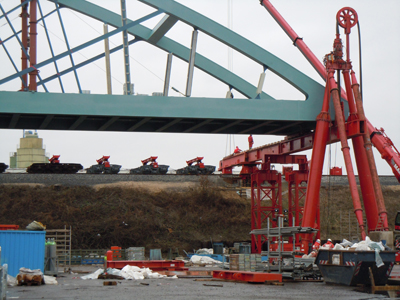
“There were also the constraints of time against us. Because of ice on the canals, the project had already been postponed for two months, as the transportation barge was unable to reach Hennigsdorf. This set-back gave us just two weeks to complete all stages.” In the first phase of the transport the 101m-long bridge structure was raised by 10m using four gantries, each with a 500t strand jack; this allowed ALE to install skidding equipment on lifting beams below the structure.
The bridge was then skidded transversely by 24m to reach the railway tracks on top of the embankment. Support of the skidways was provided by the installation of bridging beams, supported by jacks, which were able to compensate for the settlement that was predicted in the foundations.
Once the bridge was centred on the rail tracks, it was lowered by 1.5m onto 32 rail bogies. The next phase of the process was to transport the span a distance of 500m by rail to the quayside. “A major challenge that we had to address in terms of the rail transport aspect of the project, was in the tracks,” says Antens. “The two tracks were not parallel, over the distance we needed to traverse, and we could not be sure the 1,100t load would be distributed evenly.
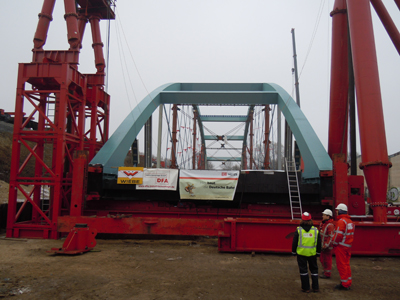
An uneven distribution would not only impede progress, but it could damage the bridge structure and the supporting equipment.” To compensate for irregularities in the track, ALE engineered a system that enabled some bogies to move laterally beneath the bridge structure, thereby remaining symmetrical in relation to the centre of gravity.
Using this system, the bridge was pushed by two locomotives to the launch site at the canal, where it was jacked up and the rail wagons removed to prepare for launching on a barge. The delivery of the structure by rail meant that the bridge was at the correct elevation already and could be launched forward directly over the canal it was to span. ALE created a bespoke launching system that included beams, skid tracks and four 5m-high towers to support the steel superstructure.
Normal procedure would be to launch the bridge forward over the abutments until it had a cantilever of some 25m; a barge with towers would then be used to guide the superstructure across the canal. However this particular structure was not able to sustain a 25m cantilever, and strengthening it to make this possible would have been an unnecessary expense.
What’s more, the abutments of the bridge were set back some distance from the edge of the canal. To combat the problem, ALE created two 44m-long beams, each weighing 100t, which were longer than would normally be required. But this adaptation also created difficulties as Antens explains: “The length of the beams posed a particular issue for their positioning, in relation to the barge aspect of the procedure. The beams needed to be positioned diagonally to suit the skew of the bridge, but during transport they could not extend outside the barge itself, which was 11m wide.”
The beams were loaded onto the barge in Dordrecht, in the Netherlands, and transported to Hennigsdorf, near Berlin. Once the barge arrived at the bridge, the beams could then be rotated to match the bridge skew. ALE turned each beam using six axles of self-propelled modular transporters, which have computer-controlled, electronic steering.
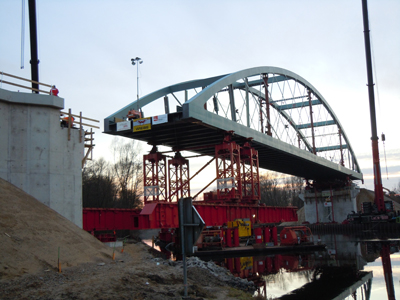
Together with a turntable and a 400t crane, they allowed ALE to position each beam accurately during each stage. Skid tracks were then installed once the beams were positioned, and ALE placed the towers on top, including stationary skidding plates. With the bridge structure supported by the launch system at the front and rail bogies at the rear, ALE then began to launch the bridge over the towers onto the beams. At maximum cantilever the bridge was fixed on the towers and skidded over the beams on to the centre of the barge. By de-ballasting, the girders were released from the quay and the barge was floated 65m across the canal, where the beams were again landed on the quayside.
The towers – with the bridge structure on top – were then skidded off the barge until the bridge reached its final position. “Once the bridge was in position over the canal we moved the launching structure out from underneath – by employing a combination of skidding equipment and precise ballasting of the barge we could effect a smooth transfer onto jacks in preparation for the final fitting,” Antens says.
Four 500t climbing jacks were used to support the bridge once all launch equipment was removed, and the bridge was lowered 3m on to its permanent support on each side of the canal. The entire installation procedure took ten days to complete. ALE’s client was steel fabricator Stahlbau-Niesky. Main contractor was Deutsche Bahn, which is also the owner.