
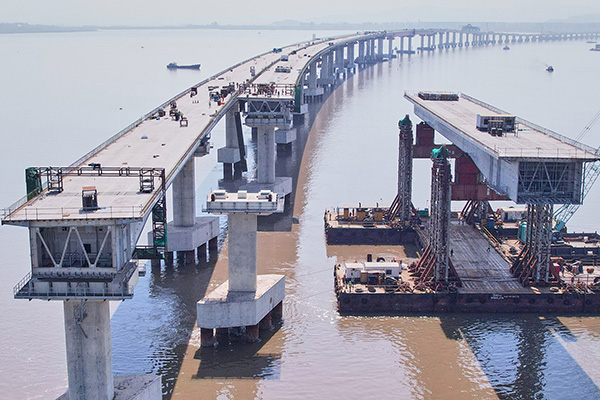
 An ambitious civil project featuring state-of-the-art technology, the Mumbai Trans Harbour Link is close to connecting Mumbai to Navi Mumbai
The 22km-long Mumbai Trans Harbour Link (MTHL), also known as the Sewri-Nhava Sheva Trans Harbor Link, is poised to be the longest sea-crossing viaduct in India by end of 2023 and is designed to provide a vital transport corridor that will unlock numerous opportunities for two important regions.
The project consists of an access-controlled link with four interchanges and a dual, three-lane expressway featuring electronic open road toll collection and an intelligent traffic management system. It will provide a critical link between urban areas, significantly increasing connectivity to the southern part of Navi Mumbai. As well as mitigating traffic congestion and reducing commuting time, it will enable greater economic integration with regions further afield in Pune, Panvel and Goa.
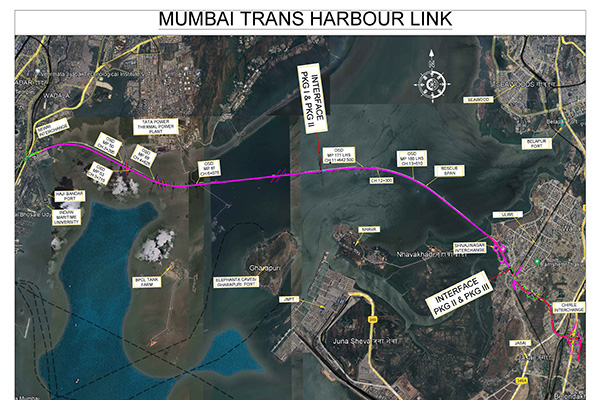
The project consists of an access-controlled link with four interchanges and a dual three-lane expressway
The idea of connecting Mumbai and Navi Mumbai across Mumbai Bay was conceptualised as early as the 1970s. During the 1980s, preliminary feasibility studies and discussions began to explore the technical and financial viability of the project. In the early 1990s and early 2000s, detailed feasibility studies were initiated to evaluate the MTHL project comprehensively. These studies considered various factors, including traffic projection, environmental impacts, financial models and engineering challenges. Environmental impact assessments were conducted to assess the potential effects of the project on the marine ecosystem.
After the MTHL project had received clearances and approvals from relevant authorities, in February 2009 the government of Maharashtra determined that the project would be owned and implemented by the Mumbai Metropolitan Region Development Authority (MMRDA). Various financing models were explored during the 2010s, including public-private partnerships, until in 2013 the Japanese International Cooperation Agency agreed to provide financial assistance, which attracted interest from international construction companies.
After analysing several options of contract packages, the project was split into three civil contract packages and one intelligent transport system (ITS) contract in consideration of the scale of work, topographic classifications, securable construction yards, bid participation and smooth project implementation. In 2015, MMRDA executed the EPC contract and in November 2017 awarded three design-build civil contracts with a total construction cost of US$2.2 billion. Construction began in April 2018.
The civil contractors for Package 1 are Larsen & Toubro and IHI Corporation; for Package 2 they are Daewoo E&C and Tata Projects; and Package 3 Larsen & Toubro. In May 2022, the ITS contract for Package 4 was awarded to Strabag joint venture.
Approximately 16.5km of the 22km-long MTHL is in the sea, the remaining 5.5km on land at either end of the project. The crossing comprises a series of concrete viaducts interspersed with steel girders spanning various navigable channels.
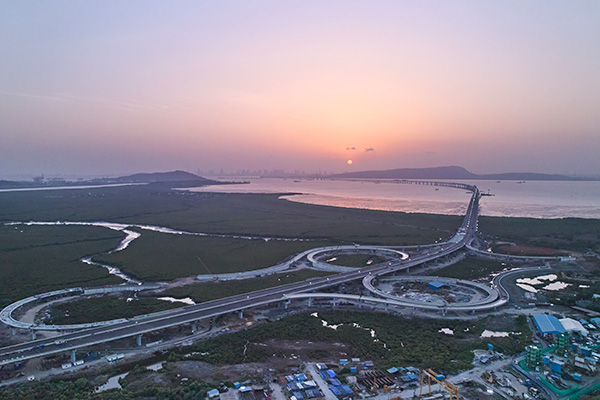 The crossing will significantly increase connectivity to the southern part of Navi Mumbai
A precast segmental prestressed concrete box girder with a typical span length of 60m was selected for the so-called ‘general’ marine, intertidal, mangrove and land sections. The girder type was chosen because of its good ‘standardisationability’, meaning works could be executed in a controlled and repetitive manner. The superstructure segments could be erected span by span with overhead launching gantries, a method that minimises adverse effects on Mumbai Bay, the home for various kinds of fish, flamingos, and mangroves. A typical span length of 60m in the marine area was designed sufficient to accommodate access to the fishing port by boats crossing under the MTHL.
The viaducts consist of 525 spans and, for Package 1 (marine viaduct), it has a typical articulation arrangement of a seven-span continuous concrete box that is 420m long and with a constant depth of 3.85m, resting on bearings. The typical bridge module for Package 2 (marine viaduct) consists of a six-span continuous concrete box girder 360m long, with a constant depth of 3.5m that is integral with intermediate piers and rests on bearings at end piers.
The client requirements stipulated a high level of corrosion protection for the prestressing steel: thus, for the first time in India, all internal tendons consist of flow-filled epoxy coated strands and all coextruded strands in the external tendons are wax coated within HDPE sheathing. The aim is to enhance durability, provide high resistance to chloride attack and offer excellent resistance against fretting fatigue. All external tendons are designed to be replaceable.
Certain marine sections require longer spans of between 100m and 180m to cover creeks, jetties, pipelines and navigation channels. During the preliminary design planning stage, three bridge types that could accommodate this range were carefully evaluated, including cast-in-situ segmental box girder, extradosed bridge, and steel box girder with steel deck.
The extradosed bridge was not deemed to significantly impact the course of migratory birds such as flamingos, but the orthotropic steel deck (OSD) box offered benefits in structural performance, constructability, construction period and environmental impact. The OSD has the advantage of lighter weight for its seismic resistance, a relatively shorter construction period, a smaller scale for piers and foundations (with much less environmental impact on the site), and higher site safety during construction. However, as steel bridges are more prone to corrosion than concrete bridges in marine settings, a heavy anti-corrosion coating had to be implemented and applied on both exterior and interior of the OSD box girder to reach the desired 100-year-plus operational life.
The OSD anti-corrosion coating was designed as per the Japan Road Association’s Coating and Anticorrosion Handbook. The external surface is a five coating solution that combines a fluoro-resin top coat with an inorganic zinc-rich paint and epoxy resin undercoat. The internal OSD surfaces feature a three-coat solution including a modified epoxy resin.
The OSD bridge superstructure comprises an orthotropic steel deck stiffened with U-shaped ribs in the longitudinal direction and with cross-ribs and brackets in the transverse direction, with bolted and welded connections in both directions.
Seven modules of OSD structure have been constructed with a total of 70 spans (or 35 parallel spans), totalling 8km in length and approximately 85,000t of steel in weight. For Package 1, the steel sections consist of pairs of multi-span continuous box girders varying from 85m to 180m in length and 3.3m to 6.6m in depth. The maximum OSD weight is 2,700t for a span of 180m. For Package 2, the steel spans consist of pairs of multi-span continuous box girders with 55-180m spans and 3.3-7.2m depths. The maximum OSD weight is about 2,200t.
During the technical design, a desktop analysis on aerodynamic stability for the OSD structure was conducted. As the amplitude caused by vortex-induced vibration was estimated as exceeding the limit for serviceability in several steel modules, wind tunnel tests were carried out to evaluate aerodynamic stability more accurately and quantitatively. The results of wind tunnel testing showed that the vortex induced vibration would occur in several OSD modules, therefore structural countermeasures using tuned mass dampers were specified inside the steel box girders to reduce vertical vibration due to wind.
The geological strata in the MTHL project region generally consists of cohesive soil on the surface, sand, gravel, weathered basalt and hard basalt, and in some regions the basalt layer thickness is greater than 10m. A total of 2,042 large-diameter, cast-in-situ bored piles have been installed in the project, 1,501 of which are in the marine viaducts. These have diameters of 2m (maximum pile length 32m), 2.2m (maximum pile length 47m) and 3m (maximum pile length 32m).
For the intertidal and marine zones, the piles were constructed using permanent casings with a reverse circulation drilling (RCD) machine. This is an excellent piece of equipment for hard strata and deep drilling where high speed is required alongside reduced noise and vibration, and 20 such RCD machines were deployed for MTHL marine piling.
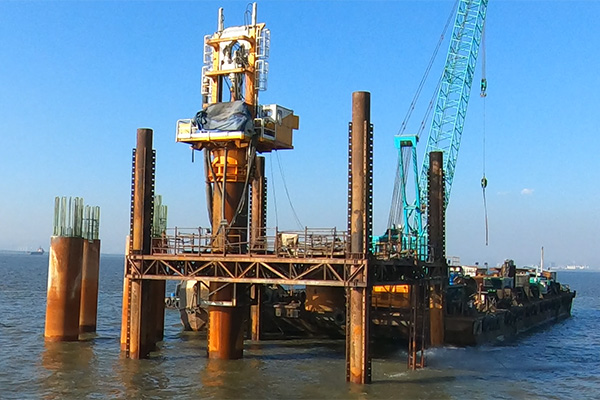
A reverse circulation drilling machine was used to construct the piles in the intertidal and marine zones
In order to carry out the typical pile foundations at the marine zone, where even at low tide a constant draft has to be available for marine craft movements, the RCD rigs were deployed using barge-mounted cranes and jack-up barges (self-elevated platforms), with material transportation also by barge. In the intertidal zone, where piling using jack-up barge was not possible due to the lack of water at low tide and the shallow water depth at high tide, a temporary access bridge (TAB) was constructed for transportation of the RCD, materials, equipment and labour. The temporary bridges on intertidal zones on Mumbai and Navi Mumbai sides were built with extending platforms at each pier location for carrying out foundation and substructure works. The positions of the pile foundation for the TABs had to be carefully considered to allow the passage of small fishing boats during the construction phase.
The MTHL contains a total of 10,689 precast concrete segmental boxes, for which casting yards were established by each package’s particular contractor. For Packages 1 and 2, 33 and 17 casting machines were used, respectively. For the erection of the precast spans, 9 and 3 overhead launching gantries were deployed, again respectively.
Precast concrete technology was used so that the marine viaducts could be realistically completed within 54 months. All yard-precast segments cast were loaded onto trailers via gantry cranes and, for the marine spans, transported to a temporary jetty. Here, the segments were loaded onto the barge and carried to the launching gantry location, where they were lifted by winch trolley with spreader beam. The overhead launching gantry – a self-launching mechanised steel structure specifically designed for the erection of precast concrete segments – allowed the rapid assembly and placement of precast concrete segments safely and efficiently.
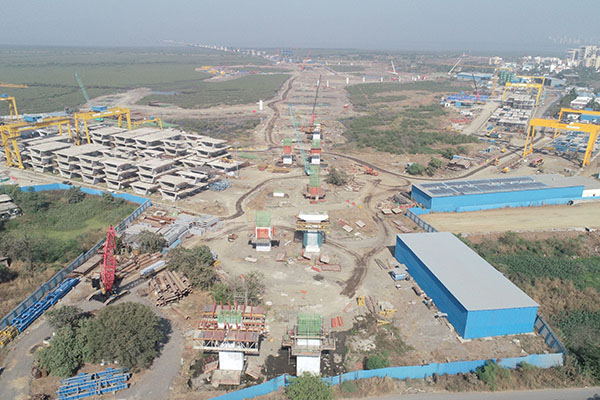
The package two casting yard
One of most complex construction activities was the erection of the orthotropic steel deck spans, which were crucial for expediting the construction of the MTHL. The 70 OSD spans were fabricated and trial-assembled at different facilities outside of India due to the capacities of each fabrication yard. Overseen by IHI, the 38 OSD spans within Package 1 were fabricated in Japan, Vietnam, and Taiwan. The 32 OSD spans of Package 2 were fabricated in Japan, South Korea, Vietnam, and Myanmar.
To facilitate sea transportation to India, the large OSD blocks were split into smaller blocks or panels and then stored within the ships’ decks to prevent corrosion arising from waves and rain. These were delivered to the OSD assembly yards that had been set up near the construction project sites at Mumbai and Karanja.
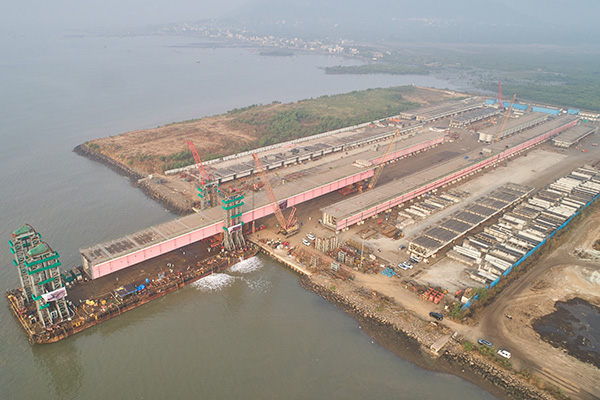
The OSD Kanaja Port assemby yard
Alternative erection methods were studied for installation of the OSD spans, based on actual site conditions and water depth. The method chosen consisted of a large barge with built-in lifting towers equipped with heavy strand jacks with an 800t capacity and 450mm strokes. During the erection of each OSD section, tidal changes at the construction site had to be carefully considered to avoid interference between lifting tower and previously erected OSD spans, in addition to sea water level, barge draft and lifting tower height. The maximum number of erected OSD spans per barge per month was four.
For OSD span erection, a uniquely shaped barge was used that took the form of the letter ‘H’ - necessary to negotiate the piers of the two parallel structures. Somewhat unusually, the piers are not side by side but are instead staggered in places, to avoid sharp-angled seabed pipelines. A standard rectangular barge sliding sideways between the piers would have therefore been obstructed by a pier for the adjacent parallel structure. Similarly, trying to use a rectangular barge in the transverse direction was not possible because the centre of gravity of the steel spans would have shifted to one side, leading to an unbalanced and unstable condition.
The H-shaped barge was the result of a detailed feasibility study that considered stability and dimensions. The 2,000t-heavy structure was designed for loading out, transporting, and erecting the OSD at a height of around 30m from its deck. It was fabricated by Das Offshore at its yard in Dighi Port and used for the erection of 24 OSD spans within Package 2.
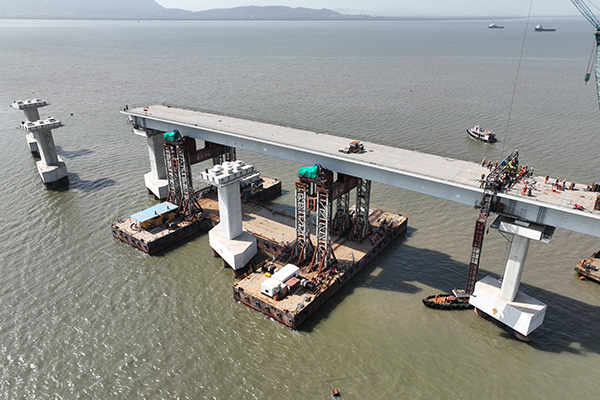
An H-shaped barge was specially designed to install the orthotropic steel deck spans in areas with staggered piers
One of the critical milestones on the project for Package 2 was the relocation of two launching gantries 950t in weight and comprising 135m-long trusses 6.5m in depth. After the erection of parallel spans MP 195 and 194 by the launching gantries, both were relocated to MP 148A and 148 for further launching using a 100m-long OSD barge equipped with erection towers and 580t strand jacks.
After placing adequate strengthening on the launching gantries and their components, each was positioned in a way that minimised load eccentricity and with a centre of gravity that was in line with that of the barge, while the barge towers were positioned eccentrically to the centre of gravity of the barge. The method used took around one month to complete and the authors believe this operation is possibly the first of its kind in the world. It is estimated that the traditional alternative of dismantling and re-erecting the two launching gantries would have taken four months.
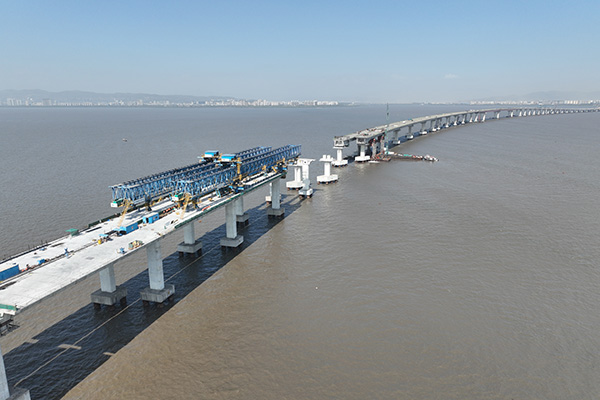
Precast segmental erection was carried out using launching gantries
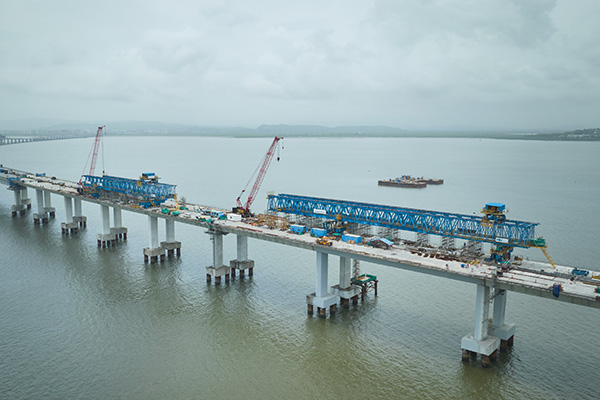
The launching gantries are shown being dismantled
An ambitious civil project that has been under consideration by the MMRDA for more than 30 years, the Mumbai Trans Harbour Link is close to connecting Mumbai to Navi Mumbai. Featuring state-of-the-art technology, the crossing is more than 97% finished, with all structures completed by end of May 2023, prior to the monsoon season. The remaining works are taking place at full speed, including installation of crash barriers, waterproofing of the concrete steel decks, wearing surface and asphalting.
The MTHL sea link crossing is scheduled to open to traffic for the public by the end of 2023.
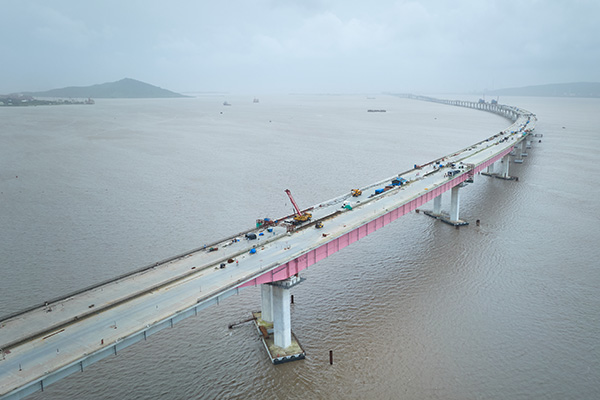
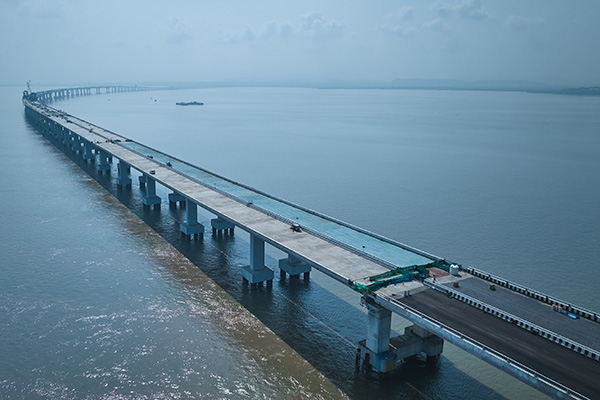 The 22km-long Mumbai Trans Harbour Link is scheduled to open by the end of 2023
Hohsing Lee is resident engineer and bridge expert for the general consultants joint venture comprising Aecom, Padeco, Dar Al-Handash, and TY Lin. Sunil A Wandhekar is engineer in chief for the Mumbai Metropolitan Region Development Authority
Bridge owner: Mumbai Metropolitan Region Development Authority
Funding agency: Japan International Cooperation Agency
General consultants: Aecom, Padeco, Dar Al-Handasah and TY Lin Consortium
Package 1 civil contractor: Larsen & Toubro, IHI Corporation
Package 2 civil contractor: Daewoo E&C, Tata Projects
Package 3 civil contractor: Larsen & Toubro
Package 4 system contractor: Strabag