
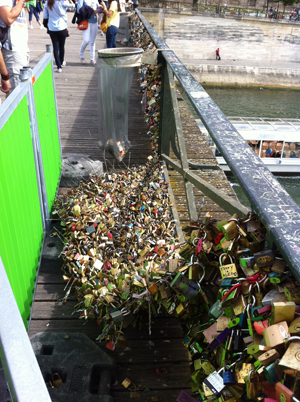
Panels are collapsing on footbridges in Paris due to the weight of the locks (No Love Locks)
The collapse of fencing on a Paris footbridge has highlighted the perils that can arise when thousands of couples insist on leaving a lasting mark on a bridge by securing a padlock bearing their initials. Several mesh fencing panels along the Pont des Arts have collapsed in recent months under the weight of the tens of thousands of ‘love locks’ left there by visitors, who then throw the key into the river.
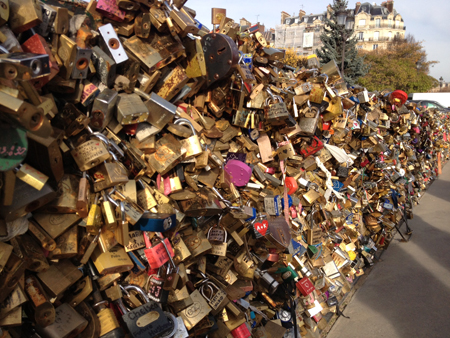
The locks are fastened to the bridge and to one another (No Love Locks)
Paris is perhaps the most extreme example of the craze but locks are left on bridges all around the world. They are banned in some cities, particularly in Italy – though even the threat of fines doesn’t always stop people. Some places take action to remove them regularly while others tolerate the padlocks – albeit generally in far smaller quantities than in Paris.
Locks may have been left on bridges for decades or longer, but the start of the current craze is widely attributed to the Ponte Milvio in Rome appearing in an Italian novel, ‘I want you’ by Federico Moccia, published in 2006. Countless others have since followed the couple in the book by putting their names or initials on a padlock, fastening it to a bridge, declaring their love and throwing the key into the river. Social media has contributed to the rise in popularity; people can snap photographs and share them instantly.
But social media is also contributing to a backlash, with successful campaigns launched in both Paris and Venice. Local groups can play a role in addressing the issue when it gets out of hand, whether by putting pressure on officials, working with a city in cutting away locks, or even, as has happened in Dublin, staging their own unofficial sessions to pick locks and remove them.
The most vocal opposition to their excessive placement in Paris comes from No Love Locks, a campaign launched at the start of this year, a few months before June’s panel collapse on the Pont des Arts drew worldwide attention to the issue. In Paris the safety fears stem primarily from the risk of overladen fencing panels – reported to weigh 700kg - falling onto the walkway, while the recent removal of locks from New York’s Brooklyn Bridge was particularly driven by concerns that they could fall onto traffic below.
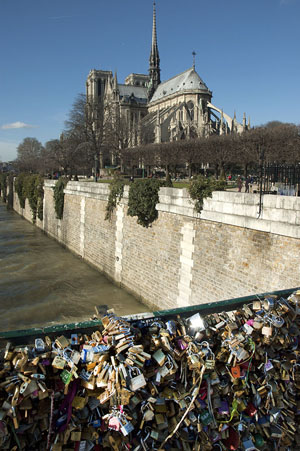
The weight of dense layers of locks that are locked onto one another could potentially create loading issues for parapets. There could also be increased wind loading when the sheer number effectively creates solid parapets, potentially making them more likely to be blown over.
Wind was cited as the key reason for removal by the latest council to take action, although the number of locks was, at 330, relatively small. Cheshire West & Chester Council in north west England said that a recent structural assessment and sensitivity analysis by bridge engineers had shown that the locks had brought the Queens Park Suspension Bridge close to its theoretical capacity to resist the effects of wind loading. The council also pointed to the locks damaging the new paintwork when moved around by the wind.
Aesthetic damage is a concern in some places, whether by spoiling the open appearance of a new landmark or when rust-prone locks in cities such as Venice risk staining historic stone structures. “No-one has yet suggested we should be designing for this but I suspect it won't be long!” says Flint & Neill chief operating officer Ian Firth. “I think it is a crazy fad which hopefully will pass. The only answer is a very fine mesh (not good when ice is a risk) or glass balustrades (not wanted by most clients).”
Designers do often have some sympathy with the idea of locks being left, though naturally not when it reaches the levels seem in Paris. “I can see that there could be opposing views on the practice,” says Ramboll UK director Peter Curran. “On one hand there’s a certain charm to it, a warmth and humanity in what might otherwise be fairly cold inanimate parts of a bridge. It really is a demonstration that a bridge has a strong symbolism of connectivity.”
But as with everything there are extremes, he feels, and excessive placement takes away that initial charm and becomes an eyesore or nuisance, certainly for the bridge owners who have the responsibility to maintain and operate the structure safely. The loads from the heavy accumulation of multiple layers of locks can clearly be significant for mesh infill panels such as those in Paris. Curran suggests that there might also potentially be a safety issue for a bridge parapet itself from such loading, depending on the parapet configuration - for instance if it were inclined.
Martin Knight of Knight Architects feels that the locks strengthen the emotional engagement that the public has with bridges, compared to buildings and other structures. “This reinforces my view about the importance of bridges in establishing a sense of place,” he says. “In that respect it is a positive thing.” However it is clearly untenable to have sections failing under loads. “I have sympathy with the view they cause expensive and unnecessary additional maintenance and are ugly,” he says. “Well-intended it may be but it is still a form of vandalism.”
Even the newest of bridges can soon attract locks, as has been the case with the Slinky Bridge in Oberhausen in Germany. The colourful 406m-long bridge has a multi-span stress ribbon as its structure, with a non-structural undulating aluminium spiral bolted around it. Designer Mike Schlaich of Schlaich Bergermann & Partner said at the recent Footbridge 2014 conference that the bridge has already become quite a weekend destination and has started to attract love locks. “It has become a serious load case,” he says; the owner has to cut them off every few months.
Depending on their location, Parisian bridges are more or less vulnerable to the fad, with Pont des Arts being the most popular site. Dietmar Feichtinger of Dietmar Feichtinger Architectes was architect for a newer Paris footbridge, the Passerelle Simone de Beauvoir, which opened in 2006. This bridge is off the standard route for tourists, he says, “therefore the love locks phenomenon is less developed and can be tolerated”.
As a custom it has a positive intention, he acknowledges, going along with the symbolic idea of bridges as permanent links between people. But in places it has become overwhelming and put people in great danger, with the Pont des Arts particularly exposed because of its central location. Besides the question of the barrier stability, the locks have an impact on transparency and considerably modify the appearance of the bridge, he says, and the city will be obliged to ban them there.
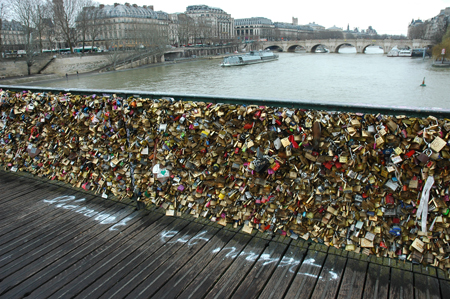
Campaigners are increasingly concerned about damage to the historic bridges (No Love Locks)
No Love Locks was founded in January 2014 by two friends, Lisa Anselmo and Lisa Taylor Huff, who are both from the USA and now live in Paris. They had become increasingly concerned about the damage being caused by locks attached historic bridges spanning the River Seine. The campaign was picked up first by local press and then internationally, particularly after the panel collapse on the Pont des Arts in June. The Pont des Arts has railings in the shape of a St Andrew’s cross.
Some years ago, mesh panels were added to prevent children from slipping through the gaps; it is these panels that now provide easy fixing points. The mesh soon fills up but visitors get round this by attaching locks onto other locks creating a virtually solid mass of metal. The No Love Locks campaign seeks to educate the public about the negative effects of placing locks and also aims to identify less destructive - and more original - ways for lovers and others to commemorate special moments.
It is a polarising topic, Anselmo acknowledges, observing that initially the press would always show both sides of story “as if there is another side to vandalising heritage”. “But when that collapse happened on the Pont des Arts, we noticed an absolute shift in the language the press was using – suddenly everyone was on our side.” No longer were people talking in favour of the romance of the gesture, instead they were asking when the city was going to do something about it.
The number of locks has exploded in the last two years. On the day another panel collapsed in early July, Taylor Huff counted a further 30 panels with visible separation of the wires. She says that there are some 110 fencing panels along the straight expanse of the 155m-long bridge and that the city weighed one of those that fell and found it to be 700kg. The campaign has been seeking to persuade the city to take action. “Whether or not they were interested in taking us seriously before the recent collapse, certainly as a result of it they were willing to have a conversation and it was extremely positive,” says Taylor Huff.
Paris is seeking ideas for something other than placing locks and the first deputy mayor, Bruno Julliard, has said that an alternative will be proposed soon. The campaigners also receive a lot of suggestions. However, many are lock-related alternatives and they don’t want to encourage a proliferation of locks in any shape or form.
One of the immediate actions that the campaigners favour is for the city to post multi-lingual signs on all the affected bridges and monuments in a bid to turn the tide. Taylor Huff understands that signs may be placed shortly, and thinks that this will go a long way to at least reducing the number of new locks, believing most people to be decent by and large.
Clamping down on selling of the locks is also recommended. “For every engineer in every city across the world, we would say take a look at Paris and use that as an example of what not to do,” says Anselmo. “Cities need to draw a hard line and engineers and architects need to be part of the solution,” she says.
In addition to Rome’s Ponte Milvio, Italy also has plenty of other romantic spots where locks have been left. The municipality of Venice referred enquiries on the topic to Cecilia Tonon of the not-for-profit association Masegni & Nizioleti, which has recently carried out a high-profile operation to remove locks from some of the city’s historic bridges.
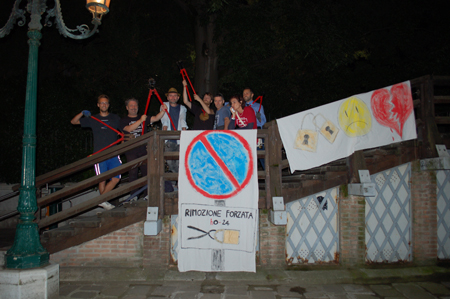
Campaigners in Venice are removing the locks themselves (Alberto Alberti)
People will be less likely to leave locks if there are none already there, she believes. “If someone sees a place is polluted, they are not likely to treat it carefully,” she says. The association, which has its origins in Facebook groups and was officially founded earlier this year, has a focus on cleaning up Venice, including targeting graffiti.
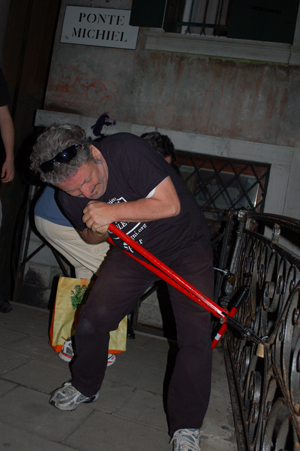
Tonon says that the association’s removal of locks was carried out both for the sake of helping Venice itself and to set an example for the city’s government. The latest operation has seen locks removed from some of the many small bridges and from the Accademia Bridge. As well as damage to the bridges, Tonon points to the pollution caused by the countless keys thrown into the canals.
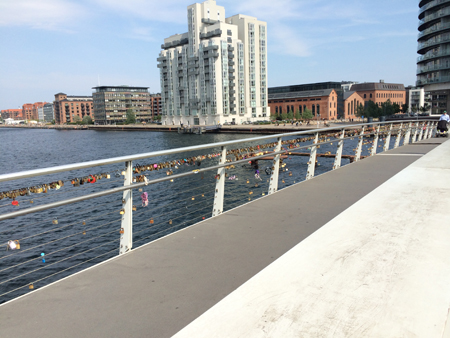
Locks on Copenhagen's Bryggebroen are allowed to remain
Locks are also placed along the Bryggebroen footbridge in Copenhagen, although there aren’t too many, says the city’s service manager for bridges and structures, Peter Hammer de Jong. A few hundred have been left along the central section; he estimates there to be no more than a thousand along the whole structure, which is about 200m long. He adds that the city checked with its engineering advisor Ramboll to confirm that leaving them would not be likely to cause a problem. There could perhaps be some discolouration from rust, but the locks are fastened onto stainless steel wires, which aren’t primary structural members and in themselves wouldn’t get damaged.
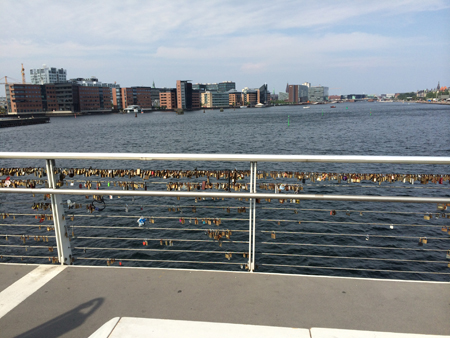
Unlike Paris, the locks aren’t fastened onto one another so there isn’t an issue with heavy accumulations and they are allowed to stay. To avoid hurting anybody’s feelings he even had the locks put back onto a new wire when one had to be replaced for other reasons. If it did develop into a problem, he could envisage removing the locks for fixing onto some kind of special structure nearby.
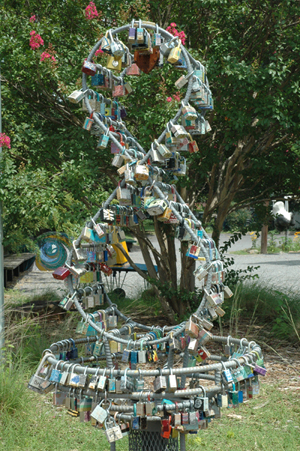
Some cities have opted for replacement objects on which locks can be fixed (Laura Cartwright Hardy)
Little Rock in Arkansas, USA, has just such a structure. “Sealed with a wish” is a sculpture donated by artists John Van Horn and Erika Droke to the city’s Bernice Garden. Locks have been attached by couples as far afield as Missouri and the garden’s coordinator, Laura Cartwright Hardy, says that there are now hundreds of personalised locks adorning the sculpture.
Dublin City Council removes locks from the Ha'penny Bridge about every six months; removing the 2,000 or so each year costs about US$1,600 plus tax. The city council says that the locks cause damage to paintwork and lighting cables and when they hang down into head height they could cause an injury. If they were left, the weight may damage the lantern support arches.The council has put up signs urging people not to put locks on the bridge. Alternative sites have been considered, but it seems the attraction of bridges is their landmark status - and the ease of attaching locks to railings.
Roads & Maritime Services in New South Wales (NSW), Australia, discourages placement of locks on bridges and removes them every month as they can corrode and rust metal and cause damage to bridges, which are not designed for the extra structural load, says a spokesperson. Almost 100 are removed from the bridge each month; they are kept for another month to allow people to come and collect them if they wish although none have been claimed so far.
As the bridge is heritage protected, locks are treated as visual pollution in the same way as graffiti. Under heritage guidelines, signs are discouraged on the bridge, though there are signs advising people not to attach love locks on the coastal Sea Cliff Bridge, another popular target.
Policy has recently changed in relation to locks left on the Kurilpa and Goodwill Bridges pedestrian bridges in Brisbane in the Australian state of Queensland. Up to 200 locks are fixed annually and the Department of Housing & Public Works had previously removed them.
However, in March this year it reviewed its position to only remove locks that are exhibiting signs of rust, says a departmental spokesperson; the locks have not caused any damage. Similarly, the Canadian city of Ottawa has no plans to cut off the love locks from the Corktown Bridge as they do not compromise the integrity of the bridge’s infrastructure, says infrastructure services manager Alain Gonthier.
The Forth Road Bridge in Scotland is unusual in seeking to ensure that locks are left only on its own terms: as part of September’s Forth Bridges Festival it is selling special aluminium padlocks for permanent placement on a designated stretch, with a contribution from each sale going to charity. Forth Road Bridge communications manager Chris Waite says: “People everywhere have a special affinity with our bridge and we welcome anyone who wants to take this special opportunity to make a very personal statement with their own unique memento.”