

Tucked away in a quiet corner of the NPL’s huge campus in south west London is an ageing footbridge connecting nothing more than two blocks of fresh air. The concrete piers and substructure of the bridge are dotted with little boxes and strung with wires, and a couple of huge water tanks are hung by orange webbing straps from the end of one of the cantilevers.
The whole footbridge is securely locked in a compound surrounded by high wire fences. A few metres away in an unprepossessing building, a bank of computers logs the various measurements that are taken every few minutes, building up a thorough picture of what is happening to the structure throughout the day.
Structural engineering is not a discipline which is usually associated with NPL, but as project leader Elena Barton explains, the footbridge programme falls more within the field of condition monitoring, the study of material degradation and damage detection as well as validation of technologies for structural assessment and life prediction. It is intended to be a three-year programme, funding permitting, which will enable the team to study the bridge as it is loaded and unloaded, to damage it and then repair it and study how the repair behaves, and finally to damage it to failure. All the while they will be monitoring the structure using the equipment currently in place, adding new technologies as the work progresses, and also monitoring the environmental conditions in which the work is being done.
The opportunity to carry out such a comprehensive investigation into the degradation process of the materials and the monitoring technology currently available came about with the redevelopment of the NPL’s campus. The bridge was part of the former campus, providing a link for pedestrians over a road between two buildings. The buildings, built in the 1960s, were demolished to make way for modern facilities, but the research team asked if they could save the footbridge for use as a full-scale, outdoor experimental facility.
The structure was removed from its original location by building a frame around it, then cutting through the fixed joints at the base of the piers. It was relocated to its new position and installed on new foundations, with the same fixity at the base of the piers. The only difference was that the ends of bridge now led to the open air rather than connecting buildings.
This will be one of the first research programmes to carry out such extensive monitoring in outdoor conditions, claims Barton, and it covers three main areas of interest.
The first aspect of the programme is the cooperation with numerous universities and companies that manufacture structural health monitoring equipment, offering them a full-size test bed for prototypes; a real structure which is about 40 years old and which is operating under real environmental conditions. Structural health monitoring systems and equipment can be tested under real conditions to see how they operate.
“We are working with about 20 different companies,” says Barton, “and each one is like a project within the project. Each company has different requirements and is using different equipment, and it gives us an opportunity to view them from an impartial point of view and assess the optimal conditions of each system.” In some cases she believes that they may even be able to help identify particular niche applications for new equipment.
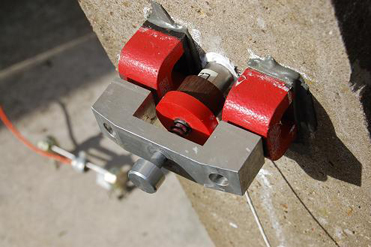
They are also working with bridge owners to identify what kind of systems they need in order to maintain, inspect and monitor their bridge stock in the most effective way possible. “There is much more emphasis on maintenance these days and on looking after what we have got rather than building new structures,” Barton says. “We are working with those who own and those who maintain structures, in order to try and develop alternatives to traditional methods such as visual inspection. Sometimes it is a case of identifying a need and then working with a manufacturer to try and develop a solution to address this need.”
One example outside of the bridge sector is the need for the insurance industry to monitor subsidence of buildings by measuring crack growth. Instead of sending out a surveyor once a week to physically take a measurement, huge savings in time and money can be made by having equipment that can take the measurement automatically and then make it available online or send it by SMS to a data gathering system. As well as being quicker and cheaper it is also greener, eliminating the need for the surveyor to drive to each site.
The second part of the programme is the use of the bridge as a structural health monitoring ‘demonstrator’ project, which enables manufacturers to showcase their systems, and potential customers to see them at work on a real structure. Barton predicts that this activity will increase as time goes on, as more equipment is added to the bridge and people get to know about the project.
Getting commercial interests involved is crucial to the success of the project – not just in terms of testing the equipment, but also in the funding of the work. The cost of the NPL staff and facilities at the site is partly covered by a government grant, but all the equipment is donated, installed and operated by the partner companies, who also offer their structural health monitoring expertise for free.
The third aspect of the project is perhaps the most challenging and interesting, says Barton; it concerns the results of the testing and analysis of the structure itself. “Ultimately we want to know how we can tell if the structure is safe, and also if we can predict how much longer it will last,” she says. “If we want to impose additional loading on a structure, or add new traffic lanes, will this equipment be able to tell us how these changes will affect the structure?
“We are also keen to be able to estimate the remaining engineering lifetime of a structure,” Barton adds, “although we are already discovering that the definition of engineering lifetime is a rather variable thing!”
The programme has already been running for about 18 months, during which time the bridge has been relocated, instrumented, and subjected to dead loads on one of the cantilevers. “One of the great things about this project is that we have got a real bridge dating from the 1960s, and we are free to test and damage it as part of the project. The bridge was built using the typical reinforced concrete construction of the time, and there must hundreds of thousands of similar bridges in Europe that could benefit from what we are learning here,” says Barton.
Later this year the bridge will be subjected to a series of dynamic load tests, after which the team will deliberately damage the structure by removing the concrete cover and cutting through the reinforcement. In the second year of the programme, the intention is to carry out a repair and then monitor the integrity of the repair and the behaviour of the bridge, before finally loading the structure to failure.
As yet, explains Barton, no final decision has been made on what kind of repair will be made, and what failure mechanism the team will inflict for the final destruction. The type and range of sensors and technologies being used will change for each part of the programme, depending on what is appropriate to the work being done. “Up to now we have 48 different organisations involved in the pro