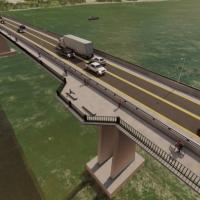
The cantilever is one of the world's earliest bridge forms originating in China, Tibet and Japan. Shogun's Bridge built in the 4th century AD still spans 26m over the Daiya-gawa River in Nikko, Japan. In the mid-nineteenth century, this structural bridge form was reintroduced and used extensively. But today, two of the world's oldest cantilevers are struggling to survive in the USA.
By inserting pins, a continuous girder can be made statically determinant. This was the cantilever's first attribute but later, the possibility of erecting a cantilever over deep gorges or wide waterways without falsework became was identified as another major benefit. The cantilever principle was also applied to the erection of other bridge types such as arches. For example, the arches of the Eads Bridge (1874), were assembled using cantilever methods because the shipping channel, width, depth, and current of the Mississippi prevented the erection of falsework.
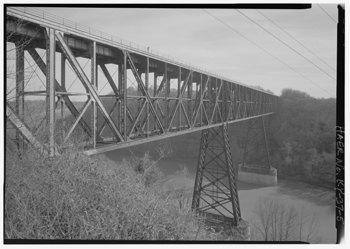
High Bridge (1910, double tracked 1929), spanning Kentucky River, Dixville vicinity, High Bridge, Kentucky. HAER Collection, Library of Congress.
Although British engineers suggested using the cantilever form as early as 1846, the first modern cantilever actually built was Heinrich Gerber's Hassfurt Bridge over the Main in Germany (1867), with a central span of 38m. The form was statically determinant, which made it easier to calculate the stresses and size the parts of the structure. Members did not suffer the inherent deficiency of the continuous beam or girder - developing unknown, possibly large internal stresses which could lead to failure should one of the piers or abutments subside. Unstable soil conditions plagued foundation, pier, and abutment design, so the ability of a bridge's superstructure to adjust should one of the piers or abutments sink was a significant design breakthrough.
The next important cantilever was built by American engineer C Shaler Smith, ten years later in 1877. It provided the first practical test of the application of the cantilever principle to long-span bridge design. He built what was then the world's longest cantilever for the Cincinnati Southern Railroad over a 366m wide and 84m deep gorge of the Kentucky River near Dixville. The bridge resolved the difficulty and expense of erecting a forest of falsework in a deep wide river gorge. It had three spans of 114m each. The outer spans are 11m-deep Whipple trusses cantilevered 23m beyond the piers and resting on roller bearings at the abutments. The centre spans were constructed as continuous trussed girders, but once assembled, the bottom chords were cut and pinned resulting in 91m semi-floating trusses fixed at the abutments and hinged to the cantilever, making the overall span from pier to abutment 114m. The bridge was selected by ASCE for the 1878 Paris Exposition as one of the prime examples of American bridge ingenuity.
After the success of these bridges, the technique was accepted and widely employed in the 1880s, especially in the USA. Other important counterbalanced spans are the Michigan Central Railroad bridge over the Niagara Gorge, designed by Charles Conrad Schneider in 1883. With cantilever arms supporting a simple suspended truss, this 151m span and, the nearly identical Fraser River Bridge in British Columbia, Canada, directed the attention of the engineering world to this new bridge form. These two were the prototypes for subsequent cantilevers at Poughkeepsie over the Hudson in New York, Young's High Bridge over the Kentucky River, the Forth Rail Bridge in Scotland, and the Quebec Bridge in Canada. Cantilever bridges in the US are one of the standard bridge types for long span-crossings of deep, broad river gorges where it is difficult if not impossible to erect falsework. The cantilever also eliminated the high cost of building anchorages required by the other long span bridge type, suspension bridges, thus saving money and materials.
Though many of these early cantilevers have been destroyed or replaced, two of the world’s great cantilevers still survive in the United States: Poughkeepsie Bridge (1888) and Young’s High Bridge (1889). While most engineers are familiar with the Forth Rail Bridge and Poughkeepsie, few will know of Young’s High Bridge, which is located 24km west of Lexington, Kentucky.
The Forth Rail Bridge remains in service as part of the main line in east Scotland, but the two older American spans have been threatened since they went out of rail service. Poughkeepsie was closed in 1974 when a fire burned a 304.8m section of wooden walkway and ties over the land portion on the Poughkeepsie side. But the fire did not spread to other parts of the bridge; 914m of bridge is completely intact.
Young’s High Bridge went out of rail service in 1985 when the last freight train traversed. The only reason these bridges survive is their robust size and the difficulty of dismantling such large superstructures. At the same time, there have been many attempts by rail-to-trail and bridge enthusiasts to save the structures over the years.
The Poughkeepsie cantilever was the first rail crossing of the Hudson River downstream of Albany, and is 130km north of New York City. Built by the Union Bridge Company of Athens, Pennsylvania, to designs by Charles McDonald and AB Paine, the overall length is 2063m, including three cantilevers of 167m connected by two fixed spans. The bridge was strengthened by Ralph Modjeski in 1906 by adding a third line of trusses down the middle.
The organisation 'Walkway over the Hudson', formerly headed by Bill Sepe has been campaigning for more than a decade, along with citizens on both sides of the Hudson, to save the magnificent bridge as a pedestrian crossing. Its vision for the bridge is to provide a critical link connecting more than 48.5km of rail trails, including the Poughkeepsie Cantilever, as part of the Hudson Greenway trail system.
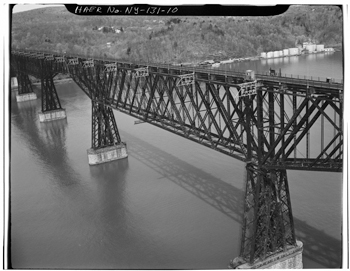
Poughkeepsie Bridge (1888), spanning Hudson River, Poughkeepsie, New York, HAER NY – 131. HAER Collection, Library of Congress.
Under the recent leadership of Fred Schaeffer, Walkway Over the Hudson hopes visitors soon will be able to experience the magnificent Hudson valley from a height of 64.6m, crossing the bridge deck. The organisation recently received a US$874,000 federal transportation equity grant to assess and stabilise the Poughkeepsie cantilever for pedestrian and bike use by 2009. However, completing the walkway from shore to shore is expected to cost US$5-10 million. (www.walkway.org)
Also involved in campaigning , this time to save the Young's High Bridge, is the Tyrone Bridge & Rail Company and the Blue Grass Rail Museum, under the leadership of Jodie Wells. She and her group have worked for a similar period of time to convert the bridge into part of Kentucky’s rail-trail system linking Lawrenceburg and Versailles including a repaired rail line with parallel walking and bike path. Good ideas have to come from somewhere and usually start with a dream. To make their dream a reality, Tyrone Bridge & Rail Company has struggled to find support and funding from the state, the local community and the bridge’s owner, the Norfolk Southern Railroad. The vision is a new state park centred around Young’s High Bridge, which would bring tourists dollars into Anderson County, more jobs to the community and maybe even make Tyrone a tourist destination as part of Kentucky’s world famous racehorse-breeding Bluegrass area. The Kentucky Derby i