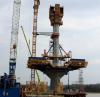
With a total length of 2560km, the Orinoco is the longest river in Venezuela and the third longest in South America. Currently, the river is crossed by only one bridge, which is situated at Ciudad Bolivar, the capital of the state of Bolivar, in a region called Guayana.
The second crossing, which is now under construction, is about 100km downstream from the first and some 300km from the river delta, close to Ciudad Guayana.
The project, whose official name translates as the 'combined transportation system, second bridge over the Orinoco river', will connect Bolivar state in the south with the states of Anzoategui and Monagas on the north bank of the river. The city of Ciudad Guayana is the main centre for processing iron and bauxite in order to convert it into steel and aluminum. This city is also home to the heavy industries of Corporación Venezolana de Guayana, and one of the main reasons the crossing has been developed is to allow access for railway as well as vehicular traffic, in order to transport the corporation's products to a deep water port that is being built on the northern coastline of Venezuela. This will eliminate the problem faced by docks on the Orinoco River, which have to be dredged regularly to remove the huge quantities of sediment that transports the river.
The existing suspension bridge, which has a main span of 712m, was finished in the year 1967. Even at that time, the government was already considering developing a second crossing and its study of the economics indicated that such a project would be justified by the 1990s. Lustgarten y Asociados Ingenieros Consultores was involved in carrying out several studies that included possible alignments, economical analysis and conceptual engineering for various government agencies over a 30-year period. Eventually, in 1997, the CVG selected Lustgarten y Asociados to carry out the preliminary design of the second crossing.
Three years later, the Venezuelan government invited Brazilian contractor Construtora Norberto Odebrecht to tender for several construction projects, including the second Orinoco River bridge. The contract was awarded to CNO in 2001, based on the preliminary design drawn up in 1997.
The project that is now under way involves the construction of approximately 4.5km of structures and more than 170km of new roads needed to connect it to the existing highway system. It includes the 3.2km-long Orinoco River bridge, a 900m-long north access viaduct and several smaller structures.
At the site of the bridge, the Orinoco is 3km wide and has flows that range from 66,000m2/s up to 85,000m2/s. Two separate navigation channels already exist at this place, and these define the locations of the two main spans of the bridge. A small island is revealed between the two channels during the low water season, which is where the designers chose to locate the pier that acts as the fixed point for the horizontal loads on the main bridge. The river navigation mainly consists of barge convoys used for transporting of minerals such as bauxite from the upriver mines to the processing factories at Ciudad Guayana.
One of the main challenges for the builders of the bridge is the seasonal variation of the water level, which has a range of 12.5m. Another important consideration in the design and construction was the current of up to 2.6m/s. In some areas of the river bed in the north channel, foundation design had to take into consideration the possibility of scouring up to 28m depth.
In the early stages of the project, cable-stayed bridges with two, three and four towers were studied, but the chosen solution was a configuration of two typical cable-stayed bridges back to back with a fixed point in the centre. This fixed point is located over the small island separating the channels, which enables all braking and longitudinal seismic loads on the main bridge to be transferred economically. The final solution was derived from L&A's 1997 proposal, and developed with German consultant Leonhardt, Andrä & Partner.
The bridge consists of two approach structures and the main cable-stayed bridge. The south approach is 1320m long, consisting of 22, 60m-long spans while the north approach of 636m total length has ten 60m-long spans and one of 36m. The main bridge itself is 1200m long and has a total width of 24.7m; it carries two traffic lanes in each direction and a single railway track in the centre.
The cable-stayed bridge consists of two main spans each 300m in length and a series of 60m side spans. The vertical clearance of the soffit above high water level is 41m, matching that of the existing first river crossing.
On the south channel ground conditions consist of bedrock covered with a thin layer of sediment, and the bedrock level rises to form a small island between the channels. Along the north channel the bedrock dips to more than 90m under the river bed and re-emerges near the north abutment, covered by a thick layer of sediment which carries a risk of major scouring.
Most of the deep foundations consist of 2m-diameter piles to transfer the loads down to rock level. The piles were bored using steel tubes through the free length and the sand layer, and then cast in place; the steel tubes are permanent and acted as the form for pouring the tremie concrete. A Wirth boring machine of 1.8m diameter was used to install the piles. In the north channel, the piles are longer and are designed with a larger diameter to counteract the expected scour. They are up to 83m long and 2.5m in diameter. Some of the approach foundations were built as raft foundations but most of the piers are founded on groups of four, six, eight or nine piles spaced 6.5m apart.
The towers are founded on groups of 36, 2m or 2.5m-diameter piles, while the fixed point pier with its double legs is founded on 34, 2m-diameter piles. The top of typical pile caps was placed at elevation +12m, hence they will disappear completely under high water while the tower pile caps, which have elevations of +13m, should be generally visible, even during the highest flood.
Construction of the foundations was a very difficult logistical challenge, considering that 90% of the foundations are under water half of the year; the task was also complicated by the huge variation in water level. Construction by contractor Construtora Norberto Odebrecht involved a lot of aquatic equipment and specialised personnel in order to meet the time schedule.
The main bridge has four H-shaped reinforced concrete towers each about 120m high, rising 74m above the bridge deck. This particular shape was selected for its clear form and ease of construction, and each tower consists of two hollow rectangular columns connected together by a lower and upper cross-beam. To make the slip-forming of the tower legs easier, the box-section was designed with a constant dimension of 4m in the transverse direction. In the longitudinal direction it decreases linearly from 7.5m at the bottom to 4m at the top. All 38 piers, with heights varying from 15m to more than 42m, have the same cross-section and were built by slip-forming.
The fixed point pier consists of two inclined hollow rectangular columns 4m by 8m, arranged in a delta form. At the top of both columns is a hollow box 8.35m by 7.2m by 13.3m, where the superstructure is connected monolithically and all horizontal and vertical forces are transferred by direct bearing and shear keys.
The deck is designed as a composite section with a steel box 6m by 5.5m in the centre, to support the ballasted rail track