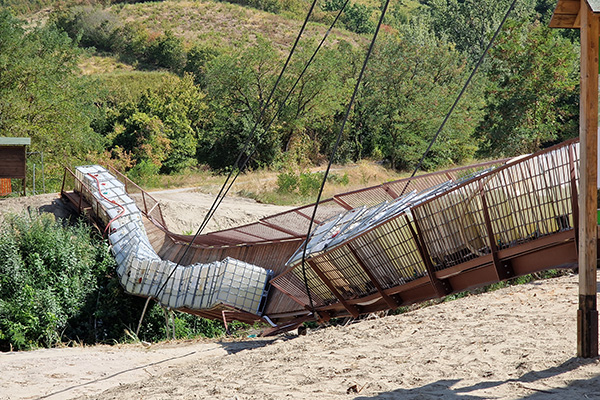
 The collapse occurred at around 350kg/m2
The story of the collapse started with the design of the architectural and structural proposal for the Borgo Rivola Bridge, a replacement footbridge that crosses the River Senio close to Riolo Terme, a town around 40km south-east of Bologna. The bridge was commissioned at the end of 2019 by the Riolo Terme Park Authority and the Consorzio di Bonifica della Romagna Occidentale of Faenza, who required a replacement for an old pedestrian bridge destroyed by a river flood in 2018. The assignment included both the architectural and detailed structural design.
The construction site is in the Vena del Gesso Regional Park - a UNESCO-recognised protected area – so we had to pay particular attention to the aesthetic aspect. I immediately focused on searching for a pylon shape – the most impactful part of the project – that would fit into the natural context of the river park. The idea I developed for the innovative 42m-long, 1.9m-wide single-span cable-stayed crossing featured a tree branch-shaped pylon consisting of a thicker main stem and a secondary, thinner branch extending away from it.
Cable-stayed bridges usually have a single anchor point at the top of the pylon but, in this case, the structural branch pylon bifurcates at the upper section. This detail was designed to allow the entire bridge to integrate within the river park surroundings and thus maintain the balance in the natural landscape. Consequently, the forward stay cables that link to the steel and timber deck extend from different points of the pylon’s branches and thus have different lengths. Similarly, the counter stays are anchored in non-symmetrical locations on the ground, balancing the whole structure from the back in an interweaving pattern.
Due to our inexperience in this type of structure we decided to set up the cable calculations by assigning a pretension to the stays, even though we opted not to pretension the cables during their installation due to the high cost of cable-pretensioning systems. The stress and strain results that we arrived at in the initial calculation model were thus already distorted with this modification. Cost was a constraint that overly conditioned the structural design, and it also directed us to adopt limited thicknesses and quantities of steel.
During fabrication of the structure and the building of the foundations, the location of a ground anchor was moved into a new position that was not suitable for the general balance of the structure. The new position resulted in the downstream stay having a greater angle than the inclination of the walkway, making the bridge less efficient. The latter implementation meant that the executive design no longer complied with the calculation model, but the drawings were not compared with the calculation model by the civil engineers who validated the project, nor by me.
The assembly proceeded and was carried out without any particular issues in around a week at the end of July 2023. At this point, I neglected to note that the stay cable connecting the two branches of the pylon at the top was not under tension, something that I attributed to an error in measurement. Instead, it was a symptom that should have been investigated rather than rushing to validate the structure. Testing operations proceeded at the beginning of September 2023.
The load test of up to 250kg/m2 revealed general deformations within the calculation model limits (about 120mm in total). However, there was a significant rotation of the deck on the side where the forward stay cable connected to the main stem of the pylon, which in the design wasn’t balanced by a counter-forestay. Nevertheless, the top of the main pylon showed no appreciable deformations so, disregarding the warning, we continued the test with the aim of increasing the load to 500kg/m2. Taking intermediate readings would perhaps have allowed us to stop the test.
With half of the deck loaded, we realised that the deformations were too high – beyond those foreseen by the analyses. At this point the load configuration was not considered in the calculation, but it is estimated at around 350kg/m2.
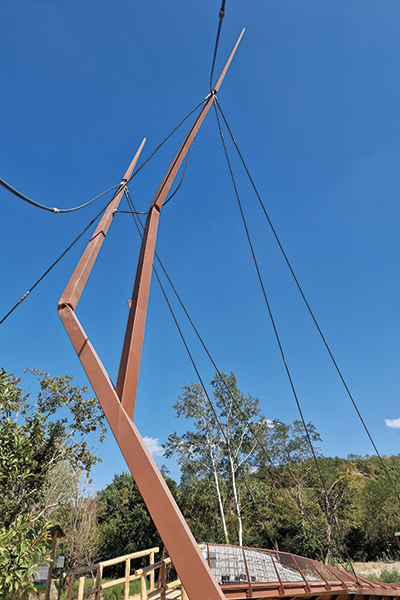
The collapsed pillar
The branch collapsed due to the local instability of the main stem of the pylon – which did not have a counter stay – bringing down the entire pillar. The bridge fell into the stream with nobody on board, fortunately, as the workers who had been loading the water tanks had left the deck shortly before.
After the collapse I immediately proposed to cover the costs of the reconstruction under the conditions that I remained as designer and that the replacement be built to the same design concept as soon as possible.
Before acceding, the Park Authority administrators had to seek an extension for the completion of the works from the regional authorities, which was granted to the end of July 2024. The first months of 2024 were spent finalising the relevant contract.
Starting on 2 May 2024, the subcontractors began work on the new bridge. The fact that I had personally selected them was – in my opinion – fundamental in ensuring the structure could be fabricated and assembled in just two months.
Even before the contract had been signed, steel contractor Metal Service (based in the city of Forlì) ordered steel sheets and tie rods from Germany. The firm immediately began setting up the deck and, more importantly, assembling the pylons on site via welding individual segments along the entire height.
Working with a smile to a tight timeframe while transforming all difficulties into simple things is a characteristic that few people can boast about. But it is one that was amply displayed by Alberto Marzocchi together with his partners of welders and assemblers. I won’t forget their availability outside of working hours on the hottest days of the year to make sure that everything was carried out in a workmanlike manner.
Praise also goes to contractor CMCF of Faenza, who quickly rebuilt the abutments that had been damaged by the first collapse and consolidated the foundation of the upstream anchor, which had undergone a slight subsidence. The last effort came from 4 Emme Service of Bolzano, who carried out the final load tests necessary to validate the work.
On 1 July 2024, on-site construction operations began with the installation of the base plate of the pylon and the building of the deck, which was delivered in four sections and then assembled on the ground. The launch of the bridge took place on 13 July, with the final anchoring of the stays to the pylon carried out on the same day.
For the new design, we naturally first inserted an additional stay cable. Anchoring the new stay to the ground meant that it would be too inclined with respect to the deck so the pylon was rotated by around 20°, towards the deck. The modification also meant that the stay cables connected to the deck had similar lengths, avoiding differentiated elongations under load. The previous stay linking the secondary branch and the main stem remained to provide greater safety.
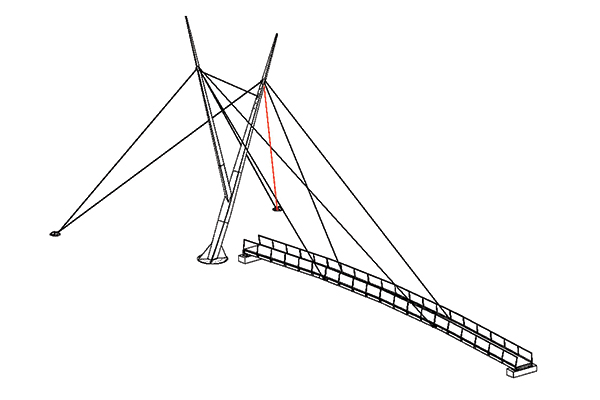
An extra stay cable (shown in red) was added to version two
The steel sections of the pylon were greatly strengthened in the new version of the bridge. They are all 20mm thick as opposed to the original 10mm, and vertical and horizontal internal stiffeners have been introduced comprising 10mm welded plates at 600mm intervals. The size of the sections of the two supporting branches have been increased by 50mm in total, and the base plate has been enlarged with more substantial ribs. All the deck profiles also increased in size.
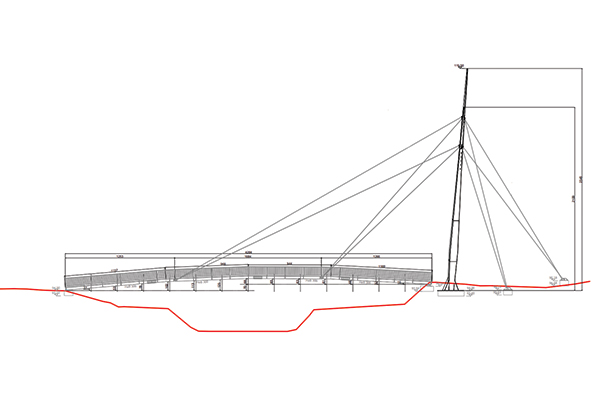
Improved design with greater thickness of steel members and more efficient cable lengths
The new assumptions led to a total steel weight of 36t, around 10t more than in the initial project. Between the pylon and the deck in total there are 860kg/m of steel distributed over the 42m of free span.
The checks showed a maximum deck deformation of 170mm under a load of 500kg/m2, plus a shift of the attachment points to the branches of about 50mm and a translation in the sliding support point of around 30mm. In terms of natural frequencies of vibration, the first vertical frequency has a value of about 2.4Hz, which corresponds to the limit between the medium and low vibration risk, as per French SETRA indications on pedestrian walkways.
The final load test took place on 16 July 2024, comprising the placement of a load of 400kg/m2 on the central area of the bridge between cable anchors (a length of around 16m), along the entire deck width. According to Italian standard NTC2018, the minimum load to be applied to the bridge had to be 370kg/m2, but this was not possible due to the slope of the deck, hence the test concentrated on the central part. With this load, we reached a higher stress state than the distributed load configuration, with a total deformation in mid-air of about 120mm and a residual deformation of around 30mm.
The following day, load test results were integrated with a micro-tremor analysis that was carried out using the Horizontal to Vertical Spectral Ratio technique. A series of sensors resting on the deck at appropriate distances measured the natural frequencies of both vertical and horizontal vibrations of the structure. The analysis showed a good correspondence with the frequencies determined during the numerical analysis, with minimal deviations from the values obtained. This test also showed a good correspondence between the calculation model and the real structure, thereby serving to validate the project.
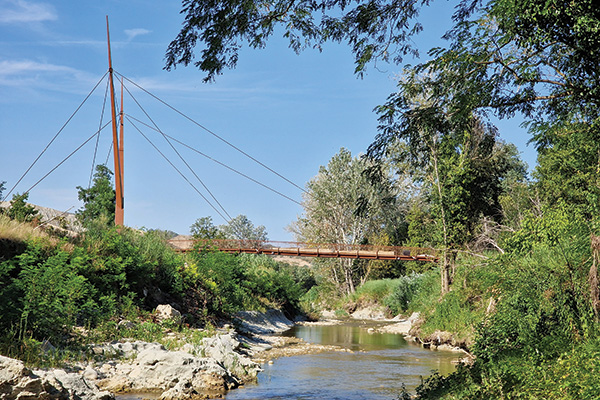
Micro-tremor analysis showed good correspondence between the structure and calculation model
Looking back, although I knew that this was a particular structure, I realise that I approached the design of the first version with too much confidence, forgetting all the pitfalls that can be hidden behind this type of steel structure – one not previously built by our practice.
Operating for 30 years in structural design, our office is experienced in steel structures made from standard rolled profiles but not so much with box sections, especially stressed ones like the mast pylon of the walkway. In the first project we neglected the phenomena of local instability and we approached it with too much superficiality for such an unconventional structure. And, finally, we conducted the testing operations too hastily, which led to underestimating several aspects – including the torsional deformations of the deck during the tests. I also allowed the stays to be installed without pre-tensioning, in contrast with the calculation model. Furthermore, last-minute changes were passed without due consideration, as I was too sure that nothing would happen, which demonstrated a lack of critical sense. This I realised on seeing the deformations that took place during the test.
There is a fine balance between optimism and recklessness and this limit was crossed with the first project. While not being afraid to take risks is not the same as being reckless, placing one’s head in the sand and hoping that everything will go well is not an option when human lives are at stake.
The resolution of such a controversial issue via an agreement between the public administration and the private sector is rare. The administrators should be congratulated for their foresight and flexibility in accepting my proposal and then for setting up a contract that would enable the reconstruction to proceed.
It would certainly have been better for the mistake not to have occurred in the first place, but I am consoled by the fact that no one was hurt.
I conclude by sharing a beautiful artistic image [below] that was part of the initial sketches made of the bridge concept, and finish with a famous aphorism that brings me comfort: “If you are not willing to make mistakes, you will never do anything original.”
Marco Peroni is founder and owner of Marco Peroni Ingegneria.
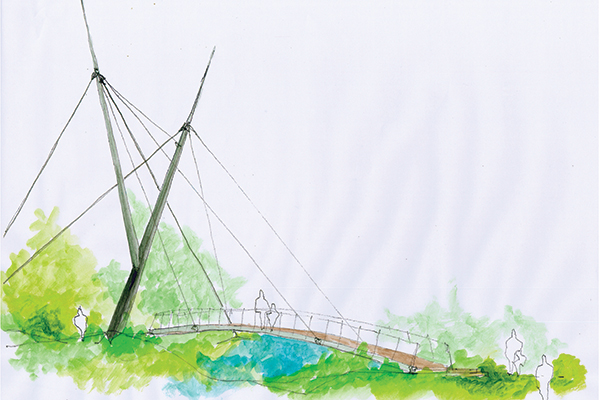
Artistic sketch of the initial design of Borgo Rivola Bridge