
An emergency intervention has safely stabilised a structure of national cultural importance and provided a temporary pedestrian crossing over the scaffolding system supporting the arches beneath.
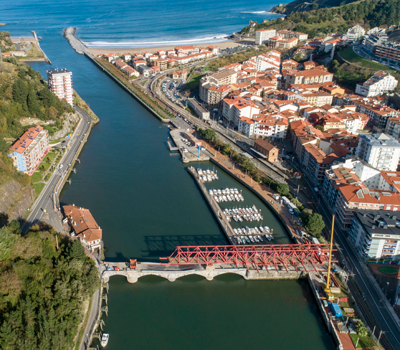
Opened in 1866, the 67m-long Deba Bridge is an historical crossing considered as the most representative example of its type and time in the region. It is located in the town of Deba, a seaside town around 40km west of San Sebastián in northern Spain. The crossing consists of four arches, three with a similar span of around 15m and one at 9m.
In September 2018, the Department of Culture of the Provincial Council of Guipúzcoa commissioned Freyssinet to undertake the emergency works on Deba Bridge, as outlined in a project carried out by a temporary joint venture composed by Fhecor Ingenieros Consultores and Injelan.
On 5 July 2018, sudden and significant subsidence occurred on the main pier of the bridge, which also twisted along its longitudinal axis. The pier subsided by 1m on the downstream side and 0.9m on the upstream. There were no warning signs detected by pedestrians on the days leading to the incident.
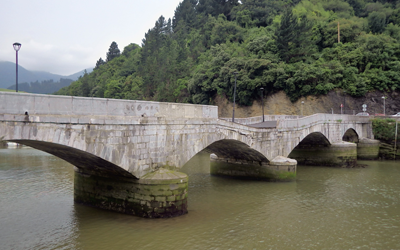
Miraculously, the structure did not collapse. However, the ensuing extensive damage included, among others, cracking above the central arches, the loss of some keystones/stone quoins, twisted sections, loss of a large section in the downstream parapet, and loss of deck alignment over the affected arches.
Deba Bridge was originally intended to connect traffic between the N-634 road and local road GI-638, which leads to the village of Mutriku 5km away, but from 2013 it had been used exclusively as a footbridge. It originally featured a steel lifting span on the Mutriku side, but this was replaced with a masonry-faced concrete arch in 1951, mainly as a result of reduced river traffic.
The four arches rest on 4.5m-high piers, two of which are 3.6m wide and one 5m wide; the larger pier supported the old lifting span and had been designed to balance the forces transmitted by the adjacent span to the old lifting span
The foundations on the river bed are 0.3m-diameter iron-tipped wooden piles. The upper section of the piles slot into the pier base, with further support provided by rockfill and wooden elements.
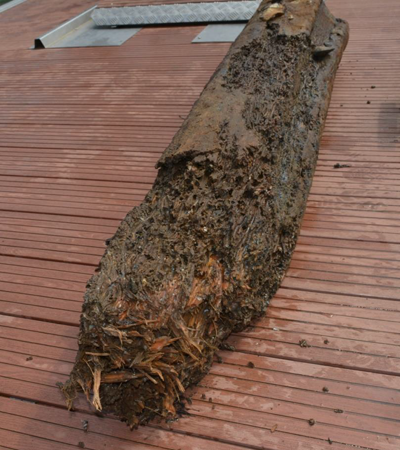
The initial underwater inspections identified the source of the damage that led to the incident. A 1.5m-long section of the upper part of a wooden pile under pier no 2 revealed that it had lost much of its resistance as a result of Teredo Navalis, or naval shipworm. This had resulted in some piles breaking, causing the sudden subsidence in the pier.
The proposed repair works were divided into two phases. The first, classed as the emergency intervention, aimed both to stabilise the arches that were at serious risk of collapse and to ensure the safety of the whole structure. This phase also included the second objective of re-establishing pedestrian access across the river, which was urgently needed by the local community.
Once structural integrity had been secured and a new footbridge installed, phase two would then begin, namely the return of the bridge to its original geometry, as required for a structure of such national cultural importance.
Works falling under the first phase were contracted to Freyssinet with two principal requirements; that they be carried out quickly and safely, given the risk of imminent collapse of the arches. Any operation that could put personnel at risk was forbidden, in particular the carrying out of works under the arches, including walking on the deck above them.
In the first instance, preparatory works involved rerouting pipes and cable tunnels for water, utilities and telecommunications via an exterior bypass, with a view to ensure that they did not affect or impair repair works; interestingly these were still in operation in spite of the subsidence.
It was decided to carry out a detailed ground analysis within the first phase, given the number of incidents that had befallen the crossing through its long history. These incidents had included scour of the two piers on the Deba side in 1883; subsidence of the same two piers in 1892; and subsidence remediation works at the beginning of the 21st century due to a subsidence of the first pier on the Deba side. Five ground surveys involving sampling were undertaken, two in P1 on the Deba side, at depths of 41m and 20m, two in P3 at around 24m, and one in the Mutriku abutment at 9m.
These found the sandstone bedrock at a significant depth, descending rapidly from the river bed on the Mutriku side to 23m deep three piers onwards, then to over 41m in the pier closest to the Deba side. The alluvial ground is formed by various depths of silt, sand and gravel.
The result of the survey at P1 also showed gaps in an area that had been reinforced with jet-grouting, which discounted the use of the pier for supporting the formwork.
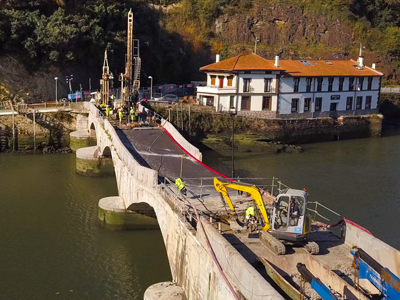
Micro-piles were therefore proposed and subsequently installed through the deck above P1 and P3. Rotary bored piling was used for the initial sections through the piers to avoid any vibration effects on the structure; thereafter traditional pile-driving was undertaken to a 190mm diameter for the placement of concrete-filled steel micro-piles. Nearly 1.1km of piles were placed; 15 at 36m below P1, and 18 at 30m below P3. The micro-piles were capped above the bridge deck to form the support structure for the movable scaffolding system.
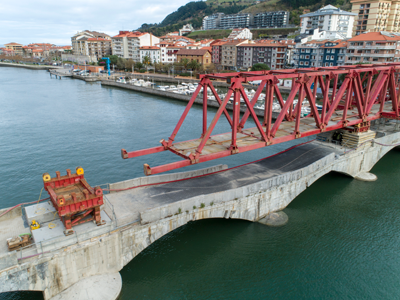
Once preparation works had been finalised, the critical phase of the project began in November 2018, which consisted of the assembly of the self-launching MSS on temporary supports and its subsequent launching onto P1 and P3. This assembly was a complex operation due to the dimensions of the MSS, which was around 102m long and 15m wide, and the narrow space available of only 40m between the river and the railway line. Space restrictions required a highly precise launch sequence involving assembly and disassembly of intermediate modules as well as partial launches.
The MSS was designed to fulfil a number of requirements. It had to be capable of supporting the load of spans 2 and 3, as well as the upper section of P2, in order that the latter could be repaired in safety. In addition, it also had to be able to carry the load of a temporary pedestrian bridge. In effect, it was designed so that its upper section could also be used as a temporary pedestrian footbridge.
Once installed in its final place, temporary work platforms were then suspended from the MSS and placed at a position level with the lower sections of the arches, on both sides of the bridge, and at a distance that enabled safe access.
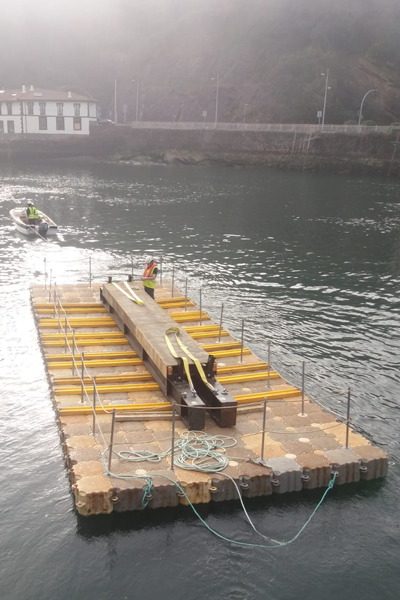
The shoring and formwork system for the two affected arches was also suspended from the MSS. It consisted of a combination of steel bars of type HEB-300 and HEB-450, steel beams and formwork panels. The steel bars were installed perpendicularly to the vault face to avoid a ‘swing’ effect that could result from the sudden subsidence of the bridge.
The shoring systems were pre-assembled nearby at Deba Port and then positioned beneath the bridge using towed barges, a process designed to avoid personnel going underneath the arches. Once in place, the beams were lifted using the integral winches carried on the MSS.
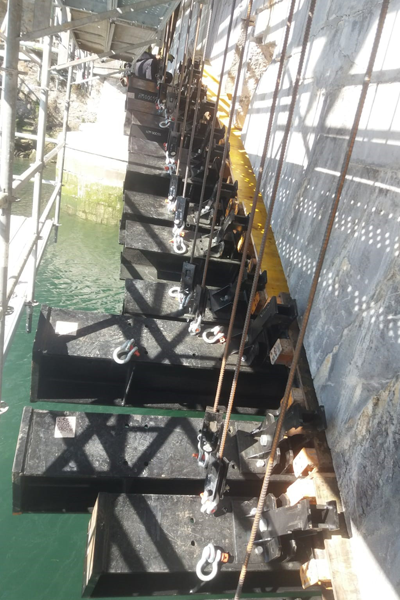
In March 2019 the bars of the shoring system were tensioned simultaneously on the longitudinal axis and in the pier axis, so the load was doubly symmetrical. The bars were stressed using hydraulic jacks at low tension, which equated to a force by bar of 6t at the second span, and 10t by bar at the first span.
With this main objective achieved, work then focused on the repurposing of the upper part of the MSS into a pedestrian crossing, as well as the placing of access stairs on either side of the bridge, in addition to illumination and signage. These works also included the provision of an anemometer with attached public warning signage, due to the strong wind conditions in the area.
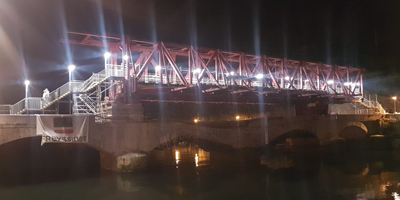
Phase One of the repair project was concluded at the end of March, seven months after it was first commissioned.
The second phase project works - bridge recovery - is currently being drafted by the same joint venture that carried out the first phase. Although no detailed information is yet available about the main works, the idea being considered is the total reconstruction of arches no 2 and 3 as well as the affected pier, using old and new keystones; these works would follow the strengthening of the affected pier’s foundations.
The authors would like to acknowledge Bridge over the River Deba: diagnostic report and proposal for an emergency intervention, written by Francisco Prieto Aguilera, Iñaki Jaime Azpiazu and Javier León González, which was invaluable in the writing of this article.
Txomin Echeveste is project manager, Pedro Sancho regional office director and Luis Cosano operations manager for repair and maintenance activities; all are at Freyssinet.