Additive manufacturing is already well established in several industries, from automotive and aerospace to the medical sector, where it has been used to create bespoke parts more quickly and cheaply than traditional fabrication processes. One of the main advantages that this type of fabrication offers over subtractive methods in construction is that material can be placed only where it is needed, reducing waste at a time when cutting emissions and embodied carbon is a major goal under numerous national and international agendas.
However, in the absence of optimisation, 3D-printed bridges and structural elements are likely only to pay lip service to the technology by failing to make the most of what is an inherently efficient way of building things. Part of the goal of Striatus – an arched unreinforced footbridge composed of 3D-printed blocks – was to push innovation and boundaries in the realm of 3D-printed concrete.
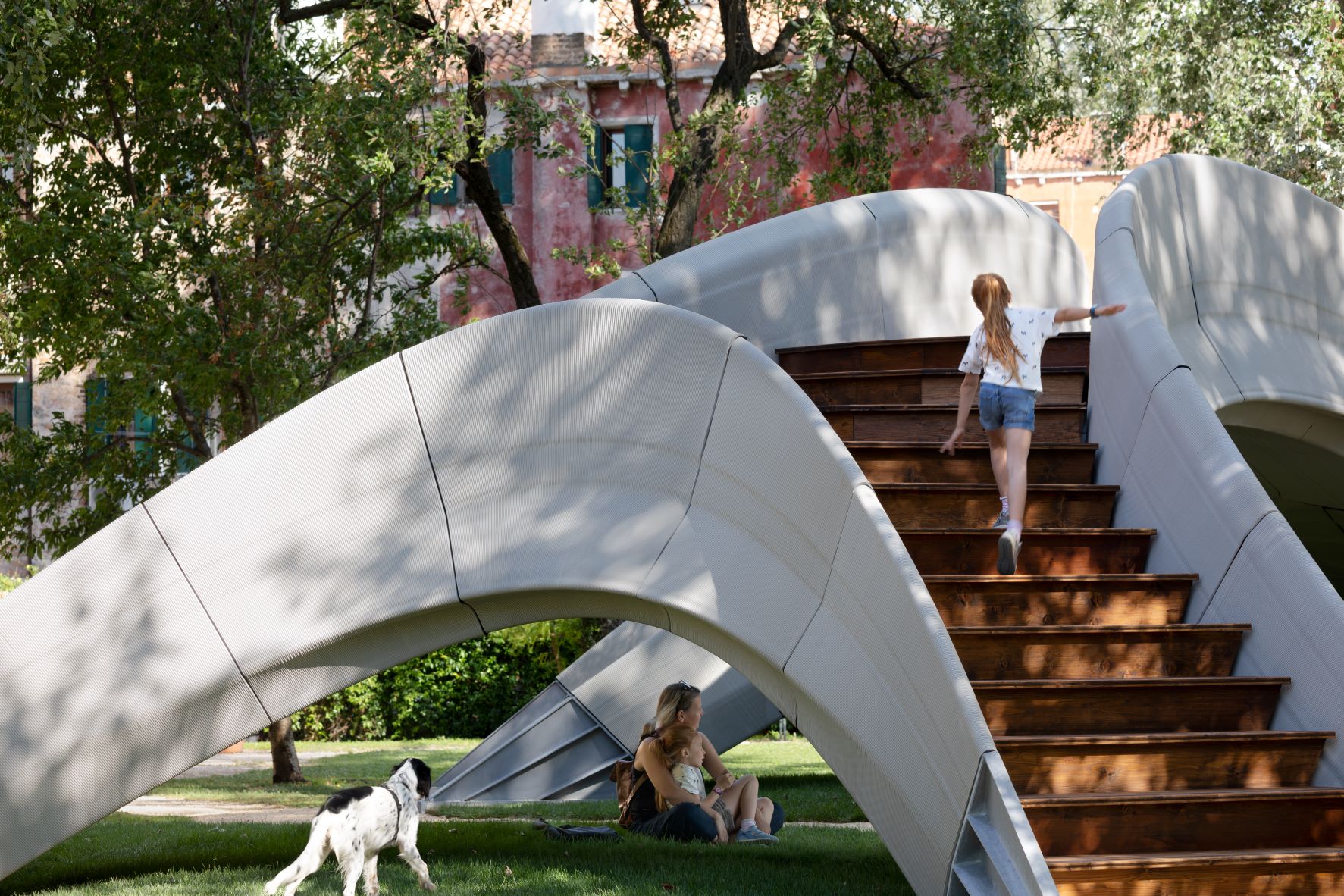 An arched unreinforced footbridge composed of 3D-printed concrete blocks (naaro)
“I wanted to set a provocation, because I think concrete 3D printing is not using this novel fabrication technique to its fullest potential,” says Philippe Block, co-director of Block Research Group (BRG) at the Swiss Federal Institute of Technology Zurich. “For me the starting point is, can we show a more appropriate language for 3D printed concrete and potentially for concrete altogether?”
The completed bridge has been on display since May at the Time Space Existence exhibition organised by the European Cultural Centre in parallel with the Venice Architecture Biennale 2021. Its realisation involved collaboration on many levels, but the core design work brought together BRG’s experience in assessing historic vaulted structures with unreinforced masonry and designing compression-only 3D structures with an ongoing PhD on 3D-printed concrete structures by Shajay Bhooshan, an associate director at Zaha Hadid Architects.
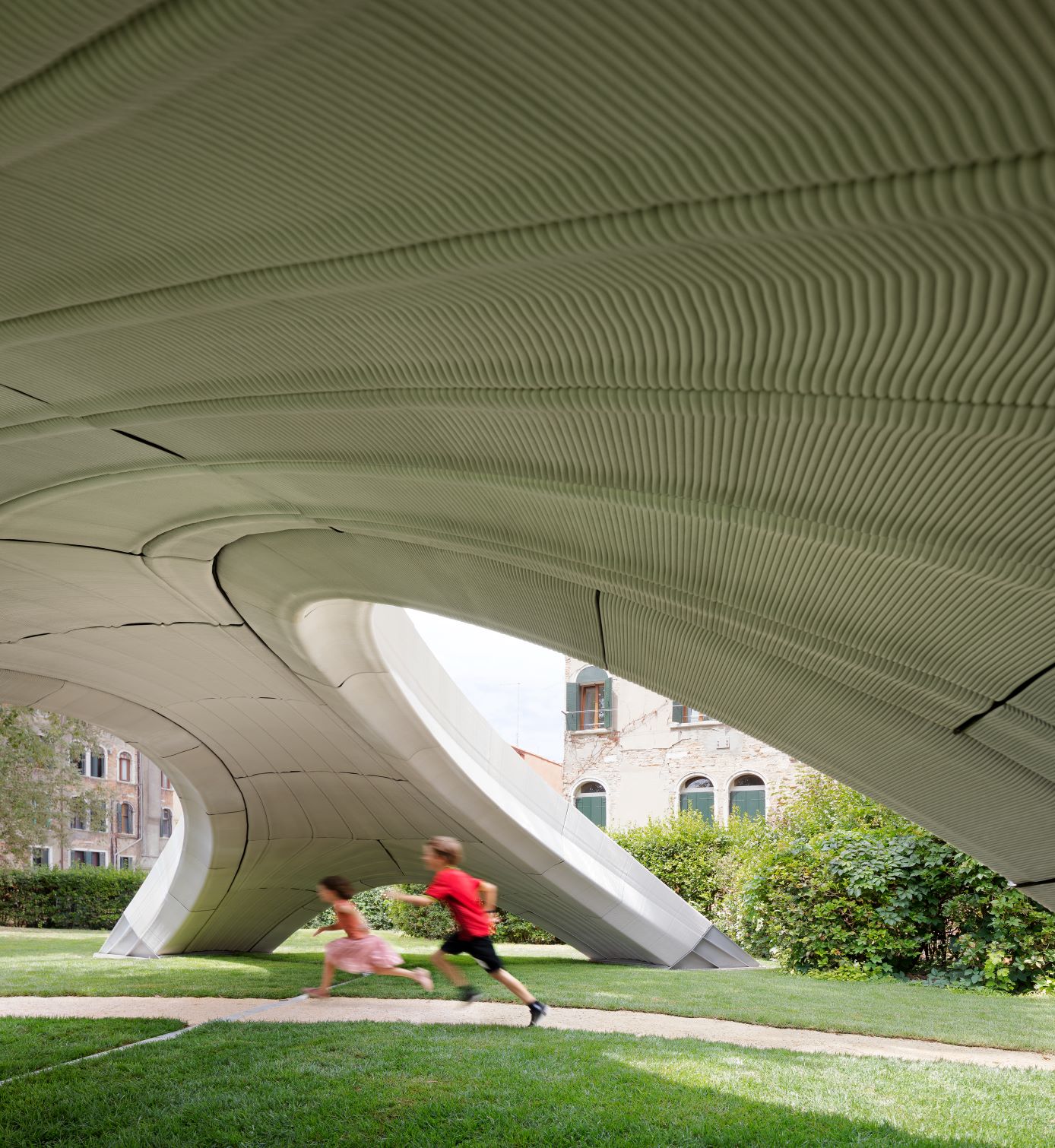 The 3D-printed masonry blocks weigh between 217kg and 783kg (naaro)
The goal of the two parties was strength through geometry, which was achieved by taking inspiration from the durable and robust voussoir arches of antiquity to transfer forces to the steel supports in pure compression. In profile, the bridge is a crescent shape, and its bifurcating deck geometry responds to the paths in its location in the Giardino della Marinaressa, creating five arches and five stairways to access the deck. Meanwhile, the use of masonry means that post-tensioning is not needed to avoid shear failure along the print layers. “Other people in concrete 3D printing seem to continuously be trying to fight shear with extreme post-tensioning, often casting concrete into the 3D-printed concrete, reducing it merely to formwork,” adds Block.
The blending of traditional masonry approaches with computational design and robotic manufacturing technologies is perhaps most tangible when the bridge is viewed up close, where the beautifully smooth concrete print lines of the masonry blocks become more apparent. The printed layers are orthogonal to the main structural forces to allow for a minimal volume structure comprising 53 masonry blocks without solid sections.
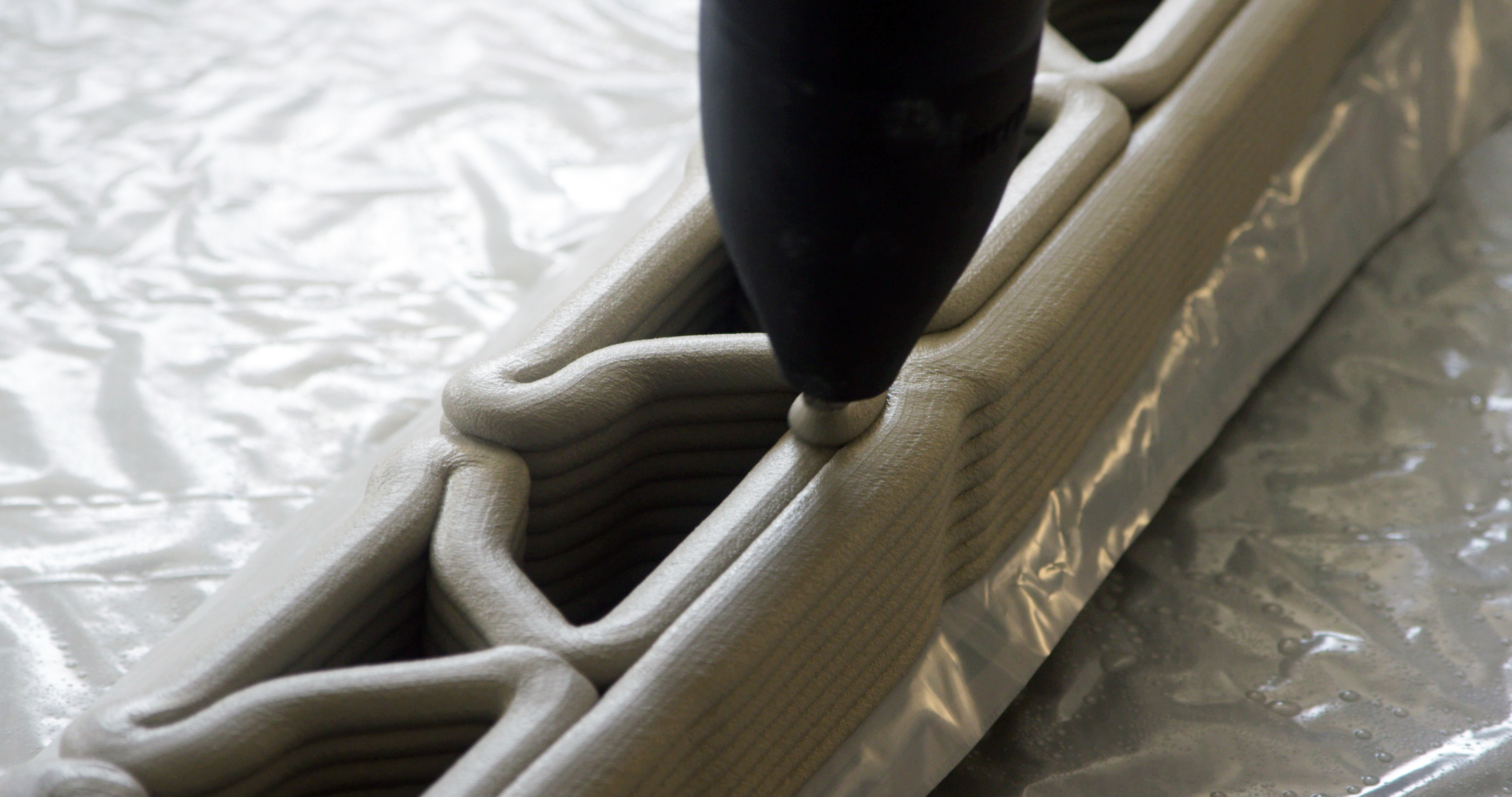 A two-component mix was used to print the blocks (naaro)
In terms of the developmental process, the team focused their efforts on making print paths that would always be aligned to the flow of forces, rather than creating a model of the bridge, splitting it up into sections and then finding what print paths were feasible. “We really started from the design of the print paths. We modelled these explicitly and the geometry followed implicitly,” he says. Having the print layers non-parallel and orthogonal to the dominant flow of forces keeps them together in compression, avoiding delamination.
Using a masonry logic not only allowed for a more materially efficient design, but also for the entire structure to be dry assembled, with neoprene pads placed between the blocks to reduce stress concentrations – another nod to historical structures where lead was used to similar effect. The structure took roughly three weeks to assemble using a spider crane to lift the 217-783kg blocks. “We took a bit more time to carefully assemble the bridge – we are not experts in assembling masonry type elements, so I see some optimisation potential there,” explains Block.
In terms of total 3D-printing time, this took just 84 hours, including the time required to prepare the one multi-degree-of-freedom robotic arm. Incremental3D were partners for the 3D printing technology, while Holcim was brought on board to supply its proprietary two-component concrete, Tector 3D Build. The latter differs from the one-component mix typically used in that it has a retarder in the mix, which keeps it liquid all the way to the nozzle, at which point an accelerator is mixed in, allowing the volume of the material to be controlled in a sophisticated manner to create inclined print paths with non-uniform thicknesses. This was important to be able to facilitate the non-uniform print layers necessary to create the multiple planes and varying thicknesses needed for the arches and bifurcations.
“In this 3D-printing process, at every centimetre, the head gets a spatial coordinate location, a pumping speed, and the amount of hardener required. You need to control how much volume there is,” says Block. For the deck and balustrade blocks, the 3D-printing widths are 25-50mm and 40mm, respectively. The layer heights are between 4.46mm and 11.98mm, with a path length per block of 602-1,754m, and total path length of 58km.
One of the big lessons learned is that the concrete ink was many times stronger than necessary for the project. “These two component mixes are based on high-strength materials that are 10-20 times greater than what we need; If you have vaulted geometries, the stresses are really low, so you don’t need the material strength at all. Now, our 3D-printing partners are testing the printing of a Holcim green concrete mix including recycled aggregate and cement replacement. That’s one of the aspects I was hoping to achieve with this bridge, if you get geometry right, the common inks are total overkill in terms of their applications in 3D printing. It’s exciting to see that this already triggered a response, offering an outlook for greener inks.”
As well as this, Striatus has demonstrated that 3D printing an unreinforced concrete bridge is not only possible within a short timeframe – with development and installation achieved in roughly five-and-a-half months – but that it can also be designed to be disassembled and the vast majority of components recycled.
Block credits the swift development process to the computational approach taken through an open-source Python-based framework that BRG had developed prior to the project, called COMPAS. “All the learning will be shared through COMPAS. It’s really important to us that we help to push the state of the art by releasing our methods.”
Knowledge sharing in this manner is highly beneficial to numerous communities within the world of bridge construction and beyond, especially when it involves a fabrication process that can still be considered in its infancy. It can also play a role in convincing clients that the technology is ready to be implemented.
Achieving an important milestone in this regard was the first additively manufactured metal bridge, which took up a permanent spot in the busy red light district of Amsterdam on 15 July. The structure has a length of 12m and a width of 2.5m and was built using Wire and Arc AM directed energy deposition with four six-axis robotic arms coupled with welding gear by Netherlands-based 3D-printing company MX3D.
“The conservative approach that many of our biggest clients have means we have to convince them that the technology is ready. Placing the bridge is an important milestone in that regard: everybody can instinctively understand, whether you have an engineering background or not, that if a bridge is placed in the busiest area of the Netherlands, it has to be safe,” says Kasper Siderius, project manager at MX3D. “Empirical tests have proven this, now the next step is ensuring repeatability so that not every part that comes off the printer needs to be tested separately. The mindset change will happen once projects like the bridge are no longer so unusual.”
Helping secure the relevant permits for the bridge’s installation from the City of Amsterdam was work by researchers from Alan Turing Institute’s data-centric engineering programme, who conducted a series of experiments to analyse the material properties of the as manufactured 3D-printed steel. These included load tests, which demonstrated that the bridge has a 19.5t load-carrying capacity.
The structure has also been equipped with a network of fully integrated sensors measuring strain, rotation, load, temperature, displacement and vibration. Now that the bridge has been in situ for a number of months, the digital twin is being calibrated with the live data collected from the sensors, providing a specifically calibrated model of the real world situation. Indeed, as with other digital twins, advantages abound in terms of providing data on how the structure is performing, including user behaviour and traffic patterns.
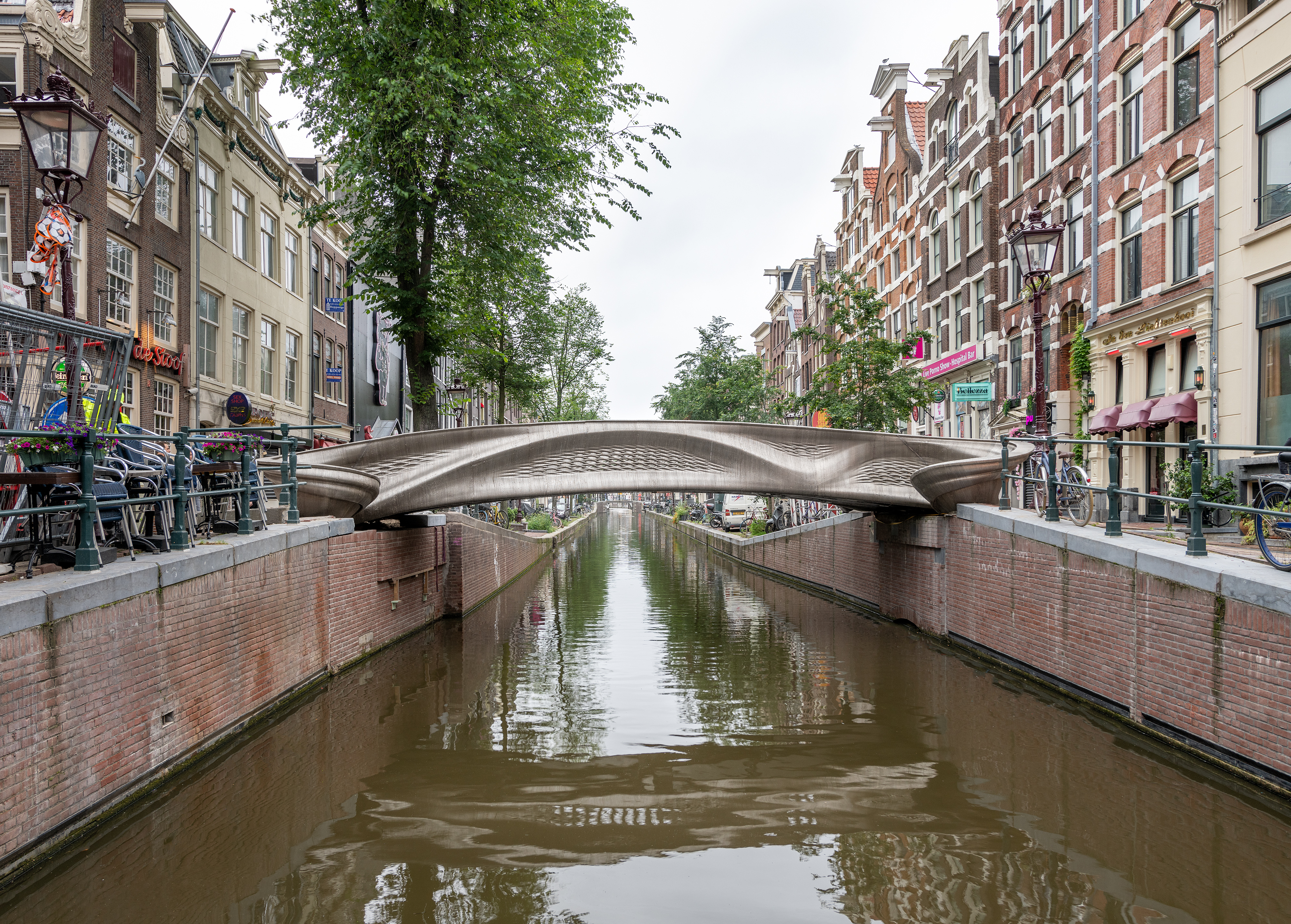 The long-awaited MX3D 3D-printed steel bridge was opened on 15 July
However, with this being a world-first 3D-printed steel bridge, there is also the potential for the digital twin to reduce uncertainty of the material’s long-term behaviour for future projects. This could lead to greater confidence among clients, as well as better optimised 3D-printed steel structures in the future. With all structures coming with a level of safety factor, and much of that due to uncertainty and factoring in the unknowns, better visibility of the behaviour of this novel bridge could open up the design envelope, and more extreme designs, which are possible with additive manufacturing, could be more readily certified.
Both the concrete and steel structures completed this year have pushed the envelope of what can be achieved with the technology in the bridge sector, but it is evident from both that high-level computational skills are needed to integrate the 3D design and fabrication processes with existing workflows. Furthermore, while additive manufacturing opens up significant design freedom, the anisotropic mechanical properties of 3D-printed parts means build orientation and printing strategy need careful consideration during the design phase to fully leverage the technology and avoid sub-optimal forms.
Given the fast-pace of progress within this space, it will be interesting to see what projects follow. “We printed and assembled the bridge in 2018, and with the speed at which this technology evolves, that is a long time ago,” says Siderius. “When we look at the quality of our prints today and compare it to the end result of the bridge, it feels like looking at the state of the technology from four years ago, isolated in this one object.”