
The French island of La Réunion, situated in the Indian Ocean, is noted for its many steep gorges; in fact it used to be thought that the island's jagged nature made the construction of a modern road network impossible. However, in 2002, a decision was made to substantially improve the island's coastal road network in an attempt to attract more tourism.
The ambitious construction project to build La route des Tamarins involves the construction of a 33.7km long highway through the island's fissured and mountainous regions. On this route it has to cross more than 120 canyons.
The difficult geological conditions mean that the route includes three tunnels and a total of 23 bridges; it is also exceedingly challenging because of climate conditions and the need for environmental protection.
The project's total cost is estimated to be more than €970 million and construction work is scheduled to be finished at the beginning of 2009. Dywidag-Systems International contributed to one of three sub-projects classified as exceptionally artful structures: the bridge crossing the broad Trois Bassins gorge. Construction work is being carried out by a contracting consortium consisting of Eiffage, Groupe Razel and Matière.
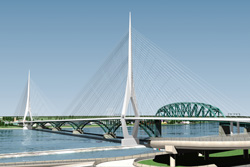
Trois Bassins is an extradosed bridge - the word coming from the French 'extradossée', which literally translates as 'out of the back of' - and is characterised by the fact that the tendons of an hyperstatic structure are lifted out from the bridge deck and deviated over an intermediate compression member, thus increasing the lever arm. The vertical reaction is directly transferred into the bridge pier below. Like stay cables, extradosed tendons must be designed to withstand long-term atmospheric influences including sunlight.
The bridge has a total length of 375m and a width of 22m; it requires a total of 14,000m3 of concrete, 1,800t of steel and 400t of prestressing steel.
DSI supplied 352 Dywidag post-tensioning anchorages, types MA 6812 and MA 6819 for tendons with 12 and 19 strands as well as 36 VC 6819 anchorages for external post-tensioning. In addition, the company supplied 34 Dyna Grip DG-P37 anchorages, tendon sheathing and approximately 105t of galvanised, waxed and PE-sheathed strands.
A special feature of these stay cables is the fire protection that was applied over their entire length. According to specifications, the strands are designed to not exceed a maximum temperature of 100oC during an hour-long fire of 1,100oC in temperature. This is achieved by enveloping the installed strand bundle into a double-layered fire protection mat.
The requirement for fire protection stems from the fact that this is only the second extradosed bridge to be built under French jurisdiction; the first one was built 15 years ago and only had a very short tower and four short cables. Initially the client demanded an industry specification offered by another proprietary cable manufacturer: that the cable should not reach a higher temperature than 100oC in a fire of 1000oC over the period of one hour, but Eiffage decided to use a normalised fire standard to design the protection system. This resulted in a cable that can resist a hydrocarbon fire of 1,100oC with a two or three-layer protection. The protection system for the cable consists of an interior layer of fire-resistant mat, held into place by some means, and covered by a second, exterior layer of fire resistant mat which overlaps on itself along the length of the cable. This overlap is covered by a layer of fire-resistant adhesive.
Subsequently, PE half shells are assembled on top of the double-layered mats. Due to the small inclination of the stay cables and the small diameter of the pylons, DSI saddles, which were also included in the delivery, were installed in the pylon instead of individual anchorages. The strands were stressed simultaneously on both deck anchorages using the patented Conten stressing method.
One of DSI's experienced installation engineers was at hand during installation. The installation of the Dyna Grip stay cables with fire protection was successfully completed in spring 2008. In total DSI supplied 34 Dyna Grip DG-P37 anchorages; 352 Dywidag post-tensioning anchorages of types MA6812 and MA6819 and 36 anchorages of type VC6819 for external post-tensioning.
Contracting authority; Région Réunion-Direction d'Opération Route des Tamarins
Consultant; Arcadis, Cotéba
Architect; Strates/Berlottier Architectes
General contractor; Eiffage, Matière, Groupe Razel