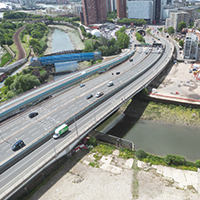
If all goes to plan, by the end of 2026 the city of Seville will have a 35-year-old cable-stayed crossing with a fully renewed operational life, a new lane of traffic and the possibility of adding four more lanes at a later date. Puente del Centenario (Centenary Bridge) was completed in 1991 as part of the city’s preparations for the 1992 Universal Exposition and it remains a vital piece of infrastructure for the historical city. Part of the SE-30 city ring road, the 565m-long bridge carries around 100,000 vehicles per day over the Alfonso XIII canal that connects to the Guadalquiver River on its journey to the Gulf of Cadiz.
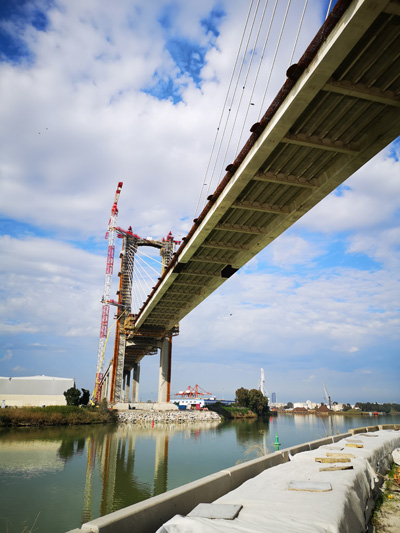
The Puente del Centenario was originally designed by engineers José Antonio Fernández Ordóñez and Julio Martínez Calzón
In 2021 Spain’s Ministry of Public Works & Transport awarded the construction contract to the Acciona-Freyssinet-Tecade cooperative joint venture, with technical oversight by Fhecor, Ideam and VS. Design work had previously been carried out in 2018 by Fhecor, first singly, and then jointly with Ideam. Works began on site in 2021 and are currently ongoing.
The cable-stayed section of the bridge features a 265m central main span flanked by 102m spans and 48m outside spans. The deck consists of twin side box girders 2.5m deep as well as transverse girders, spaced at 12m intervals, which align with passive stay anchorage points. The transverse girders support five prefabricated 0.82m-deep double-T beams and a 0.2m-thick slab. The deck is suspended by a total of 88 cable stays in a harp configuration, 22 pairs at each pier. The 104m-high cable towers are portal frames with a crossbeam beneath the deck.
Fhecor’s involvement initially arose from an existing contract for the inspection and maintenance of structures in the area. At that time, the firm had just completed a cable replacement project on the Fernando Reig Bridge in Alcoy, Alicante. Slightly shorter with a 240m length, this bridge had opened to the public just four years before the Centenario Bridge and shared many of the same structural characteristics, including the prefabricated deck. “And there one of the stays had actually snapped,” remembers Fhecor CEO José Romo Martín: “After removing and analysing the stay cables, we found that the damage we had detected in the broken one was also present in others, albeit to a lesser degree. That is, they weren’t going to fail the next day, but they would have failed in a few years.” Understandably, there were concerns that the same situation was developing on Centenario Bridge. For that reason, in 2018 the Spanish Ministry of Transportation commissioned Fhecor to carry out a special inspection, which concluded that it was not possible to make assurances that the stays were in a better condition than those at Alcoy. At only 30 years of age, the Centenario Bridge displayed the symptoms of being yet another victim of the former common practice of injecting grout into the stay cables’ prestressed tendons, of which each stay cable contains between 32 and 78.
An initial intention to carry out a similar replacement as executed in Alcoy very quickly developed into two alternatives. The first was a straightforward individual stay-cable swap using a temporary cable system: the second consisted of installing a completely new cable system that would be positioned on the outer edges of the deck.
The second option was ultimately selected because the replacement of the existing cable system could potentially lead to additional space for traffic on the already busy crossing, and it would also be less disruptive and safer to install: The de-tensioning could be carried out once the new system was in place, and the operation would only require the temporary closure of one lane of traffic at a time. “In Alcoy, traffic could be rerouted because there were alternative routes in the city to cross the ravine. However, the Centenario Bridge is the most trafficked bridge in Spain,” says Javier Torrico Liz, Fhecor’s engineering lead at the bridge department: “It was also decided to create preliminary designs that would have the possibility to accommodate additional four lanes of traffic within a future bridge widening operation,” he adds.
Combining a new cable system replacement with the lateral expansion of the pylon is highly innovative in the context of bridge interventions
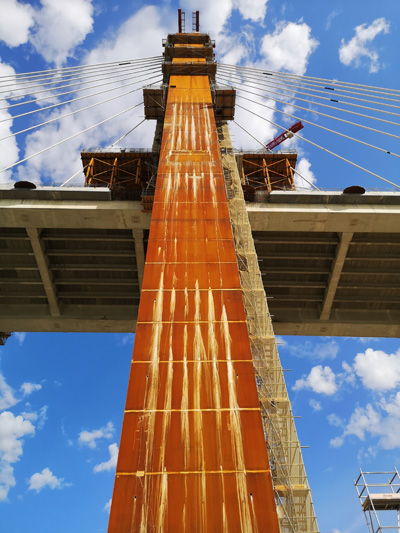
Under the plans, the bridge will see its cable towers laterally extended to fit the new cable system on the same vertical plane. The existing towers are reinforced concrete with a weathering steel plate on the outer face that provides some resistance but is mainly for aesthetic reasons, explains Romo: “And we’re taking advantage of this steel plate to anchor the new components. The idea is to preserve the bridge’s iconic appearance. We’re making the minimal necessary modifications to the pylons to accommodate the new family of stays.” And while the lateral extension was originally envisaged to be entirely in steel, this has been modified to a steel-concrete section at the lower part, which then transitions to steel from the height of the crossbeam upwards. “This was a suggestion by the contractor, to save on materials, and as it has no structural or aesthetic impact we agreed,” says Romo.
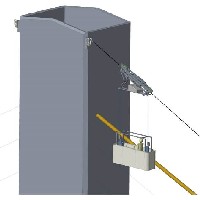
Under the deck, a steel structure comprising 1.5m-deep transverse beams and multidirectional spherical bearings is planned to be installed. This will accommodate the cable anchors and transfer the vertical load from the existing twin box beams to the new cable planes.
The existing deck presented some complexity for the design of the new support system, says Torrico: “Like the Alcoy Bridge, it has a fully prefabricated deck, which is quite exceptional. The prefabricated segments are ‘dry joined’, as we say in Spanish, so concrete pressed against concrete. The compression is provided by the stays, which ensure the structure remains monolithic.” But in some areas – particularly towards the centre of the spans – some internal prestressing was added to maintain compression between segments. “While we’re replacing the stays, we must ensure that the new stays provide the same level of compression to the prefabricated segments.” As such, the required compression force will be ensured through a steel lattice structure comprising external diagonal planes and internal transverse uprights. “These will inject the necessary compression into the deck, just as the original stays did,” says Torrico.
An interesting feature is that the new stay system is slightly stronger than the original, making the system stiffer. “Despite adding more load, the moments – bending forces – experienced by the existing deck will actually decrease in the future, a somewhat paradoxical outcome,” says Romo, adding that minimising the weight was a design priority that led to the use of high-strength weathering steel, grade 460W – the highest available.
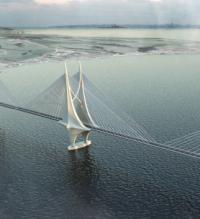
The idea of expanding the cable towers laterally to fully replace the stay cables was not wholly new for Fhecor. The firm had explored such a solution for Rande Bridge in Galicia on behalf of the regional government, who proposed it to the owner, the Ministry of Transport. It was not pursued, however, remembers Romo: “In Rande Bridge the existing stays were maintained, supporting the original bridge, while the widened deck is supported by new stays. Consequently, you’re keeping stays that are 50 years old, which is why we preferred the other approach. What we’re doing in Seville follows our original idea and to our knowledge there is no precedent in terms of replacing all the cables with a new system combined with the lateral expansion.”

The edge girders have been removed to make room for the replacement cable-stayed system
On site in Seville, preparations for the new cable system are fairly advanced. The foundations and pile caps of the cable towers have been expanded and the composite concrete-steel lateral expansions completed, with only the upper steel sections remaining to be installed. On the deck, the edge girders have been removed to make room for the new components. “By February or March, we’ll likely start installing the ribs,” says Romo. Crucially, the works are having a minimal impact on traffic flow: “We’re operating on the periphery and underneath the structure. A major advantage of the lateral extension is that the new stays are outside the vertical alignment of the existing bridge so all the work is being done externally,” he adds.
The operation that will eventually be carried out to transfer the loads from the existing stay cables to the new system has yet to be devised. There are two possibilities, depending on the state of the anchors. “If the existing cables protrude beyond the anchor terminals, then we can attach to them and pull the load across,” says Romo, adding “In Alcoy, we had to cut the cables and create a special transfer piece. Here, many cables are still concealed behind an architectural feature designed by José Antonio Fernández Ordóñez. It resembles a sculptural staircase, inspired by Brancusi. For those concealed anchors, we may need a load transfer device similar to what we used in Alcoy. I think this will be the most challenging phase.”
The project has attracted significant interest, say Romo and Torrico, with many firms visiting to evaluate whether the methodology could be applied elsewhere. It is not surprising, considering that the challenges being faced are no doubt applicable elsewhere. “The project has three critical aspects. First is the functional goal: expanding the bridge to meet traffic demands. Second is the structural challenge: replacing the stays with a new system while maintaining traffic flow. Third is the aesthetic consideration: preserving the iconic image of the bridge, which was designed by renowned engineers,” says Romo.
As regards the structural aspect, Romo highlights that the intervention essentially resets the bridge’s service life – so it should last another 100 years. “And while replacing the stay cables is something that is done on many bridges, simultaneously expanding the bridge to enhance its functionality isn’t – and this is what makes this project unique,” says Romo.
The replacement project is expected to complete in the second quarter of 2026.
Client: Spanish Ministry of Transportation
Contractor: Joint venture formed by Acciona, Freyssinet and Tecade
Client’s engineer: Joint venture formed by Fhecor, Ideam and VS