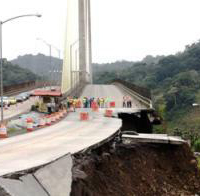
Opening of the new Basarab overpass in the Romanian capital of Bucharest is intended to improve the traffic flow around the area of the Gara de Nord railway station. Congestion was previously a major problem in this area due to restrictions created by the presence of the railway and the Dambovita river.
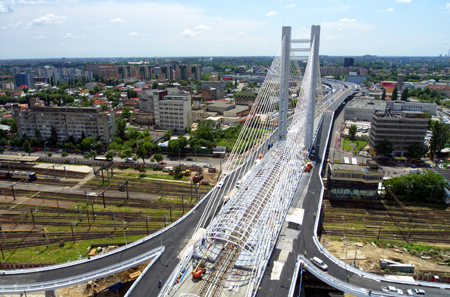
The construction of a new bridge was not considered as the sole solution to the traffic problems; other options included construction of a new railway station close to the existing one, to provide space for a new road by taking land from the existing railway.
However the overpass solution was eventually selected as the most appropriate option. The new link consists of several structures; from the southern bank, an access approach of 160m raises the road level up to cross the River Dambovita on a steel arch bridge which is 122m long. The arch carries the road on to a 790m-long viaduct to the point at which the railway passes in front of the Gara de Nord station.
At this point, the road is carried over the railway on a 360m-long cable-stayed bridge which has a width of 42.5m. The towers of this bridge rise to a height of 80m and are visible from many parts of the city. In total, the Basarab overpass is about 1.5km long and is completely designed and built to seismic isolation criteria. The structure was built by joint venture contractor Astaldi-FCC, with work starting in 2006 and the bridge opening to traffic in June 2011. Design of the three different parts of the bridge was carried out by three different teams.
The arch bridge and southern approach structure was designed by Fhecor Ingenieros Consultores from Spain; the connecting viaduct by Italian consultant C&T Engineering and the cable-stayed bridge by Carlos Fernandez Casado, also from Spain.
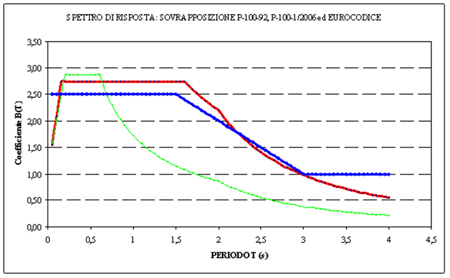
The comparison between the Bucharest response spectrum according to P100-92 (blue), to P100-1/2006 (red) and Eurocode 8 (green).
Seismic action on the structure is defined by the Bucharest response spectrum, a very particular spectrum which is characterised by a wide constant spectral acceleration branch with the maximum acceleration up to a period greater than 1.5 seconds. This leads to high accelerations that can only be reduced by applying seismic isolation techniques, which alter the natural frequency of the structure to 3 seconds and dissipate a lot of energy.
The isolation device is an apparatus that allows application of vertical and horizontal loads, movements and rotations during service conditions, under which conditions the isolators behave in the same way as structural bearings. During an earthquake, the device allows movement of the structure to be disconnected from ground motions, accommodating very high movements and leading to a reduction of the applied seismic forces.
This outcome is made possible due to the alteration in vibration period that is obtained, which forces the structure to move according to its ‘isolated’ frequency rather than its natural frequency. In order to limit the value of such movements, some dissipation systems are used. These can be integrated into the isolator or used on their own, to increase the overall dissipation of the structure. If a dissipation device is installed on its own, it will not be capable of accommodating the vertical load, hence it should be installed in parallel with traditional bearings or other isolators.
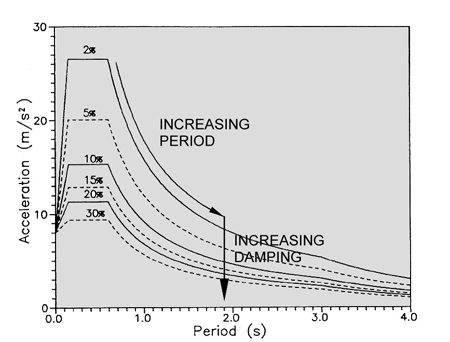
Methods for reduction of the seismic action
For the Basarab overpass, specialist manufacturer Alga designed, manufactured and tested a number of structural bearings, isolators and dissipation devices. From its product range Algalink, a number of different structural bearings were designed and manufactured. These include Algapot bearings which have a confined rubber disc of up to 65,000kN capacity and ±275mm of movement; Algaspheron spherical bearings with a capacity of up to 11,400kN and ±275mm of movement, and Algabloc laminated rubber bearings with capacities of up to 2,400kN and movement of ±100mm.
Some of the bearings were also able to withstand uplift forces of up to 620kN under service conditions. Algasism LRB seismic isolation devices incorporating lead rubber bearings were also supplied. These consist of lead rubber bearings with one or more lead cores – which have up to 11,000kN capacity and ±260mm of movement - integrated into the isolators. The yielding of the lead offers good energy dissipation and the elastic stiffness of the rubber provides a re-centring capability.
The LRB isolators which were installed on the viaduct were also capable of allowing the irreversible movements to take place without imposing any restoring force, due to a temporary sliding system installed on them. Another type of seismic isolation device that was supplied by Alga was from its Algasism FD range. Many different types of viscous dampers were installed on the viaduct – these devices dissipate energy by means of the viscosity of the fluid contained within them.
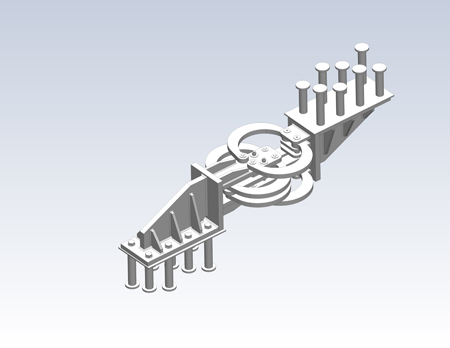
Hysteretic damper installed on the abutments of the two ramps of the stay cable bridge.
They are characterised by a non-linear-velocity-dependent law based on the variables of reaction force and applied velocity combined with two constants – α and C - that characterise the behaviour of a device. The lower the value of the ‘α’ coefficient, the higher the level of energy dissipated by the device; if the value of a is increased, the rigidity of the response will also increase. Of course by calibrating the C constant, it is possible to obtain different behaviours without changing the maximum reaction force. Alga supplied a large range of different types of viscous dampers for the Basarab viaducts, each with different reaction forces and different maximum movements. Above all, these devices all had different ‘α’ coefficients varying from 0.02 (700kN each on the viaduct) to 0.2 (2,500kN each on the towers and 3,750kN each on the abutment of the southern approach structure).
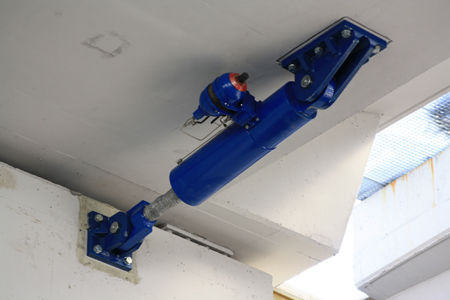
Viscous damper installed on the PS3-PS4 viaduct
All devices were tested according to the European Standard EN 15129 at the Alga laboratory and at the Eucentre laboratory. Moreover the viscous dampers of 2,500kN capacity, installed on the towers of the cable-stayed bridge, were provided with a fuse restraint that enable them to rigidly carry the full horizontal load predicted under service conditions, with the fuse designed to break under seismic loading in order to dissipate energy. The third type of seismic isolation device that was supplied was from the Algasism EP range. These were installed on the viaduct, and consist of hysteretic dampers, each with a capacity of 1,750kN and ±100mm movement in both directions.
These dampers are able to dissipate energy thanks to the yielding of the specific type of steel of which they are composed. This material is able to withstand many cycles of loading up to that which takes the steel over its yield point