
The dramatic towers of a new cable-stayed bridge in Brittany are taking shape.
The transport link across the Aulne River in Brittany, north west France, has had a chequered history. But now, with construction of a new bridge at the site, the location is finally getting a fitting structure.
A curved cable-stayed bridge designed by the late architect Charles Lavigne and engineer Michel Virlogeux is being built at the site near Terenez, which links to the Crozon peninsula between Quimper and Brest in Brittany.
Years ago, people were ferried across the Aulne River by boat, but following the turn of the last century, as traffic grew and to avoid disruption to shipping, the decision was taken to build the Terenez Bridge. The river is at its narrowest between Argol and Rosnoën, which is where the bridge was built and it opened in 1925. It provided a direct link between the Crozon Peninsula and Le Faou, saving some 26km for drivers, who had previously had to go via Châteaulin.
But the bridge was blown up by the Germans in 1944 and it had to be rebuilt in 1952 using the original piers.
The second bridge, however, suffered damage as a result of alkali-silica reaction in the concrete, which caused numerous cracks in the structure. Repair works started in 1992 and since 1998, the structure has been very closely monitored. But this policy is very expensive - an estimated €1.4 million has been spent on maintaining the road bridge and strengthening it to keep it open to traffic since 1992.
In 1995, the Finistère General Council decided it had become too expensive to continue to maintain it, and decided to replace the bridge with a new crossing. The design studies for the replacement were launched and a coordination committee was set up by the General Council to ensure that all stakeholders were involved in the consultation procedure.
In 1998, the committee selected the concept design for reconstruction of the Terenez Bridge close to the existing bridge - it was to be a curved cable-stayed bridge which would enable dangerous bends in the existing road to be eliminated, and was designed to complement the rural setting.
Improvements in the Camaret sur Mer - Le Faou section of the highway were also proposed, without modifying its route. The design also conserves and fosters the Aulne Valley's protected natural areas and species as well as the outstanding forested area adjacent to the site.
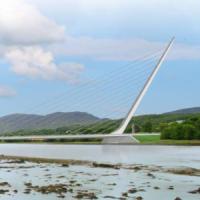
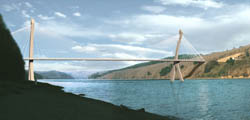
The cable-stayed bridge, which is 515m long and has distinctive lambda-shaped towers supporting the deck, is curved in plan, which means that the 90° hairpin bends which form part of the existing approach roads will be able to be eliminated from the new crossing, improving road safety for travellers. The central span is 285m long and each side has two back spans of 81.25m and 33.7m length.
The concrete bridge will have steel cable-stays supporting the deck, and the 6.5m-wide two-lane carriageway will be flanked on both sides by a 2.4m-wide path intended for pedestrians, cyclists and horseriders.
The towers are offset from the deck in order to support its curved shape, and they are inclined forwards, as if bent by the wind that blows across the magnificent site. They rise to a height of 90m, some 30m higher than the towers of the existing suspension bridge, and will provide a new landmark for the valley. The steel and concrete deck is supported by 72 pairs of cable stays.
Major landscaping works were needed on both river banks at the approaches to the new crossing, including retaining walls, terraces, underground pedestrian access passages, and car parks. The superstructure of the old bridge will be demolished but a single abutment will be retained which will be converted into a viewpoint.
The Crozon peninsula is known for the beauty of its landscapes, its tourist sites and resorts, its outstanding historic heritage and its nature reserves and bird sanctuaries. These attract large numbers of visitors during the holiday season, boosting the local economy. The Crozon peninsula is in the district of Châteaulin, which links northern and southern Finistère, and is served by two main highways: the RD791 between Le Faou and Crozon and the RD 887 between Crozon and Châteaulin.
The RD791 is the key link between the peninsula and the Pays de Brest. As well as the tourist traffic, the road is important for local residents, many of whom work in the Brest area, and for national security, since many military sites, such as the Ile Longue nuclear submarine base and the Lanvéoc-Poulmic naval airbase, are on the peninsula.
Improvement work will be carried out on the RD791 including construction of a 500m-long overtaking section between the bridge and the Plateau d'Argol, to make it easier to pass slow vehicles on the uphill section.
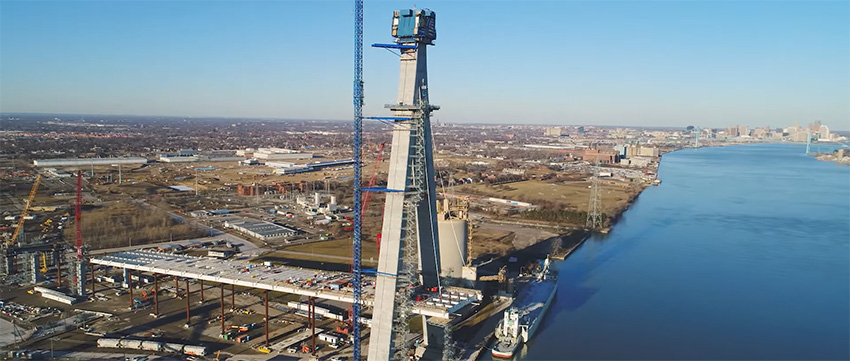
Construction work on the new bridge began in April 2007, with the towers being built one after another so that the formwork could be reused. Work on the left bank tower has passed the deck level, and is progressing through the upper section. The steel anchorages for the cables, which will be built into the top of the towers, are being fabricated in Belgium. The new bridge is due to be finished in 2010.
Project manager: Finistère General Council
Project architect: Charles Lavigne/Thomas Lavigne/Christophe Cheron
Consulting engineer: Michel Virlogeux
Project manager: Setra
Contractor: Vinci Construction France
Subcontractors: Freyssinet (cables) ; Eurovia (road surfacing)