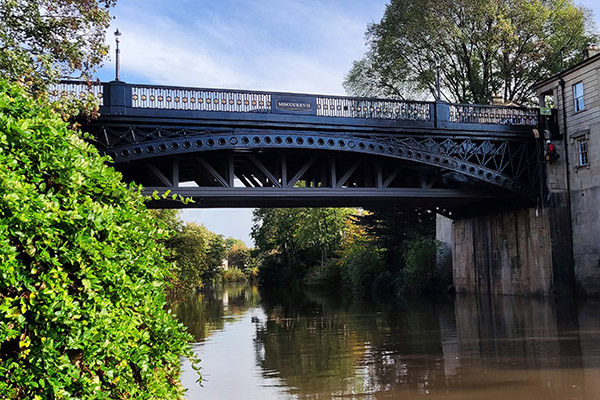
Cleveland Bridge in Bath, UK
Structural health monitoring and machine learning technology have been deployed on a historic highway bridge in the city of Bath to enable the crossing to reopen following a period of closure and traffic management measures. Spanning the River Avon, Cleveland Bridge is a Grade II listed structure famous for the four Greek temple-like buildings that stand at its abutments. As Bath has no eastern bypass, the bridge is used by around 17,000 vehicles per day, many of which are heavy trucks travelling from the UK’s southern coast to ports to the north of the country.
Originally built in 1826 as a 35m-long single arch made of multiple latticed cast iron arch ribs, the crossing has undergone significant modifications throughout its life. In 1929, the deck was reconstructed, an operation that included the addition of four reinforced concrete trusses between the lateral original cast iron arch ribs. A new road deck was constructed using four 3.3m-deep modified Pratt truss girders made of reinforced concrete. In 1992, the walkways were reconstructed as steel portal frames with a concrete deck at each side of the roadway, independently supported by bearings on the abutments.
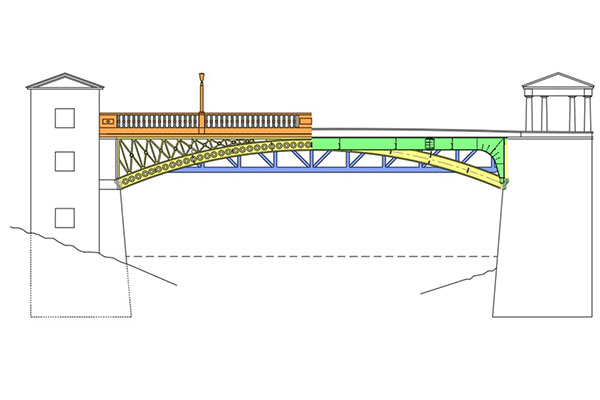
Drawing of all typologies present on the Cleveland Bridge
Unusually, the bottom chord of the reinforced concrete truss girders was designed not to rest directly on the abutments via bearings, but instead to be supported from above by hanger bars, 11 in each group. These are connected to transversely spanning steel beams that rest on mass-concrete piers. Thus, the trusses are suspended around 500mm above the abutment floor and, if they were to fail, the truss would drop in an uncontrolled way.
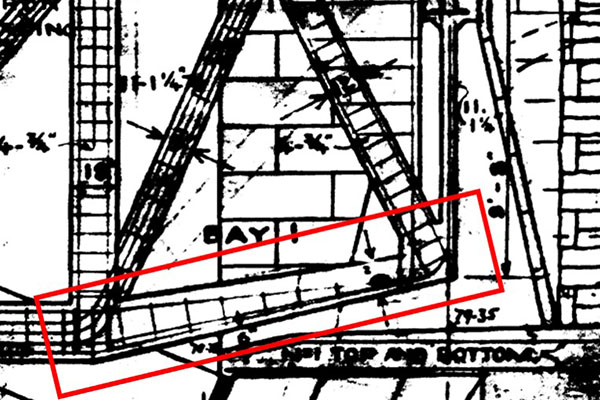
Historic drawing showing hanger bars as extensions of bottom chord reinforcement
In 2022, the structure was the subject of extensive rehabilitation work which entailed traffic restrictions, including use of a managed single lane and an 18t vehicle weight limit. In January that year, localised removal of concrete cover revealed significant degradation to one of the eight groups of hanger bars supporting a reinforced concrete truss.
Further evaluation showed varying degrees of section loss in the hangers, up to 36% in the worst case, and the structural assessment suggested a borderline pass for the critical hanger group. Interim measures during investigations included the retention of the traffic management measures and the weight limit. In addition, WSP recommended that bridge owner Bath and North East Somerset Council install an intelligent remote continuous monitoring system, to enable the structure to be safely brought into service. A passive support system was also recommended to provide an alternative load path in the event of hanger failure: in the meantime, a deck replacement scheme could be developed.
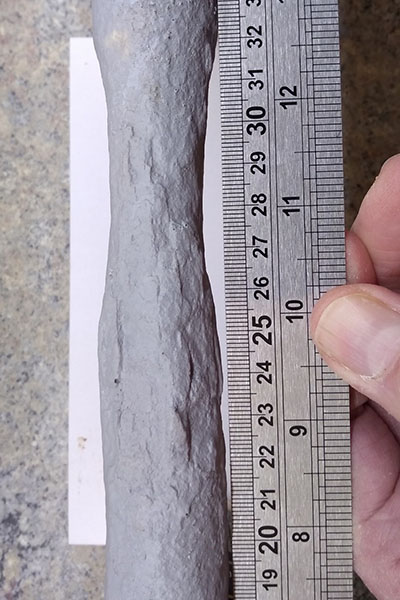
Section loss evaluation
The SHM system was installed by Accolade Measurement in September 2023: 22 LVDT gauges monitor vertical and longitudinal movements at each end of the four trusses, while strain is measured in the north hanger bars of two trusses using 45 vibrating wire strain gauges. The data, which also includes deck temperature, is transferred to the cloud server from the data acquisition unit via 4G for graphical displays, reporting, and further processing. In addition, load testing was carried out at the end of October 2022 to demonstrate the monitoring functionality and to determine the degree of load sharing between the concrete trusses, as well as the potential for load sharing with the cast-iron arches. Two gritter trucks 10.2t and 17.7t in weight were used in various configurations during the load tests. The strain measurements demonstrated that some of the loading was shared with the arches, but more critically that there were no irreversible deformations nor signs of damage from the load test, and that the magnitudes of deformation were acceptable, with the potential to increase the load limit imposed.
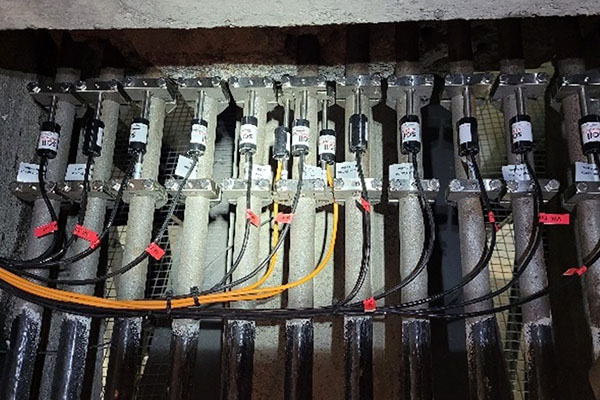
Strain gauges in the north hanger bars, trusses 3 and 4
Up to this point the project could be described as a good example of instrumented best practice. However, the data collected by the gauges is continuously combined with machine learning to not only describe the behaviour of the structure under different loading conditions and temperatures, but also to predict it and, significantly, provide confidence with regard to ongoing structural integrity. It is thought to be the first monitoring system of its kind, described by its developer AIM Group as ‘intelligent’.
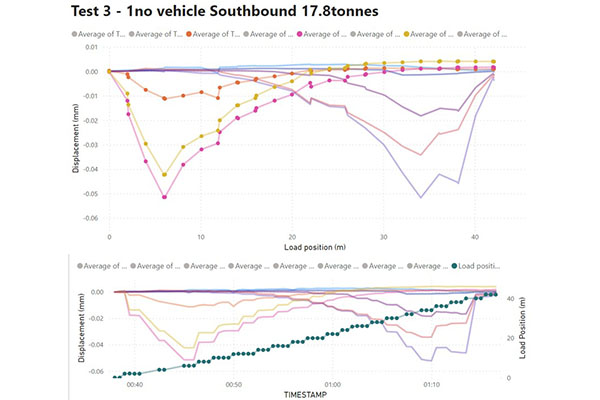
Load sharing between trusses during load test: lower diagonal line shows load position (m) (Accolade Measurement)
The solution is a more sophisticated version of a system developed for a reinforced concrete highway crossing in South Wales (Smarter Twins, Bd&e annual supplement 2023) over the River Ebbw. The Ebbw Bridge has been monitored since 2018 after corroding deck hinge reinforcement had been identified. The data collected is analysed using machine learning that, according to AIM Group, uses modern attention-based learning to directly learn structural behaviour. In South Wales, the system dynamically adjusts alert thresholds based on the learned behaviour of the bridge, which prevents the scenario where false alerts are issued once arbitrary thresholds are crossed, as is typical in standard SHM systems.
Moreover, by taking into consideration expected environmental conditions, the depth of behavioural understanding enables accurate predictions to be made 48 hours in advance. “The experience that we’ve had on Ebbw was very reassuring so I was comfortable to propose a similar solution for Cleveland Bridge,” says Tony Harris, technical director – bridge engineering, at WSP Cardiff, who had recommended the installation of the system in Wales. “We’ve been monitoring that bridge for two and a half years now and we’ve found that the system is measuring displacements to 100th of a millimetre.
“Using machine learning we are picking up so-called ‘anomalies’ that would never be transparent to a human eye looking at the plot. And when an anomaly is flagged, we can go back and look at the data in detail. And in every case that we have investigated we have seen something we weren’t aware of, for example something that was heavy and stationary sitting on the upstream side on Ebbw bridge. It was obvious from the plot that it was stationary and what the machine learning was doing was saying, ‘This is bobbing up and down slightly,’ while other sensors on the other side of the bridge were behaving as it is expected. It is a very mature data set now, two and a half years’ worth. And that’s where we want to get to with Cleveland Bridge before we make the decision as to whether to increase the weight limit back to 44t or some other figure that’s higher than 18t.”
In the case of the Ebbw Bridge, the installation of the system provided sufficient confidence by October 2022 for the removal of the 44t load restrictions implemented following discovery of the defect, as well as management measures that had imposed narrowed traffic lanes to be shifted towards the central reserve.
The system installed on Cleveland Bridge, however, is different than that on the Ebbw Bridge. Indeed, according to AIM Group, it is more sophisticated by an order of magnitude than its predecessor and has one crucial difference. While the machine-learning used at Ebbw Bridge was developed specifically – and only – for that particular structure, the new generation of machine learning software can be used on any bridge, regardless of its type.
Will Beardall, AIM Group cofounder and former data scientist in the field of genetic engineering, says that the same Bayesian learning methods that are used on three-dimensional biological data can be applied to understanding the evolving behaviours in bridge infrastructure, where the data that is analysed is obtained from temperature and displacement sensors as well as application programming interfaces available online. “There are actually surprising similarities between these sorts of data structures,” he says, “We are confident that any changes to a structure’s behaviour can now be understood to within fractions of a millimetre.”
Callum Alder, cofounder of AIM Group, has a background in writing machine-learning algorithms for detecting early failure in medical devices. He believes that the quick and accurate identification of minute, uncharacteristic changes in underlying bridge behaviour opens up a new dimension in SHM and bridge maintenance. The ideal machine learning system, he explains, is one that bypasses the expense of digital twins, learns from the real-world structure, and via its accurate and reliable predictions creates the opportunity for an early intervention. As such, the team suggests using the system to monitor ‘healthy’ bridges and viaducts so that statistical boundaries can be reliably established. Notably, they say that underlying behaviour can be ascertained by the system in six months or less and, as time goes by, the statistical boundaries become more closely aligned. “Something proposed to us by WSP was the idea of identification of non-recoverable displacement.
This is achieved by comparing the machine-learning projections and actual sensor measurements,” explains Alder: “Knowing that a hinge or a bearing has developed a static offset following a cold snap is information that is relatively inexpensively actionable,” he says. What’s more, to obtain actionable information in this scenario of preventative monitoring, he adds that it would not be necessary to instrument a structure to a high degree: “I do not believe in coating bridges head to tail in sensors, we place sensors in the primary load paths and the movement interfaces. You shouldn’t need to explicitly hard-core bridge parameters, because all bridges are different and evolving. Otherwise, you build a sophisticated model that is only good for a single bridge,” says Alder. “We see a world where a handful of sensors will identify when a structure begins developing defects away from the baseline,” adds Beardall. “The research shows that you save 64% on the management of the asset if you see the telltale signs years earlier. For infrastructure owners, it’s like having your budget tripled.”
The AIM Group is highly aware that the applications it suggests are markedly different to the traditional way such data is used by bridge owners and engineers: “Engineers normally request monitoring as a last resort and are then faced with the challenging task of sifting mounds of data and graphs to determine future operability. Moreover, if an alert is sent out because a predetermined boundary is overstepped, it is instantaneous panic – this is how we manage infrastructure at the moment, and hundreds of millions are spent on late-stage intervention.”
AIM Group is providing a bridge management platform powered by its machine learning system. Unlike traditional systems, the platform does not take the form of complex graphs that engineers traditionally have had to interpret and base decisions on. Its platform instead presents every managed asset on a simple colour-coded system based on green, amber and red. The start-up is in conversations with asset managers in Europe and North America, focussing on structures that are already instrumented.
For Harris, as the most experienced user of the technology to date, it is an intriguing prospect: “I could be persuaded once the system is mature enough and tested enough, but with my engineer’s hat on, for the moment I would be focusing on bridges with known defects, because otherwise the next jump is understanding if the AI is flagging up that something is changing. Unless you’re monitoring a specific defect in a specific way, then you don’t know whether or where that change is occurring and how critical it might be.” On Cleveland Bridge, Harris points out, the data gathering was aimed at a specific group of bars – the most corroded – to understand how load was being distributed. “That’s a deliberate piece of monitoring. We are then assessing the appropriate data about the behaviour that that defect might drive. Whereas if we were just monitoring the structure blind, currently I can’t see how you could say that something’s going wrong and it’s happening at a particular point. To me, the sensors have to reflect the problem that you’re trying to keep an eye on.”
Nevertheless, the outcomes at Cleveland Bridge have been positive. The monitoring system has enabled the structure to be brought back into service based on real understanding of its response, and at a lower cost than the traffic management system. In addition, there has been no permanent damage to the fabric of the heritage structure. And, in the near future, once the full set of seasonal machine-learning outcomes are available, the current weight restriction could be reviewed.