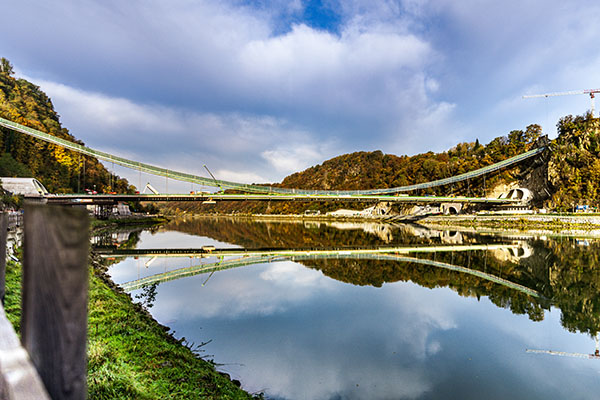
The slender Linz Danube A26 Bridge appears to float lightly above the river (Asfinag/Mike Wolf)
Starting point – Austria
Construction of Linz’s fourth bridge across the Danube River is approaching final stages with the crossing expected to open to traffic in autumn 2024. The 306m-long and approximately 25m-wide suspension bridge will carry the A26 western bypass between two tunnels just outside the city centre. The crossing (Bd&e issues 95 and 111) was commissioned as part of a larger project to alleviate traffic congestion in the country’s third largest city which is located approximately 175km west of Vienna.
State-owned company Asfinag assigned the project to Italian-Austrian consortium Arge 26 Donau Brucke, comprising F-pile and Gruppo ICM (responsible for the bridge and 4km of tunnels) and Maeg Costruzioni (responsible for the bridge steel elements). Construction started in 2019.
One of the most notable aspects of the crossing is how the 2,200t suspension structure appears to gently float over the river, thanks to its lack of cable towers. Instead, the structure is suspended by a system of stay cables anchored directly into the rock slopes of the two riverbanks. Approximately 150 anchors have been installed at a depth of over 100m to anchor the bridge’s concrete blocks through four 50t steel structures called ‘anchor swords’. This set-up serves to support the entire weight of the bridge. Twenty-four stay cables, 12 on every side, were installed on the bridge by April 2022. Each cable was dragged along a cable crane to the opposite bank before being inserted and hooked into the anchor swords that support its weight. Construction of the steel deck consisting of trapezoidal steel box girders and steel cross beams supporting concrete slabs took place from September 2022 to January 2023. The 13,000t-heavy deck is supported by two 500m-long and 85t-heavy horizontal main cables.
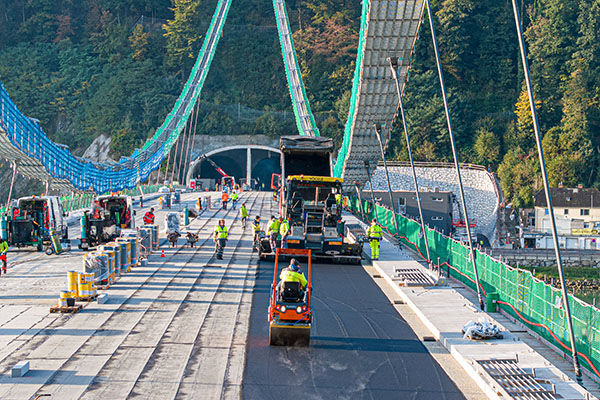
The construction site of the new Linz Danube Bridge in Q4 of 2023 (Asfinag/Mike Wolf)
On site, construction is currently focusing on the electromechanical safety technology equipment of the bridge as well as the entrances and exits to the existing road network, built as tunnels on both banks of the Danube River.
The tunnel system used to approach the bridge has a total length of 3,200m. According to Asfinag spokesperson Christoph Pollinger, the biggest challenge of the project is the implementation of the demanding bridge-roadway-tunnel combination. The Danube Valley where the project is located is very narrow, hard to access with large equipment or volumes of materials, and with little space for logistical processes. Careful planning and transparent communication with the public have been key to carrying out the works, says Pollinger. Once opened, it is expected that the uniquely supported suspension bridge will become a signature structure in the Linz skyline.
Over near Nuremberg, a custom configuration of two cantilever form travellers is advancing the replacement of Austria’s tallest bridge on the A1 highway, a 50m-high and 420m-long steel composite structure located approximately 195km north-west of Munich. Aurach Bridge is being renewed after 60 years of carrying four lanes of traffic, two towards Vienna and two towards Salzburg. The crossing serves around 50,000 vehicles during peak times and a key objective of the project is to avoid fully closing the bridge. Consequently, the method and sequence of construction have been customised to help achieve this goal. Work on the replacement started in 2022 after Asfinag contracted a consortium made up of Habau and Porr.
A temporary two-lane structure has been built parallel to the existing bridge to divert traffic. The diversion has been in use since late 2023 when construction of the new permanent bridge started. The two existing supporting structures with their respective carriageways and piers are currently being dismantled. After that, separate piers will be erected for each directional carriageway. Then, the supporting structure and carriageway towards Vienna will be completed and all traffic will be rerouted on it. Once the temporary bridge is free from traffic, its 15,000t-heavy supporting structure will be removed and transversely shifted onto the permanent piers for the Salzburg lanes. Finally, the remaining temporary piers will be dismantled and removed. According to Martin Schnellmann, manager of the project for Asfinag, the intricate operation has yet to be scheduled but is tentatively expected to take place summer-autumn 2025.
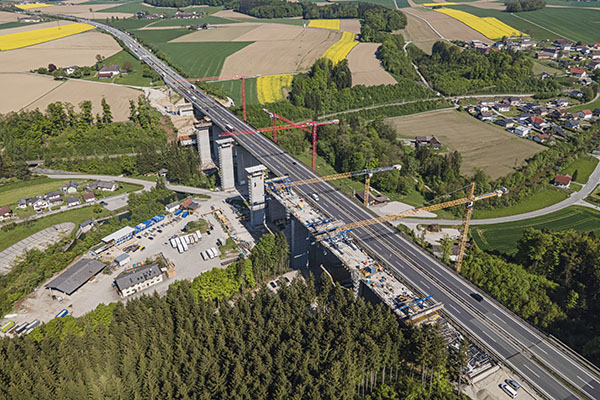
A 15,000t-heavy carriegeway will be transversally shifted to complete the new Aurach Bridge in Austria (Gregor Hartl)
Meanwhile, construction is being carried out with two tailor-made cantilever form travellers (CFT) supplied by Doka. Christoph Barth, Doka group leader of engineering (bridges) explains that the CFT was chosen as it provided a cost-effective solution to the challenge that Aurach Bridge’s unusually short hammerheads posed for construction.
A CFT is usually designed to fit 12.5m-long hammerheads, but Aurach Bridge’s are 8m in length, which made it impossible to fit two standard-sized CFTs. To solve the issue, Doka developed a ‘fork-solution’ in which two CFTs are placed one inside the other, saving space and allowing the arrangement to be fitted on the short hammerheads. Applying the thus arranged CFTs, new segments are added to the wider freely projecting sides of each hammerhead and new bridge sections are constructed in their entirety without the CFTs needing any readjustments. The superstructure is being built in 5m sections following the balanced cantilever method. Another benefit of the approach, according to Barth, is that it ensures coordination between the falsework and the formwork and helps construction to progress swiftly and safely.
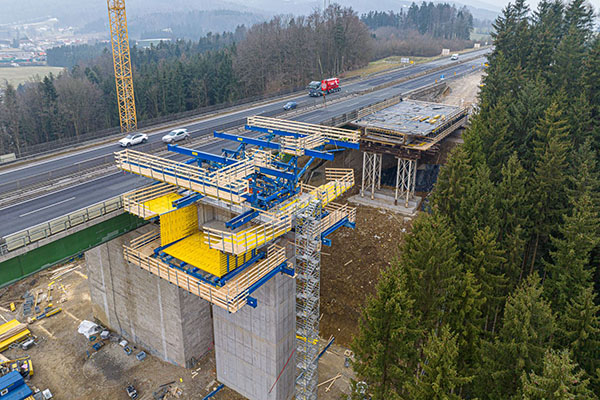
The Aurach Bridge is being built with two custom-made cantilever form travellers (Doka)
The new Aurach Bridge has been designed to withstand significantly higher loads and has a service life of 100 years. Plans have been made to recycle nearly all material removed from the old and temporary substructures so, for example, the concrete will be crushed, processed and reused for construction.
The project is expected to conclude in the beginning of 2026.
Croatia
Equally noteworthy is the Cetina Bridge spanning the Cetina River canyon in Omis, Croatia, which was connected in March 2023 after its deck segments were successfully constructed and launched from inside two tunnels located 70m above ground level. The 224.4m-long steel girder crossing with a maximum span length of 152m and weight of 1,250t cost US$25,1 million (€23,2 million) to build. The bridge is located approximately 25km south-east of Split, Croatia’s second largest city.
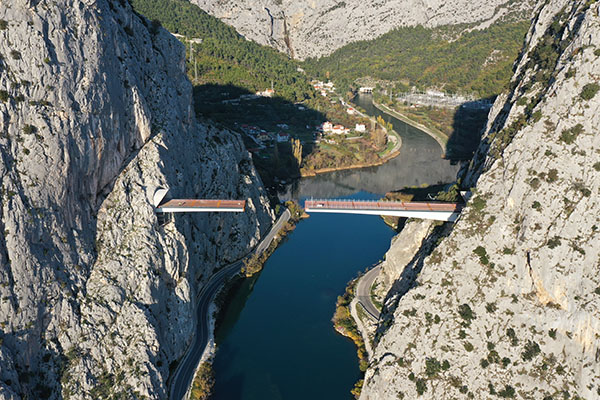
The Cetina Bridge in Croatia was launched from canyon tunnels 70m above the ground (Strabag)
According to Tonci Musulin, manager of the project for contractor Strabag, the site made working in the open very challenging because the canyon acts as a funnel and frequently produces wind speeds exceeding 150km/h. Consequently, the contractor decided to use the tunnels to construct the deck and then launch it incrementally.
Musulin explains that the launch itself posed several issues such as aligning the bridge’s cross section despite the deck halves changing position multiple times throughout the operation. Adjustable supports for the steel structure had to be designed to enable the front supports to cover the 4.5m height difference between the smallest bridge segments above the canyon and the largest segments in the tunnels.
While working inside the tunnels minimised the impact of the high-speed winds on construction, it also posed access and space challenges. The bridge was assembled from segments with a maximum length of 12m and width of 2.5m within two 8m-wide tunnels with severely limited operational space for staging and operating equipment. The trucks delivering the bridge segments to the site had to drive in reverse through both tunnels, which are 2km-long in total.
In the first stage of bridge assembly, 60m of the deck was assembled using two cranes and welded together, followed by treatment with anticorrosive coating.
Launching was performed in five steps. Using hydraulic presses, the bridge was pushed approximately 12m towards the canyon, which freed up space to add and weld new segments to the existing structure. This process was repeated twice before it was necessary to adjust the front support to match the change in the bridge’s height. This caused the steel structure to change its incline several times and even led the observing public to mistakenly think something was wrong.
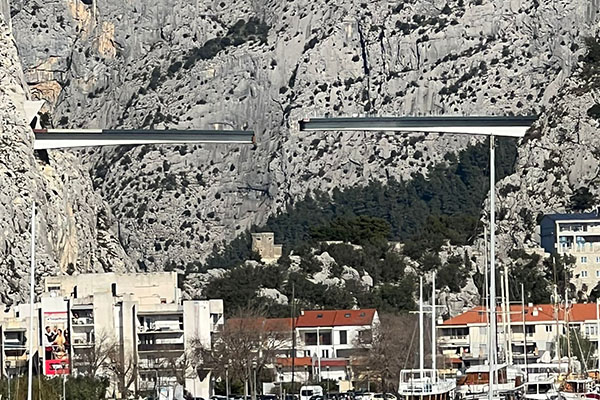
The incline of the steel deck changed several times during its launch (Strabag)
The launching proceeded with two more cycles during which the first deck half was carefully kept in balance. Counterweights were applied to the bridge segments to ensure the deck did not tip over and, later, to minimise the uplift forces during the permanent phases.
The first deck half was fully launched in five cycles, after which the bridge was placed on temporary bearings. The equipment was then transferred to the other side where the same process was repeated for the other half of the deck.
The final stage saw the bridge connected 70m above the Cetina River with the welding of the central joint using special platforms in the canyon. During this phase the bridge was still resting on temporary supports so the final height and position adjustments could be made using hydraulic presses. The construction process concluded with the mounting of bearings, dampers, and expansion joints, which took place in the third quarter of 2023.
Hungary
Construction of Hungary’s 20th bridge over the Danube reached a major milestone in January 2024 with the deck reaching closure several weeks ahead of schedule. Located approximately 120km south of Budapest, the 946m-long Kalocsa-Paks Danube Bridge is the country’s largest extradosed structure. It features nine spans and three structural parts: a 220m-long flood-zone bridge on the left riverbank, a 440m-long river bridge, and a 286m-long flood-zone bridge on the right riverbank.
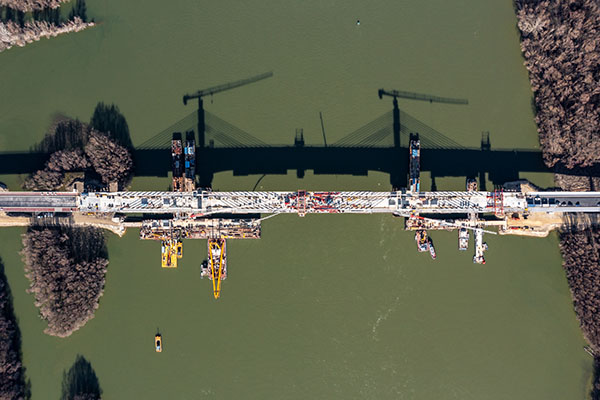
Construction of the extradosed Kalocsa-Paks Danube Bridge achieved a major milestone in January 2024 with the closure of the main river bridge (Magyar Építok)
Designed by CEH, the main river bridge has a prestressed and cable-stayed typology. Three spans with parabolic arches above the river piers comprise its superstructure. More specifically, the superstructure features a reinforced concrete floor slab with prestressed longitudinal cables and fixed inserts. Tensioned sliding cables run through the box girder to counter the effects of the payload. The main load-bearing element is a twin-cell box girder whose sloped and middle walls consist of trapezoidal steel sheets.
The Hungarian Ministry of Transport commissioned the project in 2015 and appointed Duna Aszfalt as general contractor for the construction of the bridge and road network connections in 2020. The total budget for the bridge and roadworks is estimated at US$269.7 million (€248.6 million).
According to a January update by the contractor, approximately 7,500m2 of sheet wall piling, 32,000m3 of structural concrete, and 4,000t of reinforced steel have been used so far. Duna Group also supplied approximately 4,800t structural steel for the main bridge and around 3,200t for the secondary and temporary structures.
Both steel box girder floodplain bridges have been completed and pushed to their intended location using incremental launching. The main river cable-stay bridge was built by a cantilever method executed with a formwork trolley designed by Peri.
The main bridge was fully joined with the installation of the last 89th segment and the casting of its slab on 29 January 2024. At the time of writing (February), finishing works on the project are expected to conclude by summer 2024.
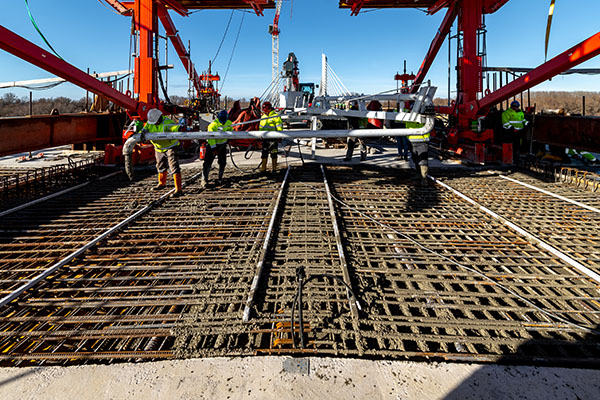
Casting a segment for the Kalocsa-Paks Danube Bridge (Magyar Építok)
According to Barna Ónodi, spokesperson for Duna Aszfalt, the most significant challenge so far has been the construction scheduling for the extradosed structure, which had to account for the use of four formwork trolleys to construct the 89 segments, each of which required over 150 individual processes.
Hungary is also gearing up to bridge the Danube River at Mohács, a town located around 185km south of Budapest on the river’s right bank. The announced design features three consecutive network arches with spans measuring at 270m, 250m and 230m, and carrying four road lanes and a 3.3m-wide cycle lane. The main bridge designer is Gábor Pál while Speciálterv analysed the preliminary studies of the crossing and carried out permit and construction design.
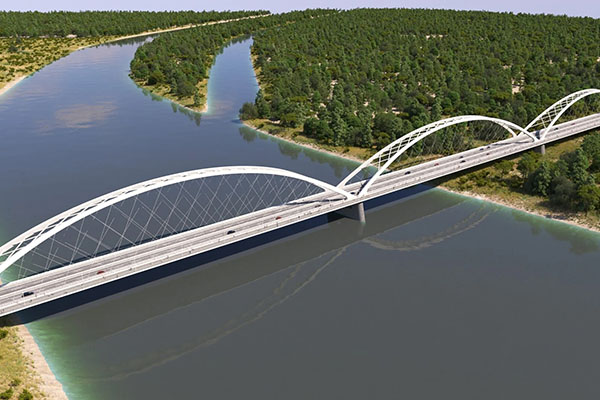
Render of the triple arch Mohács Danube Bridge (Specialterv)
The steel arch bridge is designed with a steel deck, steel arch girders, a closed box girder cross-section, orthotropic steel deck slab and double-sided suspension with a grid arrangement. The arches are planned to tilt towards each other and be connected by an X-lattice cross-connection system.

The arches of the new Mohács Bridge are designed to tilt towards each other and connect via a criss-crossing lattice system (Specialterv)
At the time of writing, the evaluation of the bids received for the construction tender was ongoing with results expected to be announced this spring.
A smaller scale project featuring several interesting solutions is a 35m-long double girder bridge which opened in December 2023 across the Ipoly River, a natural border between Hungary and Slovakia. The new crossing connects the border villages of Orhalom (Hungary) and Vrbovka or Ipolyvarbo (Slovakia) approximately 80km north-east of Budapest. Commissioned by the Hungarian state-owned Nemzeti Infrastruktúra development company, the bridge was designed by Fomterv and constructed by Hídépíto. The Orhalom-Ipolyvarbó Bridge is a simply supported steel crossing, with a reinforced concrete deck and a 31.5m-long main span. Its I-shaped cross-section features unusual side stiffeners that trace a spatial arc to create an elegant light-shadow visual effect on the girders.
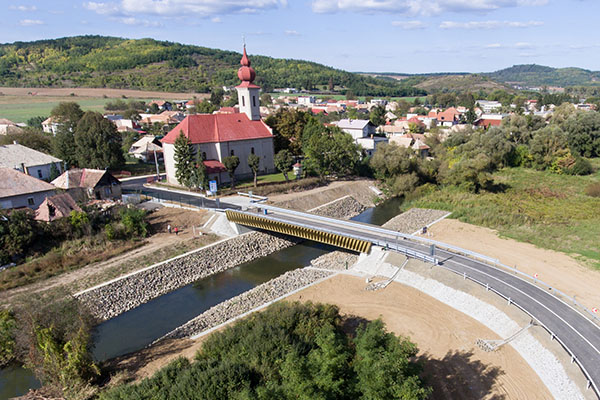
The side stiffeners of the Orhalom-Ipolyvarbó Bridge trace a spatial arc and create a light-shadow visual effect on the girders (A-Híd)
Notably, the road leading to the new crossing was designed to be below the standard flood level and the bridge itself is located within the floodplain of the Ipoly River. This design is due to expected low volumes of traffic on the Orhalom-Ipolyvarbó Bridge as there are other border crossings in its vicinity. Considering the traffic condition – and to significantly reduce the total cost of the project – it was decided that allowing the road and bridge to be flooded and closed in the case of river overflow was the optimal approach.
Consequently, the expansion joint installed on the bridge had to not simply accommodate its movements, but also have good water resistance and facilitate repair and replacement.
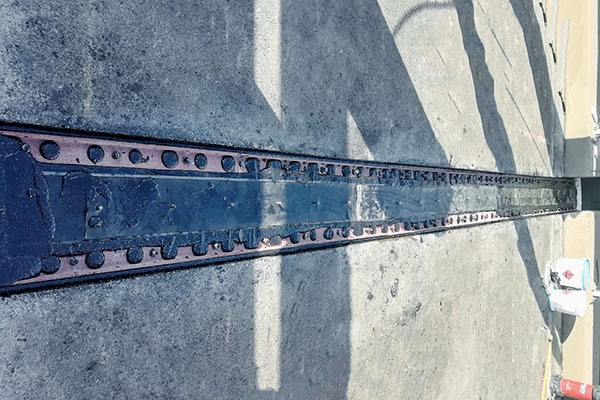
Installation of the expansion joint on the Orhalom-Ipolyvarbó Bridge (Mageba)
The answer was found in a 7.9m-long Tensa Polyflex Advanced Polyurethane flexible plug joint, type PA50, with a movement capacity of 50mm supplied and installed by Swiss civil engineering service provider Mageba. According to Szabolcs Gábor, project manager of the Mageba team, the plug joint was selected as it is watertight, can be easily repaired or replaced, and provides a flat transition between the bridge and road surface that creates little noise with respect to the nearby villages. A Robo Dur 42 polymer concrete substructure with 90mm thickness was installed under the joint to achieve a fully flat level.