Stepping off the plane at Miami International Airport on a cloudless midsummer afternoon in 2025, I’m greeted by 32°C heat and almost blinding sunlight. The airport lies roughly 10km from the construction site, so my first encounter with the city’s newest infrastructure – named The Fountain – must wait. Boarding Miami’s sleek Omni Loop train on the way to my hotel, it is not long before imposing arches emerge against the skyline – two complete, a third awaiting closure and a fourth under way.
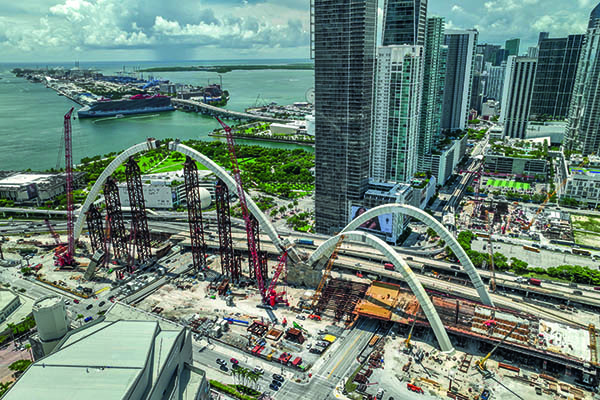
Three of the six arches that will make up the Fountain Bridge (HDR)
These arches are part of the I-395 Signature Bridge, a key project that is fast becoming a statement of the city’s civic identity as well as its technical ambition. And it is not difficult to understand why: eventually, the crossing will feature six asymmetric arches stretching from 91.4 to 198.1m in length and rising 54.9 to 100.6m in height, all anchored to a single central pier. They will carry a key segment of highway I-395 over NE 2nd Avenue and Biscayne Boulevard, linking the Port of Miami, MacArthur Causeway and Miami Beach.
As with most asymmetrical structures, the viewing angle transforms the experience. From the train window, framed by a backdrop of skyscrapers, smaller but still vertically ambitious mid-rise towers and a gleaming arts centre, the arches appear like river streams that draw the layered cityscape into a single focal point. Later, from a ground-level vantage point, the bridge stretches lengthwise toward the nearby causeway – its profile light and fluid, rising against the merging blues of sea and sky.
Locals, I soon learn, have already grown fond of this evolving feature. One man, catching me admiring the view, smiles and says: “We haven’t had an attraction like it before, only Millionaire’s Row. Can’t wait to have it on postcards!” It is easy to understand how a striking public structure that eases congestion on the city’s busiest corridors can be more emblematic than a line of luxury mansions inaccessible for most locals and visitors.
I leave the train station eager for the site visit, scheduled for next day. A forecast of possible rain and lightning has kept the agenda flexible, and there is still a risk the conditions will not allow a site tour.
Luckily, however, the rain holds off and the tour starts by meeting HDR’s design team, including project engineer of record Michael Lamont; design manager John Hansen; transportation business group alternative delivery director Jay Chiglo; and HDR’s field design representative Alvaro Aranguren, who leads the on-site tour. Fully equipped with PPE, we are joined by Lenny Gardino, project manager for the Archer Western-de Moya Group joint venture building the bridge. “For us, the project began with a design competition around 2014,” recalls Hansen, “We partnered with Archer Western, building on a strong history of successful collaborations on bridge programmes across the country.”
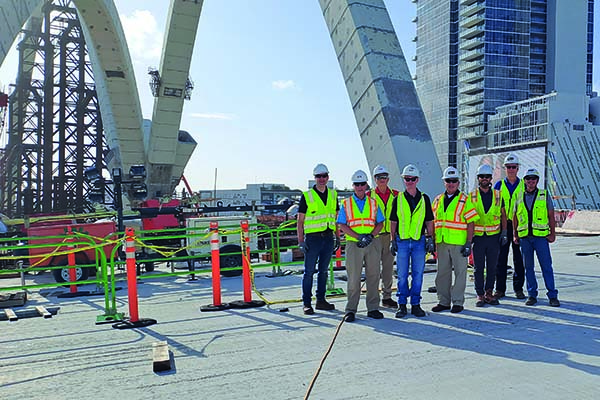
HDR design team with the CMJV project manager at the bridge site in July 2025
The competition brief called for a signature bridge that would not only enhance local transport connectivity but also serve as a landmark capable of attracting visitors and stimulating economic development. While aesthetics were central from the outset, every component had to be structural rather than purely decorative. The design also required a minimum under-deck clearance of 5.8m to accommodate future amenities such as parks, fountains and other recreational spaces. “Those are features that will be coming in the future,” says Hansen.
Beyond its transport function, the bridge is also expected to reconnect the urban fabric by creating more than 133,000m2 of public space reserved for a future underdeck area and heritage trail with parks, bike/pedestrian paths. The project initially secured US$60 million in federal funding for the under-bridge civic development, but this was revoked by the Trump administration in August. Nevertheless, the city remains committed to realising the plans in the future.
“We proposed two architectural concepts – a conventional cable-stayed option and a fountain-inspired multi-arch design – both of which were reviewed by FDOT and community committees,” explains Hansen. The chosen design’s structural arrangement features a central pier positioned between twin carriageways, with four diagonal arches extending outward to the edges of each carriageway in an X-shaped configuration that carries the primary structural forces. Two central arches span the gap between the carriageways, linking them structurally and completing the system through a network of cables.
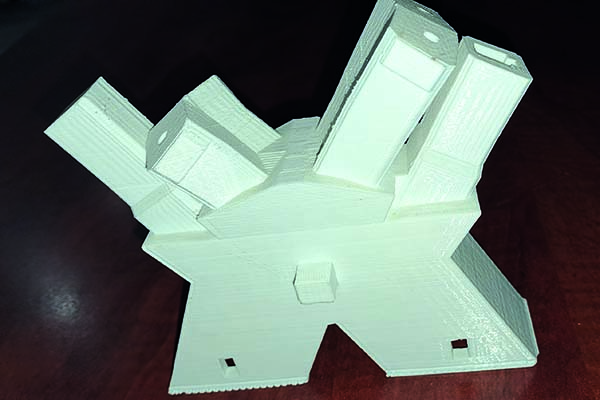
Above and below: scale models of the central pier and the bridge’s six arches
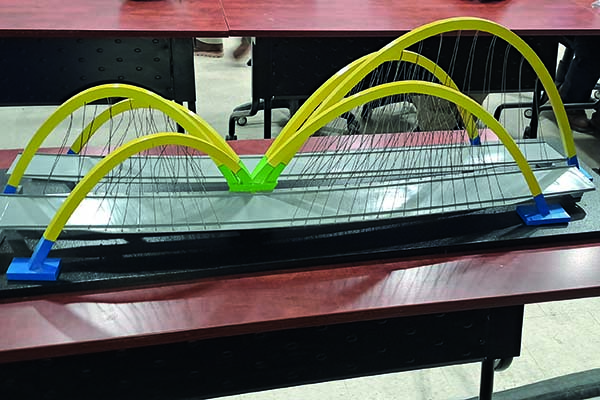
Once the arches are completed, 136 cables, each consisting of 19 to 55 high-strength steel parallel wire strands, will transfer the weight of the superstructure to the arches. The cables feature four layers of protection: galvanisation, internal grease, plastic sheathing and a polyethylene outer pipe, with hidden guide pipes to preserve the bridge’s sleek form. A special federal waiver was obtained for the use of galvanised components – an uncommon choice on such projects due to Buy America restrictions and limited domestic sourcing. This also allowed for many of the temporary works to be galvanised, ensuring they could withstand the months of coastal exposure.
“The bridge is designed to withstand the sudden loss of any single cable. Each cable includes an extra reference strand, allowing inspection for corrosion at any time without affecting performance and any lost or damaged cable can be replaced without compromising the structure,” says Lamont.
Following the selection of the winning concept, preserving the approved design and geometry became non-negotiable. A key project requirement is for the finished bridge to match the arrangement and aesthetics of the competition-approved design; therefore, every optimisation must adhere to the original concept and receive FDOT approval through supporting visual renderings.
Other engineering challenges include accounting for wind loading, enabling staged construction and facilitating post-tensioning. While the central pier will bear significant vertical loads once the bridge is commissioned, it has also been designed to resist shifting asymmetric loads during the various construction stages, with bearings providing lateral restraint. This approach enables the phased construction and opening of the carriageways – first the westbound half, followed by the eastbound lanes.
The design team aimed beyond code: while US standards typically specify a 75-year service life, HDR designed for 100 years. “The 25-year extension was achieved through increasing the rebar reinforcement’s concrete cover and careful mix selection,” explains Lamont. “We didn’t need stainless or coated rebar – we used black rebar throughout. Then we developed the concrete mix to limit chloride intrusion and designed to control crack widths. At our design loads, the concrete will crack, but we included enough rebar such that any cracks that form remain tightly controlled in size.”
“I believe we were the first bridge to use self-consolidating concrete (SCC),” adds Gardino. “We were talking about rebar and PT congestion and trying to prevent consolidation issues. We’re using SCC in the glue of a high-flow mix that still consolidates.”
SCC is a highly flowable mix that fills formwork under its own weight without vibration – making it suitable for heavily reinforced elements where conventional concrete would struggle to consolidate. It reduces the risk of voids and helps ensure smooth finishes even around congested rebar networks.
Another innovation comprises replacing grout with wax inside the cable sheaths to improve corrosion resistance. Wax creates a flexible, fully sealed, water-repellent environment around the strands, preventing voids and cracks that can occur with grout – an important consideration in Miami’s marine climate. However, it requires careful application. “Grout’s usually a little bit easier, wax is more difficult to apply because it has to be heated before being pumped up into the cable sheath,” explains Gardino.
The engineering optimisations provide enhanced longevity and easier maintenance – both critical for a coastal structure designed to last a century. “The design accounted for redundancy, long-term inspection and maintainability throughout the bridge’s life,” explains Aranguren.
For the foundations, the team used auger-cast piles – a first for a bridge of this scale in Florida – after rigorous testing demonstrated their capacity. Environmental measures include strict controls on stormwater runoff and debris to protect Biscayne Bay.
The project is being delivered through a design-build approach – integrating design and construction for faster delivery, tighter coordination and long-term cost control. “Planning required careful coordination due to the corridor’s importance, serving critical economic, medical, cultural and tourism destinations,” says Andres Berisiartu, assistant district construction engineer for FDOT’s sixth district. To minimise disruption, most lane closures are scheduled during nighttime, helping to ensure pedestrian and event access remains uninterrupted.
“Lessons learned emphasise the importance of early and continuous collaboration among multiple offices, sub-consultants, and contractors,” says Chiglo. “Despite COVID disrupting in-person work, strong pre-established team relationships allowed the project to continue efficiently.”
Construction started in April 2019 and combines precast and cast-in-place elements. The superstructure box girders are cast in place on falsework and built concurrently with the arches assembled from precast elements. Each precast segment has unique dimensions based on its position along the asymmetric curvature of the arches. These vary in internal thickness to accommodate bending, torsion and axial loads from the cables. As a result, segments are not interchangeable: each must be individually fabricated, clearly marked and installed in a precise sequence. This custom approach prevents the accelerated, repetitive casting typical of precast construction, as any error could prevent a segment from fitting its arch’s curvature.
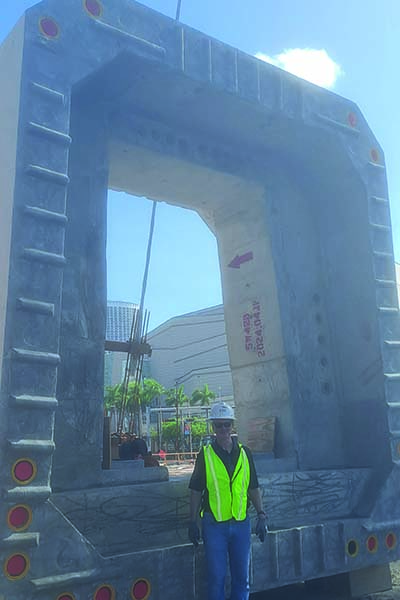
Prefabricated arch segment awaiting installation
Segments are being fabricated at multiple staging sites and cast upside down to accommodate embedded cable guide pipes. Casting can take from three days up to a week for the more complex pieces. Wet joints between segments ensure precise alignment upon installation.
Mid-visit, I’m offered the rare opportunity to climb inside an arch of my choosing and – naturally – I select the tallest. It soars over 100m up in the air and it features a gap that is due for closure with a single segment later in the summer.
Inside, a network of ladders and stairs allows crews to carry out finishing works and will allow future inspectors access for inspection and maintenance. Halfway up, Miami’s heat becomes a serious adversary. Sweat fogs my visor; my gloves slip. I pause to appreciate the crew who navigate these spaces daily, scaling confined shafts and sloping chambers with practiced ease. My hike ends mid-arch – more than enough to instil a lasting respect for the physical demands placed upon the builders.
We regroup at a small rest area where the crew generously offers ice-cold drinks – an oasis in the Florida heat. Within half an hour, another team completes a segment lift using a large crane adapted from wind-turbine installation. A segment large enough for a person to stand inside it is lifted from the staging area, transported over the deck to an arch emerging from the left side of the central pier, and positioned, all in about 20 to 30 minutes. By the time our group makes its way around the central pier, a hard capped head has emerged from the newly installed segment to signal progress to the ground crew.
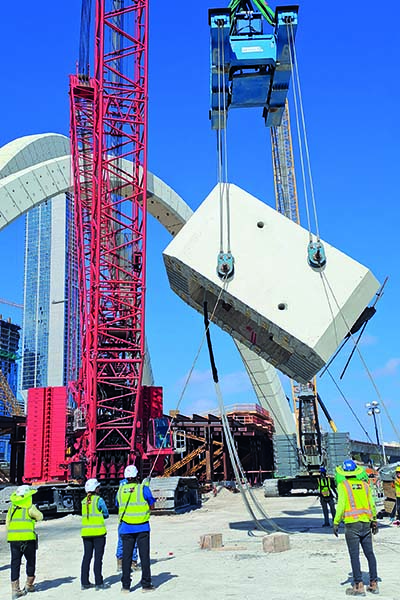
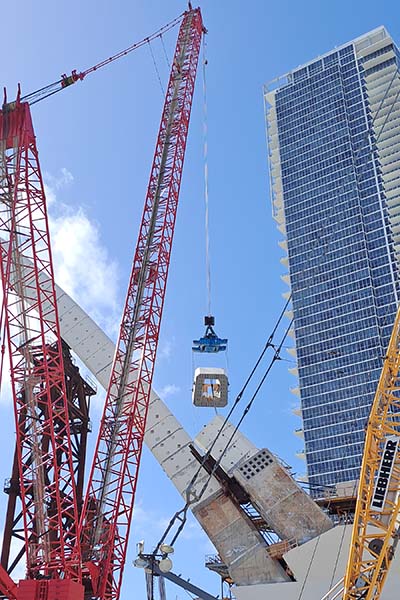
A segment was lifted and installed in a carefully coordinated operation that lasted about half an hour
Walking further down the site, I am struck by the immense temporary tower holding up the highest arch, ahead of its closure. “The temporary towers require a high level of stiffness to limit deflections during construction and under wind loads, as excessive flexibility could crack the arches,” explains Lamont. To control deflections and prevent over-stressing, the towers incorporate extensive post-tensioning capable of withstanding hurricane-force winds, with reinforcement provisions that can be implemented within 24 hours. Their removal must also be carefully timed with the post-tensioning sequences to control locked-in stresses. The temporary towers and falsework are designed for reuse, moving systematically as each arch advances, thus reducing staging costs and material use.
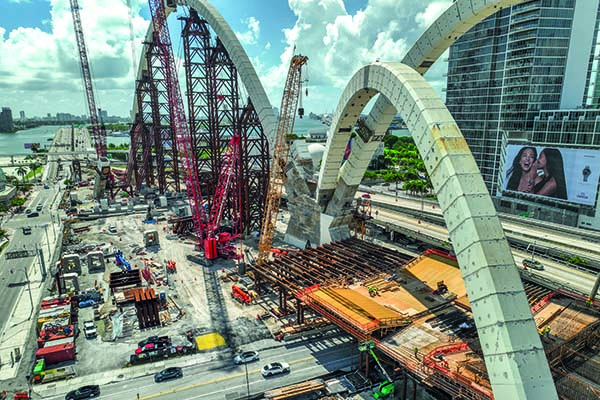
The temporary towers that support arch construction incorporate extensive post-tensioning (HDR)
Structural health monitoring has been embedded from the outset. Sensors placed on cables and footings track loads and movements, while accelerometers monitor vibration behaviour. The asymmetrical arch geometry required segment-specific modelling to capture cable angles, foundation stiffness and construction sequencing.
On-site design support has proved critical, highlights Lamont: “Having a design representative like Alvaro on site allows issues to be resolved immediately – often in minutes rather than weeks. This keeps FDOT in the loop to allow all parties to confirm changes maintain structural integrity.”
With site visit nearly over, I meet Oscar Gonzalez, senior community outreach specialist at FDOT, who explains how far the history of the bridge goes back: “The project began in 1992 with a development and environment study to address geometric deficiencies and capacity needs along the corridor. Multiple alternatives were evaluated based on socioeconomic, engineering and environmental factors, eventually leading to a locally preferred alternative for an elevated structure with ramps at North Miami Avenue.” An aesthetics review panel, he explains, developed the project criteria and subsequently evaluated the proposals submitted via a design competition.
“Each firm could submit three designs. The winning proposal was selected based on a combination of technical, aesthetic, schedule and cost considerations,” explains Gonzalez: “It’s meant to evoke a fountain, symbolising Miami as the centre of the Americas.” And the rest, as they say, is – or will soon be – history: construction has now moved on to erecting the fourth arch, with project completion expected in 2029.
With the formalities over, as I prepare to depart the city, I can already imagine the postcards: six arches exploding like water sprays above Biscayne Bay, a new icon joining the skyline.
Client: Florida Department of Transportation and Miami-Dade Expressway Authority
Designer and engineer of record: HDR
Construction: Connecting Miami Joint Venture comprising Archer Western and the de Moya Group
Segment casting: Rizzani de Eccher