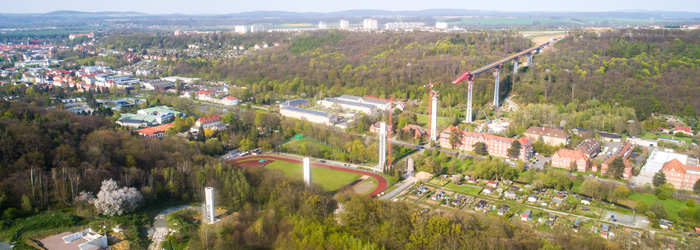
The bridge is located over the valley of River Gottleuba in Pirna, Saxony, a town known as the gate to Saxon Switzerland. The structure is part of a new city bypass, connecting the road B172 that heads eastwards towards the towns of Bad Schandau in Germany and Decín in the Czech Republic with Highway A17 that proceeds towards Dresden to the north-west. It is being constructed because Pirna’s location amidst multiple valleys surrounding the river Elbe has historically caused rush-hour congestion, negatively affecting the near-40,000 inhabitants of the beautiful town.
Gottleubatal Bridge is being built by the joint venture ARGE Gottleubatalbrücke, consisting of companies BeMo Tunnelling and Metrostav Division 4, both part of Metrostav Group. The assembly of the steel structure and the launching of the structure is the responsibility of Metrostav Division 3.
The project started in 2006 with an architectural competition. The winning design proposed a highly slender hybrid steel-concrete composite semi-integral frame to cross the 70m-deep and 1km-wide valley. Due to financing issues, however, the execution of the bridge and indeed the entire bypass was postponed to 2018. When the contract was put out to tender, in order to expedite the process the client DEGES – the Federal government’s project management company for complex infrastructure – extended the original design with detailed data and prescribed construction procedures.

The bypass crosses Gottleuba Valley with nine spans (92+ 116+120+120+124+108+92+76m). The horizontal alignment is straight, while the vertical alignment runs in a longitudinal slope of 4%. The superstructure consists of a slender - almost 1/35 of the maximum span length - steel box in trapezoidal form. It has a 5.6m-wide bottom flange and a 4.5m-wide top flange, which also features 4m-long steel cantilevers spaced every 4m. These cantilevers will support precast slabs that will act as lost formwork for a 380mm-deep composite bridge deck.
The intended construction time was 34 months, ending in summer 2021. Due to the unforeseen difficulties, however, the project completion was postponed to 2026/2027. This was due to a requirement for the incrementally launched slender steel box to be connected to the slender bridge piers using concrete haunches, thus forming a flexible semi-integral structure with low future maintenance costs.
As the architectural design puts great emphasis on the slenderness of the structure, the bridge piers - maximum height of 68m - are highly demanding in their form and geometry, with the narrowest point at 25m from the deck axis. The bridge deck is designed for three lanes of traffic, two uphill and one downhill.
At the end of the incremental launching, the five piers located in the valley floor will be rigidly connected to the bridge deck using 24m-long reinforced concrete haunches, which will provide flexibility of the vertical support to the bridge deck. The piers on the hillsides will be connected to the superstructure with spherical bearings. The bridge piers and abutments are founded on block foundations atop 22m-long bored piles 1.2m in diameter.
The joint venture has overcome multiple challenges within the launching process, the fourth - and longest, at 124m - having taken place in April 2023. In total 9 launches need to be executed.
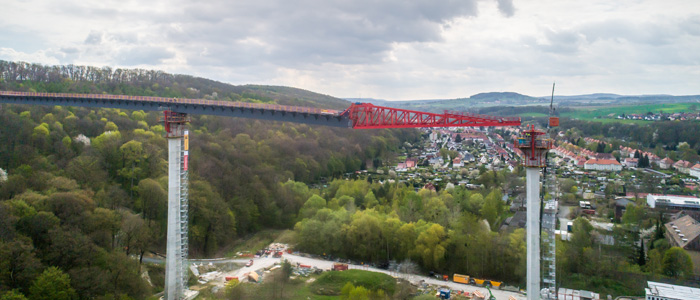
Firstly, due to space conditions of the construction site, the launching process has to run downhill in a 4% slope. Together with the provider of the launching technology, which is the Czech division of VSL International, a launching system with both braking and pulling units had to be designed and implemented.
The braking units are anchored to a temporary structure, the so-called end-block at the end of the launching yard. At the end of each launch, the anchoring structure attached to the superstructure reaches the park position at the abutment, axis 100. The park position is provided by a special steel structure designed to resist horizontal loads up to 11.5MN and to transmit them from above the abutment to the pile foundations.
The next issue is connected to the architectural design of the bridge, which insists on keeping the width of the bottom flange equal to the width of the bridge pier heads. As a result, the launching bearings overhang the concrete pier heads, half-by-half, a challenge made even more complex by the designer’s touch-down requirement during the launching. Usually, the touch-down is forced as soon as the tip of the launching nose reaches the launching bearing. On the one hand, the slenderness of the substructure means that the touch-down cannot be forced but must occur naturally. On the other, lateral guidance must be provided as soon as possible when the tip of the launching nose reaches the axis of the bridge pier. These requirements have called for complex auxiliary structures with robust independent side-guidance.
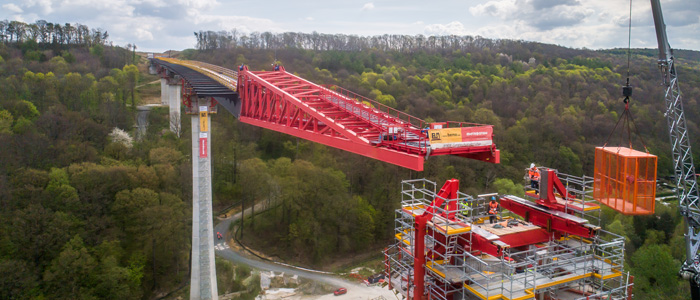
Another issue is related to the launching bearings. Due to the slenderness of the steel box webs and the skew geometrical arrangement resulting in combined axial and bending stresses, the stresses induced on them must be limited. The requirement resulted in the design of 6m-long launching bearings with limited lateral imperfections of the sliding plates. The superstructure and launching bearing deflections are compensated by elastomeric pads of varying thicknesses. In order to achieve robustness in the design, each elastomeric pad had to be tested in both warm and cold environments according to the EN 1337-3 standard. Special construction of the sliding plates had to be developed to compensate for the high contact stresses.
Finally, due to above-mentioned slenderness of the superstructure (3.57m for the span length of 124m, equating to 1 to 35), there are unusual deflections on the tip of the launching nose - up to 6m are expected during the launching of the longest spans. These deflections have to be compensated by vertical adjustments to the launching nose. In order to enable that, the end of the launching nose adjacent to the superstructure is equipped with two hydraulic jacks providing the required movements, as well as a safeguarding structure with steel pins to provide mechanical stability between the adjustment stages.
During the launching, three set-ups are being used: 6m for the touchdown, 4m after the touchdown, and 0m (tangential) so the launching bearing can cross from the launching nose to the superstructure. This demanding manipulation of the launching nose makes the launching process even more challenging.
When launching is complete, the bridge will be lowered onto the bridge pier heads, a procedure expected to also be very demanding. At the end of this stage, the superstructure will be connected to the five bridge piers in the valley with hinges.
The most challenging part of the construction will come thereafter, however, in the form of the construction of the haunches, ie the rigid connection between the slender piers and the slender superstructure. The construction of the composite bridge deck and the remaining works on parapets etc will follow afterwards.
The next launch, planned for the beginning of August 2023, will be the first that crosses a populated area as well as trafficked roads. The entire launching process should be finished in summer 2024.
Marek Foglar is project manager at Metrostav and associate professor at the Czech Technical University in Prague