One man's five-year adventure tracking down the world's highest bridges has culminated in the launch of a fascinating new website. Helena Russell reports
For many bridge engineers, a holiday is not just an opportunity to get away from the office and have some rest and relaxation; whatever their destination, there is often a bridge or two worth visiting in the vicinity or on the journey. Some enthusiasts even organise tours specifically to visit famous bridges.
But these examples are generally visits to well-known structures that are extensively documented, photographed and often world-famous. For the last few years Eric Sakowski's holidays, by contrast, have been dedicated to seeking out the world's highest bridges, some of which are still being built and many of which are not known of outside the immediate geographical area.
Sakowski has spent the last five years travelling the globe looking for high bridges, poring over books in Chinese engineering libraries and visiting remote areas to track down these elusive bridges, the existence of some of which was barely more than a rumour when he set out.
Now he has launched a website to share his findings with the international engineering community and in the hope that he may discover more high bridges that are under construction, or that he has missed.
Such dedication would be understandable if Sakowski were a structural engineer or architect, but in fact he is neither. His enthusiasm for the task comes simply from his love of bridges and particularly for those on the larger end of the scale.
'When I was a kid I used to love the Guinness Book of Records,' he says, 'and I loved reading about the highest, tallest, longest and so on. From 1973 onwards I got every new edition of the book and read it from cover to cover.' He was particularly interested in structures that were subject to large and unusual forces - he also has a passion for rollercoasters - and which seem to 'snub their noses at the forces of nature'. Added to this was his love of travel and geography, as well as his interest in photography.
Years later, when the internet age arrived, Sakowski thought it would offer him the opportunity to find out more about the world's largest bridges, but he soon realised that although a lot of information was available online, bridges were more often classified by their length than their height.
The Royal Gorge bridge in the USA had always been listed as the world's highest bridge, and initially Sakowski's intention was to create a list of other high bridges. But once he started digging it became clear that there were a lot more bridges out there - many of them recently built or under construction - that were much higher than the 'world record holder'.
Sakowski set out to create a website that would detail these bridges and hopefully classify the world's highest bridges. He set out criteria for what he would include and how he would measure this height, 'but I never thought there would be 400 bridges in the world that exceed 100m in height from deck to water,' he says.
Luckily Sakowski enjoys the thrill of the chase, which probably explains his determination in tracking down the many unknown bridges that top his lists.
'It's a bit like an Easter egg hunt,' he says, 'and it's very satisfying to find more hidden bridges.' Half of the adventure of finding a new bridge is the need to get photographs of the structure. Sakowski tries to capture a bridge from as many angles as possible, which can involve trekking through open country and exploring side roads to try and find a good aspect. But he admits that the search for bridges can also be frustrating, especially when the definition of the height of a bridge is not a universally-defined measure in the same way as span length.
Although he started working on the website five years ago, Sakowski only expected his research and development of the site to take a couple of years. But after two years' work, he realised that China represented a big void in his data. Through getting in touch with Bridge design & engineering, he came into contact with Maorun Feng, director of the Ministry of Communication, and in during brief meeting in China, he was given a peek at the details of some of the country's highest bridges. 'I realised then that the adventure would have to step up a bit,' he recalls, 'and I would have to travel out into the mountains to reach the sites of the highest bridges.'
'The initial contact with Feng started an adventure that took me back several times,' he says. 'Much of it was necessary to travel to remote regions of western China and photograph and measure many high bridges that had recently been completed or were under construction. China now has about 45 of the world's 100 highest bridges, and by 2020 they may well have more than 50 - a greater number of the world's 100 highest bridges than every other country on earth combined!'
Finding bridges in China is definitely a challenge, Sakowski confirms. 'Many I discovered by typing Chinese bridge words into a Google image or word search. When something big or interesting showed up I would then type in the bridge name symbols which I can now identify and then get more information on just that particular bridge. For the true English name and location I would then have to send it back to my Chinese contact Shijie Du in Shanghai and have him translate it and try to find the location.'
Other bridges were discovered by going through Tongji library in Shanghai or the Ministry's engineering bookstore in Beijing which holds bridge year books detailing big bridge projects around the country for that year. 'I would photocopy the articles if they were high bridges and ask my friend in Shanghai to decipher it all for me,' says Sakowski.
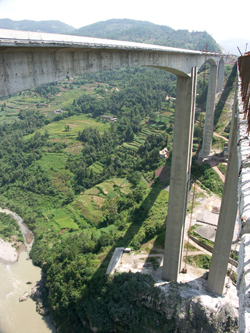
'Longtanhe bridge was one I stumbled onto on the internet and had my Shanghai friend figure out where it was. Then in 2006 we had our first visit to it when construction was half completed. That was the only time we were helped by Hubei province's DOT; I think they were curious to meet this crazy American who wanted to go deep into the mountains to visit their high bridges.
'In 2008 when we went back to Longtanhe we hired a driver and he took his brand new car on some of the nastiest roads you can imagine. I felt sorry for these taxi drivers as I would never take my car on these roads for US$125 a day.'
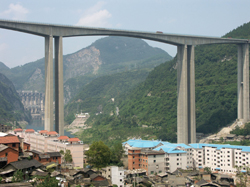
'Another bridge we visited along the highway north of Guiyang was the monstrous Wujiang viaduct, which is located at Wujiang city,' says Sakowski. 'This bridge was completed in 2008 and has piers 151m high. I have never seen a bridge dwarf a town as this bridge does. Visible from nearly every part of the city, the massive, mile-long viaduct dominates the entire valley, effortlessly leaping over multi-storey apartment buildings. The thick, monolithic piers support four lanes of highway 173m above the Wujiang river and it has long drainpipes full height on several of the piers to prevent highway runoff from falling onto the people and buildings below.'
As he tried to finish the international section of the website on the world's 500 highest bridges, information kept arriving about new bridges in China. 'I half-jokingly told my engineer friend in Shanghai to tell the Chinese to stop building high bridges for just one month so I can get my website finished!' says Sakowski. Very recently he added the Labajin Bridge which has a pier 182.5m tall and is now the tallest in China, even though it is still under construction.
Then at the end of last year, China opened Siduhe and Balinghe, the two highest suspension bridges on earth, loc