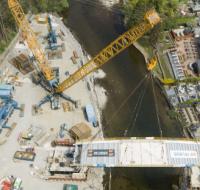
The solution that was developed enabled all six sections of the Beitstadsund Bridge – including two side spans over land – to be placed in their final locations using minimal quantities of equipment.
The new crossing under construction is located near the village of Beitstad and spans Beitstadsund, a strait on Beitstad Fjord around 120km northeast of Trondheim. The crossing is part of a new 14km-long coastal county highway that aims to improve traffic flow and safety by decreasing the number of bends in the road, as well as by avoiding the village of Velle. Enabling travelling speeds of 80km/h, the new tolled spur Fylkesvei 720 will considerably reduce travel times on the Malm-Østvik-Steinkjer route.
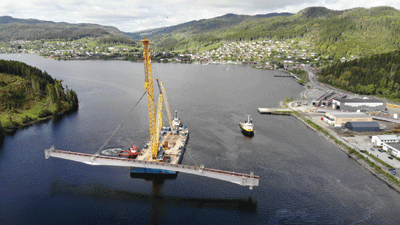
The bridge's six sections were installed in two weeks
Beitstadsund Bridge is being constructed for the Norwegian Public Roads Administration and Trøndelag County Municipality by the Sichuan Road and Bridge Group.
The new crossing is a steel box structure with a concrete deck and consists of six spans, four of which are over the fjord and measure between 93m and 149m, and two over land, which are approximately 40m long. The 6m-wide steel structure, which has a 30m clearance above the water, widens to 15m on the north side of the strait.
A strict schedule required that all six segments be transported from the assembly yard in Malm and then installed at Beitstad within a two-week window.
A number of options were considered by Sarens, who had been selected by SRBG to carry out the transportation and installation of the steel elements, three of which weighed over 600t.
One option that was discarded as being too time-consuming was to lift each section over land from the abutments, which would have required site preparations for the 650t-heavy crawler cranes as well as their dismantling and relocation to the opposite abutment. This was considered unachievable within the construction window, which needed a span to be installed every second day.
Also reviewed was increasing the number of segments to be installed, which would reduce the weight of the segments and therefore the lifting equipment required. This idea was dismissed due to the impact of the extra welding activities on the schedule. Also not progressed was using a combination of shear legs and a land-based crane to lift the sections into place, because this lifting method would have required further planning and resulted in increased costs due to the extra equipment needed.
The option that was selected consisted of carrying out the whole operation over water, a method that offered the significant advantage that all the equipment required could be transported on a single barge from Sarens’ headquarters in Belgium.
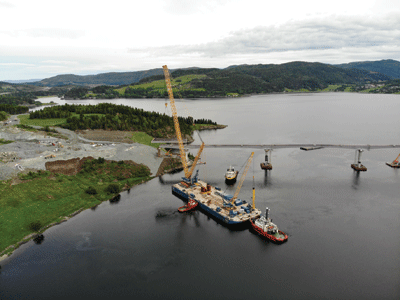
A 110-m long barge was used for installation
Operations commenced on 29 May at the fabrication yard in Malm, a village around 2km away from the bridge on the same fjord. Here the first steel section was lifted and transported by two double 6-axle lines of Kamag K2400 self-propelled modular transporters to the loading location. This section was then lifted by a 1,600t-capacity Terex Denmag CC8800 crane positioned on the barge, and secured to the front of the barge using two cables, as well as fall-back safety lines
The 110m-long barge also carried a 40m-long, 65t-heavy spud operated by a smaller CKE2500 crawler crane, which was part of an anchoring system that also comprised land- and water-based anchoring points. Each section was lifted and then transported to the bridge location using the same method.
The four bridge spans located over the water were installed first, moving inwards from each side of the river following a two-day cycle. A day of preparation was followed by a day for installation, so these four spans were in position after eight days.
The last two sections, which weighed 131t and 205t, represented a significant challenge due to their location over land. “For one particular span an installation radius of 98m was required, with an important load moment on the crane,” explains Sarens project group manager Sven Janssens. “So we had to reconfigure the crane with a longer boom.”
Following three days of reconfiguration, the last two sections were installed, with the final section being carried out, on schedule, in a record-breaking operational cycle of just 10 hours. “The first section had taken 19 hours,” observes Janssens.
Casting of the concrete deck was scheduled to begin towards the end of July and is expected to be completed in September.