
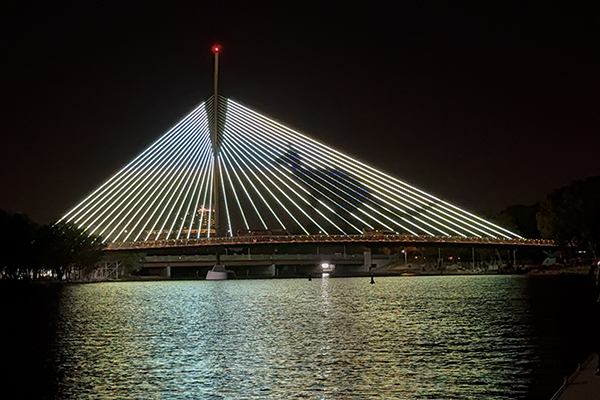
The bridge's cables function as digital canvas during lightshows (CLA/MRWA)
The new landmark footbridge features a cable-integrated LED lighting system that is almost invisible during the day but at night can create stunning light shows displaying the Australian flag, native wildlife and even readable text.
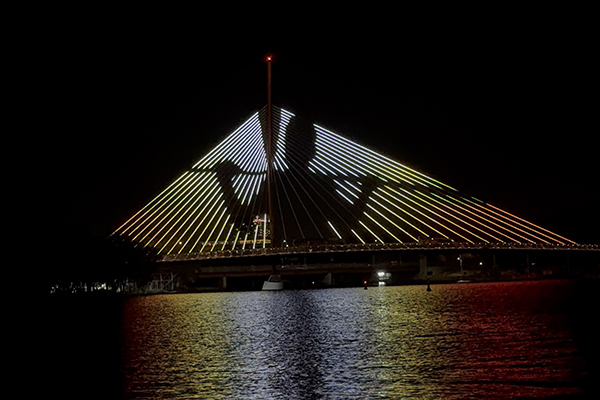
Various images of cultural significance can be projected onto the cables via templates (CLA/MRWA)
Located in Perth, the state capital of Western Australia and the country’s fourth most populous city, the approximately 1km long and 6m-wide Boorloo Bridge carries a segregated cycle and pedestrian path over the Swan River (also known as Derbarl Yerrigan), connecting McCallum Park to Heirisson Island (or Matagarup) and Perth’s central business district via the Point Fraser recreation area.
Main Roads Western Australia commissioned the crossing in 2020 to boost economic growth and reduce traffic on the nearby 2m-wide heritage-listed Causeway Traffic Bridge, which served 1,400 cyclists and 1,900 pedestrians daily. The new S-shaped bridge consists of two connected curved weathering steel box girders with main spans of up to 155m. It includes two cable-stayed sections: an approximately 280m span from McCallum Park to Heirisson Island, and an around 163m span connecting the island to the Point Fraser recreational area. The design is inspired by the Whadjuk Noongar people’s cultural heritage: the two inclined pylons on the McCallum side, each 46m high, symbolise ‘wannas’ – digging sticks used to harvest edible roots – while the 52m-high pylon at Point Fraser (Bd&e issue 113) symbolises the ‘koylie’ hunting boomerang.
The Causeway Link Alliance, made up of Civmec Construction & Engineering, Seymour Whyte, WSP Australia, and Main Roads WA was responsible for the design and construction of the bridge while Freyssinet was contracted to develop the stay-cable system.
The client’s vision for an iconic landmark bridge eventually led to the commissioning of a custom LED lighting system to be installed on the bridge’s stay cables. “Main Roads WA had added LED lights to a few bridges in the Perth area before, but never on this scale or on stay cables,” explains Nikolaj Pedersen, national design manager at Freyssinet Australia.
At the time of the request, work was under way at the site to meet the target opening date of December 2024 and Freyssinet was half-way through the design of the stay cable system. The original plan was to space the cables for both over-water sections eight meters apart along the respective decks. However, the client requested tripling the number of stay cables to create denser, canvas-resembling surfaces for projections. Although it was too late to alter the design for the section starting at McCallum Park without causing major construction delays, Freyssinet was able to collaborate with designer WSP to triple the stay cables on the section connecting to Point Fraser. The Boorloo Bridge now features a total of 64 stay cables.
Aerodynamic stability and aesthetics were the guiding principles for the design of the lighting system. “It was important for us that the system be able to deal well with all the movement that can occur during wind and rain; simply putting some lights, like you put lights on the Christmas tree, was not going to be good enough, especially for such aesthetic footbridges people will spend time outside to enjoy,” says Miklos Toth, Freyssinet’s project engineer who headed research and development for the lighting system.
The typical method of attaching LED units externally to the stay cables can detract from aesthetics during the day, with visible fixings and wiring creating noticeable protrusions. More critically, it can compromise a bridge’s aerodynamic stability: “This is a real issue seen worldwide,” says Pedersen.
The final design is a fully integrated system with no protruding elements. Each stay cable is encased within a larger high-density polyethylene (HDPE) duct, with LED units installed in the space between the cable and the external duct. The LEDs are arranged in two lengthwise lines at the 9 and 3 o’clock positions, if viewing the cable as a clock face. Rectangular openings in the outer duct expose the LEDs.
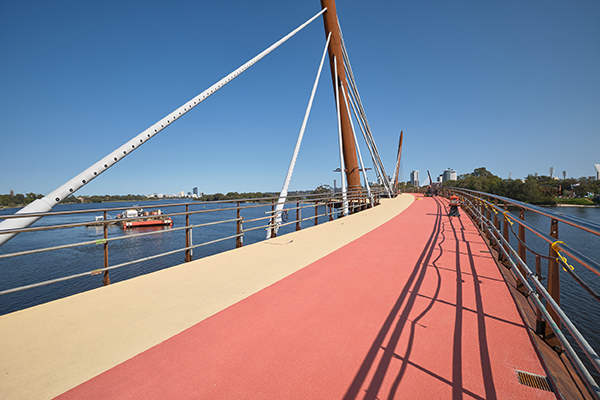
Above and below: the fully integrated lighting system has no protruding elements, improving aesthetics during daytime and at night (CLA/MRWA)
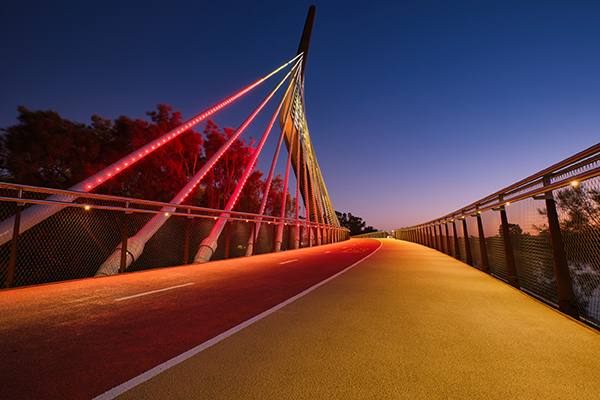
A standard HDPE duct was used for the outer tube to ensure reliable performance and simplify future maintenance. While a smooth surface was essential for aerodynamic stability, the duct’s original helix pattern was kept, as it helps reduce vibrations from wind and rain.
As this is a new system, the team built several mock-up models and conducted extensive wind tunnel testing. The tests showed that most cables would remain stable in adverse weather, but some required additional measures. As a result, Freyssinet’s internal radial dampers were added to seven of the longest cables. Meanwhile, preparations were made on the remaining cables to facilitate the addition of dampers if required in the future. Developing the system, including mock-ups and wind testing, took approximately seven months, estimates Pedersen. “The drag and lift factors of the final design are nearly the same as those of a bare stay cable without LEDs, with a drag factor of about 0.6, which is excellent for such a stay cable,” he adds.
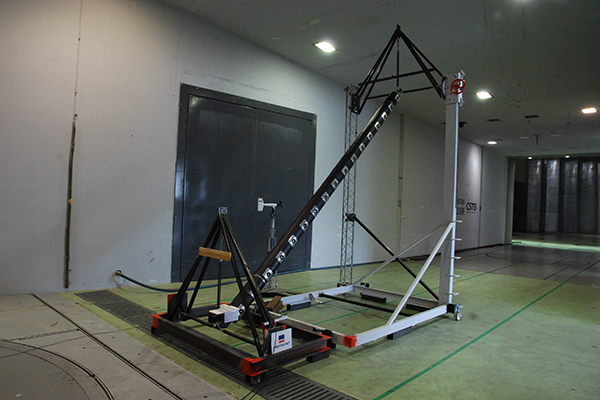
The integrated lighting system underwent wind testing (Freyssinet)
While installing the lighting system during the initial cable installation would have been a relatively simple operation, the cables on the McCallum-Heirisson section were already in place. Any plan that required removing or altering them could have delayed the project and risked missing the target opening date. Consequently, Freyssinet developed a method to retrofit the external duct and LED units without disrupting the stay cable system. The mock-up models were also used to inform the final installation plan.
Each external duct is installed in two halves, with each half split lengthwise. During installation, workers manually clip a section of the two half-tubes together, then a winch at the top of the cable hoists the joined section up along the cable. Workers continue clipping the next section until the process is complete. “The installation method is very fast: we could install up to two ducts [fully covering two cables] per day,” estimates Pedersen.
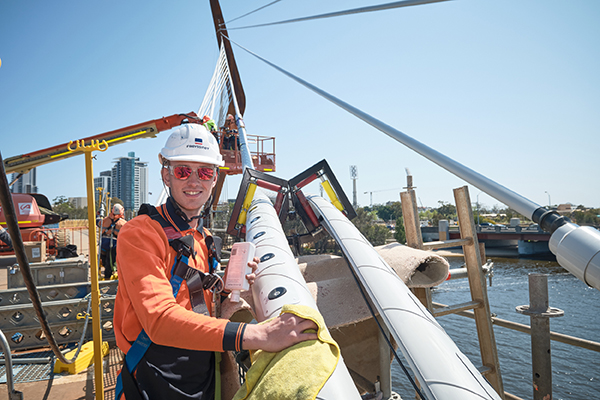
Installation of an outer duct with LED units (Freyssinet)
Accuracy during installation was crucial because once the tube sections were locked together they could not be unclipped and rehoisted, says Toth. Any mistake would require fully undoing the external duct and using new components.
Prior to installing the full-length external duct, an LED unit would be installed inside each hole and its wiring connected to the previous unit. A bezel plate holds the assembly in place with four screws, one at each corner. The plate’s colour matches the duct to make it less noticeable during the day.
The LED units of the client’s preferred supplier required 300mm spacings, which would have needed workers to reach inside the tube to detach malfunctioning units for replacement. To ease future maintenance, Freyssinet requested that the supplier modify the design and triple the wiring length between units to 900mm. This allows workers to pull a malfunctioning unit outside the duct for repair or replacement with minimal time spent working at height on the stay cables, fulfilling another client request. To replace a unit, staff simply remove the four bolts, pull the assembly out, replace the unit, reattach the wiring and secure the assembly plate via the four bolts, minimising downtime, effort and the risk of accidents.
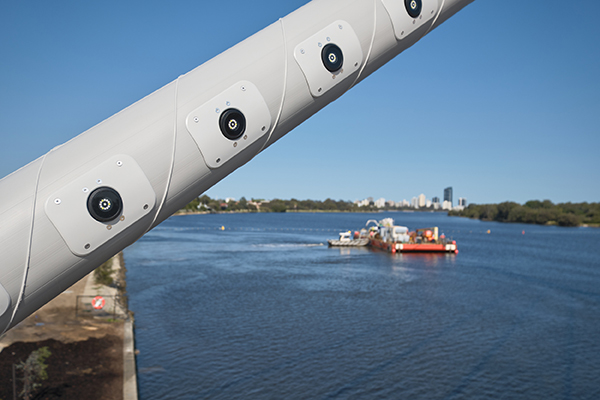
The wiring between LED units was trebled to facilitate future maintenance (CLA/MRWA)
A total of 17,130 energy-efficient LEDs are installed on Boorloo Bridge: approximately 6,700 on the McCallum end and about 10,400 on the Point Fraser side. Additionally, Gobo projectors have been installed at each of the three pause points on the cable-stayed sections, enabling the projection of images and messages through lens templates.
Boorloo Bridge’s lighting and stay-cable systems function independently without interacting. If at some point in the future the client wishes to remove the LED system, it can be done without interfering with the stay cables.
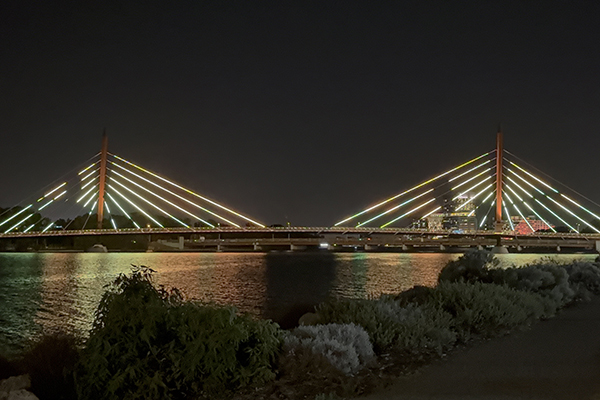
The McCallum end of the bridge features approximately 6,700 LEDs (CLA/MRWA)
The carefully planned installation methodology allowed the team to complete the works without errors and on time, leading the Boorloo Bridge to open to the public as scheduled in December 2024. The developed retrofit installation approach prevented delays on the project while also enabling the system to be easily installed on existing cable-stayed bridges. Freyssinet is currently in talks to install the system on another Australian bridge.
“This project was a unique experience, as we had to rethink everything we know about drag, lift, aerodynamic stability, and the installation and stability of HDPE ducts from scratch,” notes Toth. “It has been a radical innovation, and the client is happy with the results,” adds Pedersen.
Pedestrians and cyclists in Perth can look forward to the stunning visual displays the Boorloo Bridge will offer against the city’s skyline.
Client: Main Roads Western Australia
Design and construction: Causeway Link Alliance comprising Civmec Construction & Engineering, Seymour Whyte, WSP Australia, and Main Roads WA
Architects: Dissing+Weitling
Cable-stay and lighting systems: Freyssinet
LED supplier: Signify