

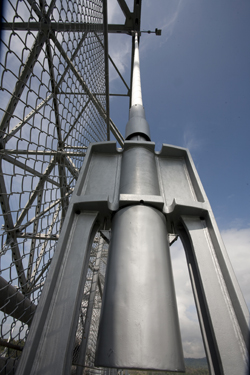
Progressive corrosion in the suspender cables of Panama's 50-year-old Bridge of the Americas led to their replacement earlier this year. Patrick Ladret reports
A delicate operation was necessary to replace the hangers on a bridge in Panama without overstressing the structure itself. The Bridge of the Americas forms a key part of the Pan-American highway - it was designed by Sverdrup & Parcel and built between 1959 and 1962. Its 1.7km length extends over 14 spans and the main span is a 344m-long bowstring arch.
On this span, the deck is suspended from 42 hangers, each consisting of four wire ropes made up of seven galvanised strands each, connected to a trussed tied arch. The length of the hangers varies from 7m up to 31.4m. The bowstring sits on two steel truss cantilever arms of variable height.
Initial inspections in 1973 and in 1978 suggested that the service life of the cables was between 40 and 50 years. But an inspection by TY Lin International in 1997 discovered corrosion in the cables.
In 2005, the Panama Canal Authority awarded a contract for the inspection and design of structural rehabilitation of the bridge to a joint venture of Ammann & Whitney/Louis Berger Group. Work included magnetostrictive inspection of suspender cables.
At this stage corrosion was qualified as progressive in suspender cables (60% of the wires) with varying degrees of section loss in localised areas and a growing number of broken wires. Corrosion had progressed significantly since the last inspections, hence the authority decided to replace all the suspenders in order to preserve the bridge service life.
In early 2008, the Ministry of Public Works of Panama awarded the project for the structural refurbishment of Las Americas bridge to the Asociaci'n Accidental (AAPA) joint venture of Freyssinet and Panamanian contractor Cusa.
The project scope of work was to replace the suspender cables by a parallel self-protected strand system in accordance with the PTI recommendations for stay cables.
Structural analysis, design and methodology of the hanger replacement - structural model, drawings and specifications - was included in the contract, along with replacement of the sliding guiding pins at dummy members.
Bearings had to be reset and the bearing devices themselves cleaned and painted to protect against corrosion. Sealing and injection of cracks in the piers and the seat of the abutments, restoration of the rip rap for ship impact protection of the piers, and replacement and installation of new components such as handrails, stairs, protection barriers, hatches and cyclone fencing formed the remainder of the contract.
The schedule was complicated by the need to meet two objectives: to ensure the safety of bridge users while reducing the impact of the work on them. To achieve this the structural requirements of every replacement phase were analysed in order to carry out the stages with the biggest impacts in the shortest possible time. The traffic for each hour in each direction was analysed, while a traffic management plan with alternative routes for trucks and heavy loads was put in place to reduce the impact on and risk to bridge users.
The first technical proposal for use of temporary stay-cables failed to meet schedule requirements: it generated loads near the suspender connection nodes such as gussets, beams of the bridge and the arch ties, for which the structure was not designed. The structure is composed of various materials of different strengths, and the available information did not allow all the arch and deck components to be classified precisely. The loads and bending moments exerted by the temporary stay cables exceeded the strength capacity in some members, depending on the properties of the material in that member.
Finally the engineers chose to place the new stay cables between existing cables. As well as preserving the structural integrity of the bridge, it also enabled a reduction in the critical path, reducing the amount of time required for the cable force transfer activities from 21 weeks with temporary cables to just 17.
Before any work took place on the bridge, Freyssinet-Cusa carried out a full inspection to gather the full as-built data of superstructure, in order to adjust member strength during the structural analysis and clarify the methodology of the rehabilitation. This work included non-destructive testing of those materials for which no information was available. In the case of the ropes, for example, there was no spare material to test in order to determine its exact composition. Instead this was solved by use of analogy and reference to existing norms and the supplier catalogue from the time of the bridge construction. The force in the hangers was also measured using the taut string method, and a survey of the bridge was carried out when it had not traffic on it, and also during a load test.
For a general review of the bridge, using the information collected during this inspection, a three-dimensional model was performed. Structural analysis was conducted following AASHTO LRFD rules. The models and structural analysis included the bridge's original state, bridge with new hangers, seismic behaviour and state of the bridge at various stages of replacement of each hanger. Independent checking of the bridge analysis, at the initiative of Freyssinet-Cusa, was carried out by Ammann & Whitney.
The client wanted the new system of hangers to be made of parallel strands that would fulfill the current recommendation of the Post-tensioning Institute. To meet this requirement, Freyssinet H-1000 was chosen, which provides a 100 year service life.
Each hanger is made up of 15 T15, seven-strand (150mm2 diameter) with a nominal tensile strength of 1,860N/mm' and triple protection against corrosion - galvanised wires, wax filling and individual sheath of HDPE. Both hanger terminals are fork-shaped and the anchorages are fitted with individual strand fatigue systems consisting of extrusion sleeves at the top and conical jaws at the bottom; this enables individual strand replacement. The bundle of strands is contained in a white HDPE outer sheath that improves its aerodynamic behaviour and cable aesthetic.
Each hanger enables the original anchor system to be kept hollow, so it is easily accessed for restoration projects. The hanger fork terminal connecting to the existing structure is designed and verified according to the PTI recommendations.
The purpose of the replacement project was to restore the structural integrity of the hangers. The overall response of both arch and deck during the works and in service should equal that with the original cables.
The system chosen provided a number of advantages in terms of planning, traffic impact, technical and structural safety, at the same time generating stress levels on the structure that are lower than, or equivalent to the initial levels.
The process was designed to enable the old and new cables to coexist without overstressing the structure, until the old hangers had been dismantled. The original force and axial stiffness of the hanger was maintained in order to control and re-establish the deck and arch geometry and deformation under service conditions. The mechanical properties of the new hangers do not mitigate deformations and comfort of bridge users.
New hangers were initially placed with no force, then stressed to a calculated intermediate force under limited traffic loading. This force was such that it partially distressed the old hanger but without exceeding the strength in the arch and deck members, or provoking