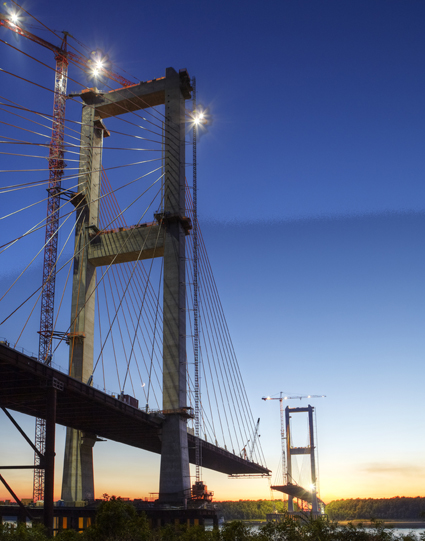
South-central Louisiana is now home to what is claimed to be the longest cable-stayed bridge in North America; the John James Audubon Bridge, which crosses the celebrated Mississippi River with its 482m-long main span. The structure is named after the naturalist John James Audubon, who once lived near the bridge, and in recognition of Audubon’s legacy, harmony with nature was a guiding principle in the development of the bridge concepts and details.
In fact the US$408 million project consists of more than just the landmark bridge over the mighty Mississippi River. In addition to the 3.7km-long crossing of the floodplain, there are seven bridges across bayous and a railway siding. This greenfield project is being built through the wetlands and cane fields that border the Mississippi and extends for 19km between the towns of St Francisville on the east side of the river to New Roads on the west. Part of the wetlands between these towns is the habitat of the threatened Louisiana black bear, so ten bear crossings were incorporated into the project, exemplifying the spirit of conservation inspired by Audubon. The tunnels provide a continuous habitat allowing the bears to travel under the road and they are combined-use features, doubling as drainage structures at high water levels.
The Louisiana Department of Transportation & Development first initiated the design-build process for this landmark project in 2005, but it was interrupted by Hurricane Katrina, which devastated the Gulf Coast. While the hurricane itself only delayed the procurement by about four weeks, its effect on material and labour availability for the project was felt for some time.
The joint venture of Flatiron Constructors, Granite Construction Corporation, and Parsons, working under the name of Audubon Bridge Constructors, was one of three design-builders shortlisted by LADOTD and invited to propose on the project. In addition to achieving the highest technical score, ABC also had the lowest adjusted price and hence was awarded the project in May 2006.
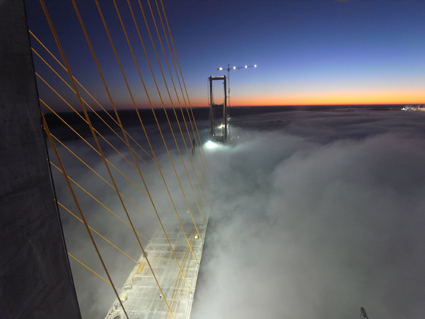
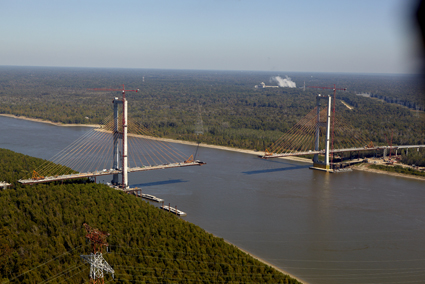
The centre-piece of the Audubon Bridge project is the main cable-stayed span across the Mississippi River; this part of the structure consists of five spans, symmetrically arranged about the navigation channel. The 482m-long central span is flanked on each side by 189m-long side spans, which are also supported by the stay cables, and by 49m transition spans. The semi-fan arrangement of stay cables offers both economic and aesthetic benefits, and the two planes of stays attach to the top flange of the plate girders to support the steel edge girders.
Anchorage of the stays in the two 152m-tall towers has been designed to enable access for stressing and make it possible to replace stays in the future, if necessary. But while this feature makes replacement possible, the stays are not expected to need replacement, as ABC has installed a system with three levels of corrosion protection. Individual strands are galvanised, greased and sheathed with polyethylene, and the entire strand bundle is then encapsulated in a high-density polyethylene duct.
A flexible superstructure system is provided by two 1.8m-deep steel plate girder edge beams supported by the stay cables. The cable anchorages are spaced 14m apart, with floor beams spanning between girders at 4.6m intervals. The deck slab is composed of 240mm-thick precast concrete panels that span between floor beams and are connected by cast in situ concrete joints. The deck panels are composed of 55N/mm2 high-strength concrete, which is necessary to resist the compression forces induced by the inclined stay cables. The deck panels are post-tensioned in three parts of the structure where the compressive forces are reduced: the middle of the central span and over each of the anchor piers.
Several key features were included in the design and construction of the Audubon Bridge in order to meet the stringent 100-year design life requirement of the contract. Weathering steel is used as the structural steel in order to reduce the initial cost of the project, as well as to lower maintenance costs during the life of the structure. This steel not only protects from corrosion, it also enhances the aesthetics of the bridge, as it is a reddish brown colour that blends into the surrounding area. The sacrificial thickness of the steel was determined in order to ensure that the structure maintained sufficient member resistance throughout its life.
Also, the concrete deck panels are protected by a 50mm overlay of latex-modified concrete, which provides a smooth riding surface as well as additional protection to the reinforcing bars in the concrete deck panels. The overlay serves as a replaceable barrier which preserves the underlying precast deck panels for the life of the bridge.
Each stay cable is connected to a sealed anchorage at both the deck and the tower. The anchorages were designed by the manufacturer and tested in accordance with the Post-Tensioning Institute’s Recommendations for stay cable design, testing and installation to confirm that they provide reliable leak-proof protection to the ends of the strands. The stays are protected against vibration by friction dampers specifically designed to suit each stay’s characteristics. The dampers’ performance has been confirmed through testing after construction, but as a contingency, provisions for additional viscous dampers have been made in case unpredicted cable vibration is observed.
The stays were installed and stressed one strand at a time, using a system specifically developed by manufacturer VSL. This process allows for the use of a much smaller stressing system that can be easily manipulated inside the tower section. Since the superstructure system is relatively flexible, the stays were stressed to final length and confirmed to be within the tolerance of the design forces. Final adjustments were then made to balance the load and structure elevation.
Bridges across the lower Mississippi River have traditionally been built on sunken caissons, as the soft sediments are quite deep and there is no rock within a reasonable depth. However, for the Audubon Bridge, the foundations were constructed on 2.4m-diameter drilled shafts to eliminate the risk associated with lowering a caisson. The drilled shafts are founded in a dense sand layer, approximately 60m below the river bed. A further increase in depth was not feasible, as the dense sand is underlain by a very thick layer of clay. Extending the drilled shafts into the clay would have resulted in a significant decrease in end-bearing capacity, which accounted for nearly half of the capacity of the shaft. Therefore, the end-bearing capacity was enhanced using a technique known as tip grouting. This process injects cementitious grout at the base of the drilled shaft, after the shaft has been poured, in order to compress the soils at the base of the shaft.
This technique has the added benefit of increasing the side shear capacity of the shaft near the tip.
The drilled shafts were installed using a permanent casing in the upper region of the shaft, in the scour zone, in order to provide additional bending capacity as well as a form for the shaft where it extends through open water. The lower portion of the shaf