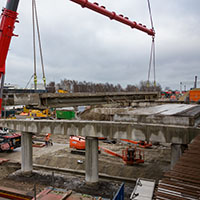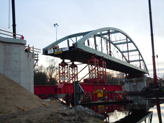
Almost two years into a five year construction programme, the legs of the pylons for the new Cooper River Bridge are rising from the huge ship protection islands in the middle of the waterway in Charleston, South Carolina.
As Bd&e went to press, steel girders for the approach spans were being lifted into position, while concrete girders were being placed on the Charleston interchange, but the really visible work was under way on the main bridge, with construction of the concrete pylons.
The 471m main-span bridge features two diamond-shaped concrete towers supported on 3m diameter high-capacity drilled shafts. Each of the towers is protected from ship collision by a large rock island and the main navigation channel will be 305m wide (Bd&e issue no 28). The towers will be 183m high from the water line to the top of the tower.
High-level approach spans that are approximately 2,438m-long make use of composite steel girders and reinforced concrete piers. The mainline structure will include the main cable-stayed structure and approaches totalling approximately 4,000m.
Design of the new structure has bee carried out by consultant Parsons Brinckerhoff, working for the design/build contractor Palmetto Bridge Constructors, and as Parsons Brinckerhoff senior vice president Mike Abrahams explains, the procurement process had to be adapted to suit the budget of the client. "Under the traditional method, as the design work progressed, the projected cost of the bridge continued to rise. South Carolina DOT had limited funds for the project, so it decided to halt the preliminary design and put the scheme out as a design/build contract."
By this stage the profiles, alignment, boreholes and so on had been set. The design/build team provided the DOT with a selection of fixed price options from which to choose. For example the client was offered the option of a four-lane bridge, an eight-lane bridge, the possibility of a transit lane or walkways and so on. The choice of an eight-lane bridge with walkways clocked up the US$530 million price tag.
Palmetto Bridge Constructors, which is a joint venture between Tidewater Skanska and Flatiron Structures, has to meet a very aggressive and demanding programme to complete the crossing by the July 2006 deadline.
Due to the history of seismicity in Charleston - there was a magnitude 7.3 earthquake in 1886 - the design was particularly challenging. Abrahams explains: "This is one of the hotspots of the USA in terms of seismic activity," he says, "and the area has a history of major seismic events." Hence the design included a time-dependent non-linear analysis to evaluate the effects of a 2500-year event. The structure also had to be designed to cope with hurricane wind forces.
The required seismic criteria also affected the design of the foundations, Abrahams reveals. The bedrock here is Cooper marl, but it does not occur until some 50m depth, and is overlain by a very soft material. To address this problem, large-diameter drilled shafts were chosen as the foundations for the main pylons - 11 shafts for each pylon - and these provide the requisite flexibility for the seismic design.
A total of more than 400 drilled shafts are being installed for the foundations of the entire bridge - work on these started in the spring of 2002 and is expected to be completed this summer.
Another design issue that had to be considered was the longevity of the concrete structure - with a 100 year design life required, this was very important. The usual solution of specifying epoxy-coated, galvanised or stainless steel rebar did not meet all the criteria, and the use of silica fume for the concrete was not really suitable either.
In the end, explains Abrahams, a concrete permeability was specified and the contractor talked to local concrete suppliers to find out how this could be achieved. The solution - using a fly-ash based concrete from a local source - has provided a cheap mix with a very low permeability, and is a good example of how the design/build procurement route can work successfully.
The two massive pylons, some 472m apart, will support the loads of the cable-stayed construction which will eventually connect both sides of the Cooper River.
When finished, the diamond-shaped pylons will soar to 175m, and the deck at centre-span will be 61m above the water, in order to allow the passage of even the largest ships.
The short construction time and logistical requirements, such as the fact that all materials have to be transported to the two pylons by barge, and the need to use as little crane capacity as possible, meant that the use of a self-climbing formwork system was vital to ensure that certain milestones could be achieved.
Contractor Skanska had used Peri's Automatic Climbing System successfully on the Uddevalla Bridge in Sweden - a structure very similar in size and geometry to this one - and decided that it would choose the same solution for the Cooper River Bridge.
This system was developed for crane-independent formwork for tower-like structures such as high-rise building cores and facades, bridge piers and pylons, and shafts.
The stringent requirements for quality of the concrete surfaces together with the required dimensional accuracy can be achieved using this self-climbing system combined with Vario GT 24 girder wall formwork. The self-climbing system also provides a very safe solution, since the scaffolding units remain permanently connected to the structure, even during climbing. Construction design has been assessed based on high wind speeds for offshore applications, and all wind loads according to DIN 1055 have also been taken into consideration.
For the Cooper River Bridge piers, Peri engineers designed a formwork concept containing detailed pre-determined working speeds which are maintained by the construction crews to ensure a high degree of productivity. Approximately 1,000m2 of Vario GT 24 girder wall formwork has been used as well as eight ACS-V platforms for the inclined sections of the piers. Eight ACS-R platforms are required for the sloped areas which are taken the ACS modular system. Two 50m-long temporary bridges built using a Peri-designed special steel construction allow personnel to move safely between the two pylon legs. The concreting height per section is constant at 4.15m with the exception of some cable stay areas.
The varying wall thicknesses demand an easy-to-use, variable formwork solution in order to keep reassembly time to a minimum. Platforms are assembled and modified at the job site on specially-built assembly areas and then transported to the piers on barges. During this time a Peri supervisor assists on-site and supports the construction crews in case particular concerns have to be addressed.
On the lower half of the pylons, on the section before the slope begins to vary, each 4.15m section can be concreted in a week. But due to the simplified reinforcement arrangement and smaller construction geometry, concreting will take place every four to five days in the top half. The contractor has already managed to reduce the scheduled pour sequence from seven to five days.
The main project elements consist of the cable-stayed crossing with its 471m main span, carrying eight lanes of traffic, four in each direction, which are separated by a central barrier. There is also a pedestrian walkway/bikeway. Two diamond-shaped concrete towers supported on 3m high-capacity drilled shafts to a depth of 64m, will carry the deck over a 305m main navigation channel. Approach spans total 2,438m