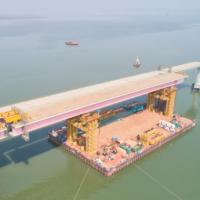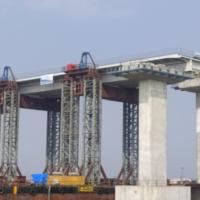
At Sultanganj, a site of mass pilgrimage on the holy Ganges River in the underdeveloped Indian state of Bihar, contractor SP Singla Construction has begun building what will become a new landmark crossing valued at US$200 million.
Bihar is India’s most populous state, but one of the poorest with 80% of the population still working in agriculture over the wide fertile plains. The rate of economic growth is one of the fastest as the state strives to raise living standards with per capita GDP still only US$680 compared to US$1600 for India on average and US$57,000 for USA.
Much of the state has very poor highway infrastructure which greatly hampers activity. At the beginning of the monsoon each year, long convoys of trucks and tractor-trailers become bogged on the mud-rutted tracks where they struggle to make any headway. The state government has planned various infrastructure projects to expand and strengthen the highway network across the state. This particular link addresses the urgent demand for connectivity across the vast Ganges River, which bisects the state and is its largest natural barrier.
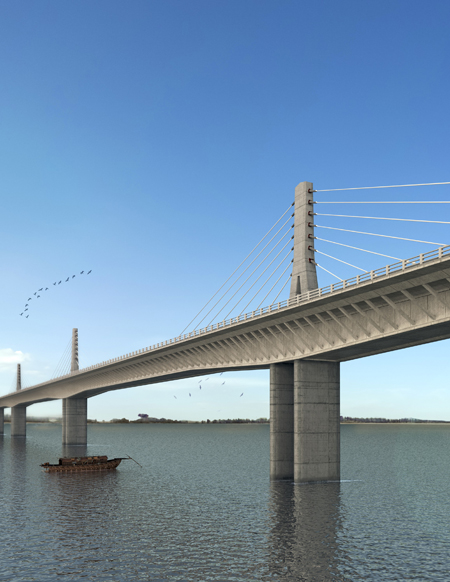
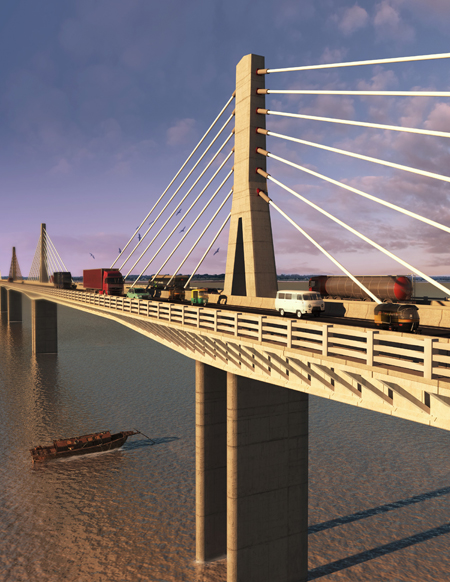
The bridge structure, currently in detailed design, is intended to be a bold statement of the future aspirations of the state. It will feature a three-span cable-stayed bridge flanked by multi-span extradosed spans on each side. Located at what is already a scenic bend in the Ganges, the bridge is envisioned as a symbol of modernity, bringing increasing numbers of visitors to the site.
The site selected for the crossing is overlooked by an ancient Hindu temple built on a rare granite outcrop on the south bank of the Ganges. The rock has been a site of religious worship and teaching since at least 500-700 BC and has hosted both Hindu and Buddhist faiths; evidenced by the excavation of the bronze Sultanganj Buddah in the nearby town. At this bend the Ganges turns northward and each July the site sees the arrival of more than 10 million pilgrims, drawn from all over India and even as far abroad as Nepal and Bhutan. The devotees come to bathe at the Sultanganj “ghat”, or river bank, and collect holy water which they carry by foot more than 100km south to a temple of the god Shiva. This massive influx requires action annually by the state government to ensure that basic infrastructure is not overloaded during the festival. The bridge, which is the biggest infrastructure upgrade ever made in the region, will provide all-weather safe passage to millions of pilgrims.
The new bridge is also expected to attract large volumes of sightseers, including many hoping for a glimpse of the indigenous Ganges ‘blind’ dolphin. To accommodate this demand and avoid traffic congestion, a multi-storey observatory is planned to be built at one of the river piers. From this multi-level platform, 35m above the river, sightseers will be able to take in views of the cable-stayed and extradosed spans and the temple, and look out for the dolphins. The observatory will consist of two towers rising on each side of the bridge. Each tower will have a vehicle access deck, for visitor drop off, from which the visitors can either ascend to a high-level lookout or descend to a glass deck for a closer look at any passing dolphins. The glass deck extends to the opposite tower, as a bridge underneath the main bridge, creating a circulatory route to give visitors a 360° appreciation of the river environment. This circulatory route also allows visitors to ascend the opposite tower to the pick-up zone at bridge deck level.
However native dolphin sightings in the River Ganges have become very rare according to wildlife researchers. The impact of human development on India’s greatest river has hit its ecology hard; upstream dams and the diversion of water for irrigation have greatly reduced dry-season flows in Bihar. This, combined with overfishing, destructive dredging and fertiliser runoff has decimated fish numbers and rendered most of the state’s fishermen idle and destitute. The blind Ganges dolphin relies on echo-location to find its dwindling prey; but this is disrupted by the noise and sediment of dredging and barge traffic.
In a bitter irony, the massive works in the river bed at Sultanganj will further impact the dolphins which its landmark observatory is being built to observe. It can only be hoped that the increased volume of visitors combined with widespread rising prosperity will move the community to conserve what remains of the holy river’s ecology and allow it to flourish once again.
In the latter half of the 20th century the procurement of major bridges in India was typically fraught with delays and could commonly take more than a decade to complete. The upstream Mahatma Gandhi Bridge is sadly representative of that era; after ten years of construction it opened in 1982 only to be closed in 2016 for complete demolition of the superstructure and replacement.
More recently, procurement methods have changed to incentivise timely completion and to give more control to the contractor, empowering them to make faster progress. It has also opened up the design process by allowing contractors to bring in international consultants to provide expertise on new bridge technologies and international best practice.
This shift has taken the form of design-build contracts, which have been instrumental in delivering infrastructure projects much faster, for example on the 600m-long Atal Setu cable-stayed bridge in Punjab-Jammu and the 4.4km Veer Kunwar Singh Setu bridge in Bihar, which were completed in record construction periods of just four to five years. The Sultanganj Bridge is also being procured through a design-build contract awarded to SP Singla Constructions. On this project SP Singla will again collaborate with McElhanney Engineering Services which has been engaged as prime consultant for the extradosed spans. Wiecon is the prime consultant for the cable-stayed spans.
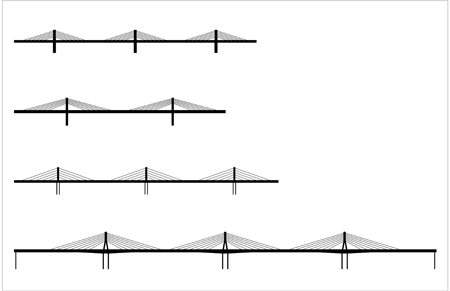
India's extradosed bridges, top to bottom: Nivedita Setu in Kolkata; Third Narmada in Gujarat; Arrah-Chapra in Bihar and Sultanganj
Concrete segmental construction will be used throughout to achieve the speed of construction required. Foundation work is already under way with caissons being sunk to a depth of 56m. The 3,160m-long bridge features a 550m-long cable-stayed bridge over the main channel, with a main span of 270m and side spans of 140m at each side, and a single box girder deck. The extradosed spans make up 1,560m of the bridge and build on SP Singla and McElhanney’s experience from the Veer Kunwar Singh Setu Bridge. A typical extradosed unit is a 575m-long single-cell box girder, a continuous integral structure, with four spans of 125m, 163m, 163m, 125m. Each extradosed tower rises 24m above the deck and supports seven stay cables in saddles arranged in a semi-fan pattern. The remaining 1,050m length of the bridge will consist of twin box girders erected as simple spans of 64m.
The reference design featured variable-depth concrete box girders for the 163m spans, but after the contract was awarded, the design-build team proposed to make these spans extradosed both to speed up construction and increase the landmark status of the project. Extradosed spans use a cable system to act as external post-tensioning on a stiff girder. The cable system mainly carries the self-weight of the bridge; during construction the cables are actively stressed to a tailored set of forces. During service, the stiff girder takes the brunt of the traffic load and the stay forces largely remain constant. Compared to a variable-depth girder design, the stay cable system greatly increases the structural depth and allows the self-weight of the bridge to be carried much more efficiently, reducing the weight of the girder segments. These lighter segments are easier and faster to transport and erect, reducing the construction schedule and the capital outlay for equipment.
The Sultanganj Bridge will break a host of records for Indian bridges. This general increase in scale addresses the scale of the Ganges River and the deep foundations which have to be sunk, at significant cost, into the fine sand to guard against scour. It will feature the nation’s longest extradosed spans of 163m, and the tapered towers will rise 54m above the foundation; making it India’s tallest extradosed bridge. At 33.5m wide it will also be the widest deck of an extradosed bridge in India and it is the first cable-supported bridge in India to be built on a curved alignment. To suit the highway geometry, the most southerly span will be curved on a 550m radius, adding to the complexity of the stay cable system, making it three dimensional and imposing transverse forces on the tower. The solution was to develop a tapered tower with a base wide enough to resist the transverse pull of the cables, but narrowing as it rises to improve the aesthetics.
The 575m-long integral units are believed to be the longest in India which are continuous and integrally connected to the piers and foundations. This reduces the number of expansion joints that need maintaining, and increases the robustness of the system to seismic loads. Creating long continuous structures results in significant thermal and shrinkage deformations on the piers but in this case the height of the deck above the foundation is sufficient to allow the double-bladed piers to flex. To keep these units in compression under all types of service loading, the longest bridge tendons in India will be threaded inside the box girder and tensioned. Being housed in external ducts and running on straight and level profiles, they will not suffer significant friction losses despite their unprecedented 332m length.
Considerable design effort was invested to create a slender box shape and keep the segment weights down with two main aims: to speed up segment transport and to reduce the seismic demands on the foundations. In the reference design the twin box girders were supported independently on twin piers at each well foundation. Changing to a single box girder supported on a single wide blade pier increased the transverse stiffness of the system and increased the seismic force on the foundations. As the wells were already being sunk it was imperative to keep below the seismic reactions of the reference design, and through the design effort, sufficient reduction in girder weight was achieved to overcome this stiffness penalty.
To achieve the necessary reduction in the segment weights, the depth of the girder was tapered from 5.5m at the pier to 4m at midspan. Segments will be cast by the short-line method in a mechanised casting cell. To simplify the design of the casting cell as much as possible the webs were set in a vertical plane and the outer wings of the deck are supported by diagonal concrete struts. The stay cables are arranged in a single central plane and are anchored in the deck of the segments. To anchor the vertical component of the stay force, a pair of diagonal struts is introduced which contain high-strength prestressed bars which bring the force down to the bottom of the webs where it can be introduced as compression.
Achieving this efficient and lightweight design has been made possible by recent advances in Indian design codes. The previous generation of codes was conservative in comparison to European and US codes, and resulted in bridges of thick and chunky proportions. This approach by the code writers was understandable considering the quality of execution of construction work, which was frequently poor, and represented a rational move to increase factors of safety by the only means which could be practically controlled; the design drawings.
National economic reforms begun in the 1990s have enabled international firms to participate in the Indian construction market, leading to a general improvement in the standard of construction quality. International firms such as stay-cable supplier VSL train their staff at international centres and they in turn train local staff to execute work to international standards.
These improvements in construction quality have given the Indian Roads Congress the confidence to adopt a new code for concrete bridges, IRC:112, which is closely aligned with Eurocodes and less conservative. In particular it contains much more lenient limits on compression stresses in a prestressed girder which translate directly to reductions in the bottom slab thickness and segment weight. The new provisions for shear, which are very similar to the Eurocode, allow the webs of girders to be around 30% thinner. These improvements generally allow infrastructure projects to proceed with lower material costs and therefore speed up the pace of development across the country.
Currently the sinking of well foundations is in full swing on the site, and stay cables are being fabricated. Assembly of the casting cell is also beginning; this will form the heart of the casting yard on the river bank which will start churning out precast segments later this year. By the time the monsoon rains recede in 2018 the first precast segments will be brought out onto the river bed to be lifted and joined with epoxy. As the cantilevers grow outward, in balanced-cantilever construction, stay cables will be installed on every third segment. On the current schedule, when the first of the 10 million pilgrims arrive in July 2020, they will be able to cross the new bridge.
Morgan Trowland is senior engineer, David Jeakle is long-span practice lead and Raj Singh is market sector lead – bridges; they all work at McElhanney Engineering Services
Owner: Government of Bihar
General contractor: SP Singla Constructions
Prime consultant (extradosed spans): McElhanney Engineering Services
Cable supplier & installer: VSL India