Although the contracted date of completion was set at 16 September 2023, thanks to impressive progress, sound engineering solutions and good cooperation between all parties involved, the inauguration and opening of the bridge to traffic is now planned a full year and a half ahead of schedule on 18 March 2022 – the 107th anniversary of Turkey’s Dardanelles naval campaign victory.
Once completed, the structure will hold the crown for the longest span suspension bridge in the world at 2,023m, symbolising the year 2023 and the 100th anniversary of the founding of the modern Turkish Republic. The side spans are both 770m, taking the length of the main bridge to 3,563m. The main bridge is connected via two concrete deck approach viaducts – 680m long on the Asian side and 365m on the European side – for a full length of 4,608m. Currently, the record for the longest suspended span is held by Akashi Kaikyo Bridge in Japan, at 1,991m.
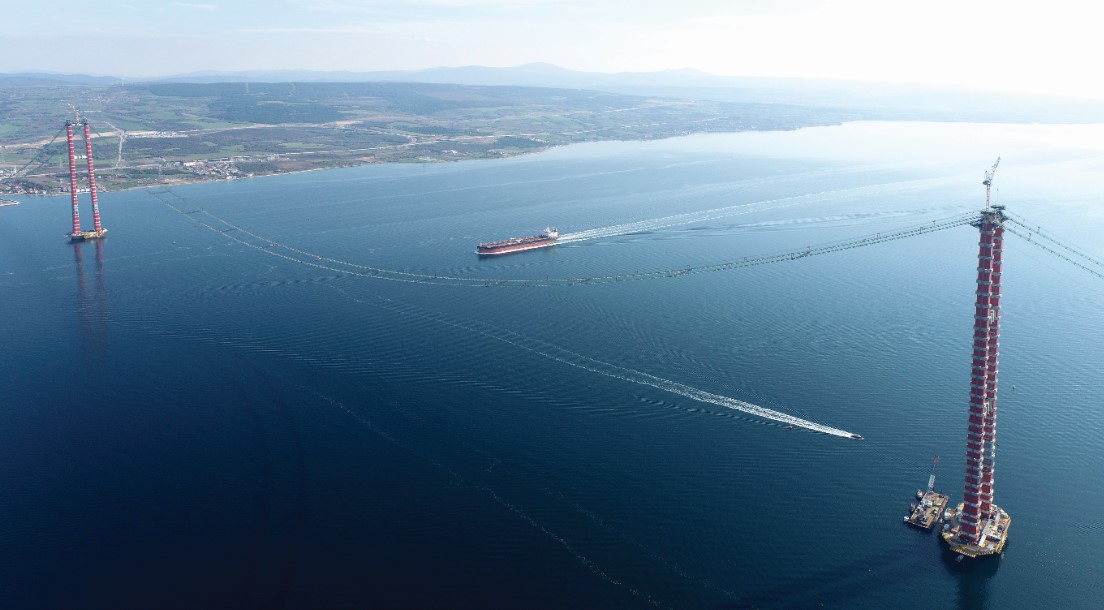 The towers are formed by two legs that are connected by three cross beams at elevations of 130m, 221m, and 310.5m (DLSY)
The 1915 Çanakkale Bridge is part of the Malkara-Çanakkale Highway, which comprises 89km of highways and 12km of connecting roads. The contract price for the entire project is US$3 billion, with the bridge accounting for 70% of that value. This central segment is to be further continued into the Kinali-Tekirdag-C¸anakkale-Savastepe Highway, a 324km-long road that will create a full loop around the Marmara Sea, with crossings over the Bosphorus and Dardanelles straits. The new connection will improve local access between Istanbul and Izmir, two of the largest cities in Turkey. It will also facilitate transit between other European countries and the west shores of Turkey.
The client for the project is KGM, General Directorate of Highways. The appointed (concession) company is ÇOK, which partnered for the construction with a multi-national joint venture. The JV is formed by Turkish firms Limak and Yapi Merkezi, and South Korean companies Daelim and SK E&C. The main designer of the bridge is Cowi, and on behalf of the client, the supervision consultant is a JV of Tekfen Engineering and T-Engineering.
On each side of the main span, with the tower saddles installed, the steel towers now stand at 318m in height, again as a symbol of the anniversary of the Dardanelles naval campaign victory on 18 March. Both towers are formed by two legs, connected for lateral stiffening by three cross beams at elevations of 130m, 221m, and 310.5m. In cross section, each leg ranges from 11m by 10.5m at the base and 8m by 7.5m at the top. The thickness of the skin plates varies from 75mm near the base to 30mm on the higher blocks. The thickest steel plate used at the towers is the base plate for Block 1, at 130mm. From this, the connection to the concrete plinth and the caisson below was made via 168 anchor rods of 85mm in diameter for each tower leg, embedded over 10m into the concrete.
The installation of the towers was divided into 32 blocks, with an average height of 10m. The first six blocks were installed by floating crane and placed in position as full block sections. The remaining 26 blocks were installed by a 300t-capacity tower crane installed between the two tower legs. Because of their weights, most were installed in half blocks, comprising two panels. The blocks from the deck level and from the three crossbeam connections were installed as four individual pieces, panel-by-panel, to allow for even greater precision in their installation.
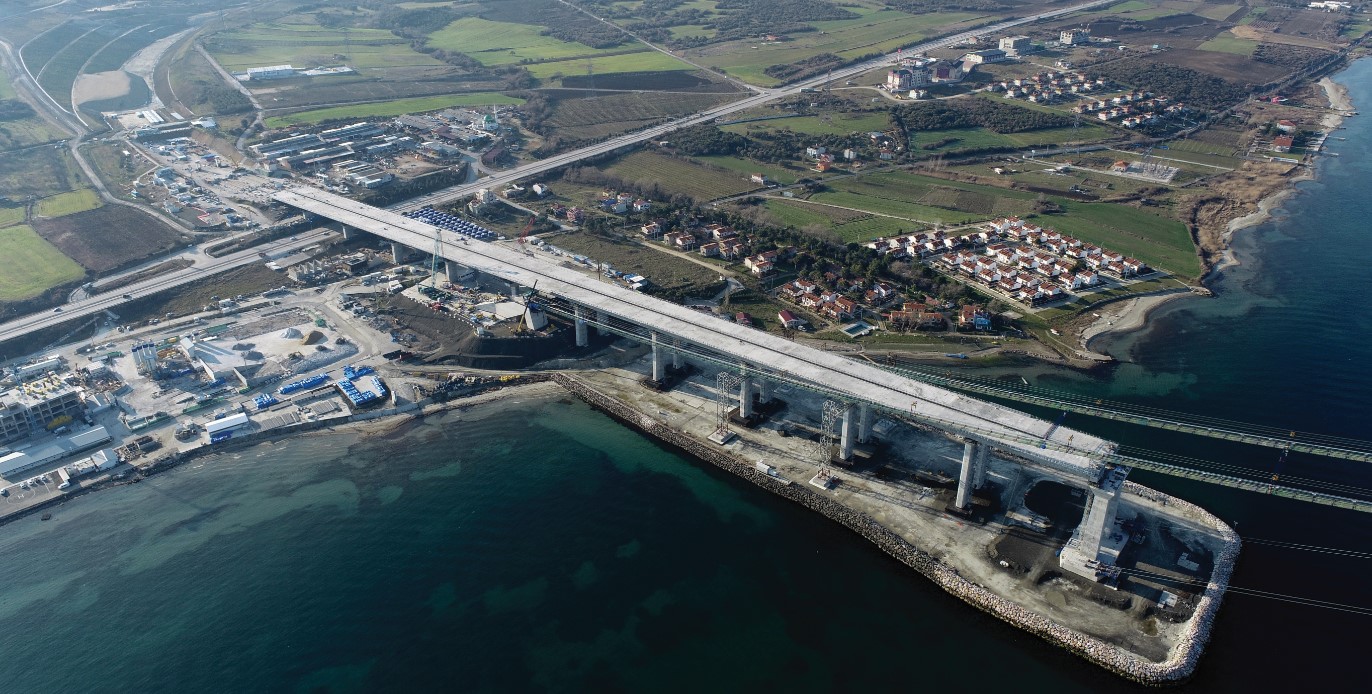 The concrete approach viaducts are 680m long on the Asian side and 365m long on the European side (DLSY)
The tower joints are ensured by a mixed connection, with welding of the skin plates and bolting of the internal vertical stiffeners. The bolts used are HRC type M24, M30 and M36 with calibrated preload, and more than 425,000 bolts were used on both towers, without counting the number of bolts used during the preassembly stage. Roughly 320km of weld passes were made for just the skin plates on the towers and cross beams.
With a 100-year design life, each element of the bridge needs to be treated for long-term reliability. For the towers, this was achieved with paint protection and a dehumidification system, which will become operational before the end of the year. As the towers are constructed in a C5-M environment, ie a location with very high atmospheric corrosivity, the outer paint system had to be of the highest quality to deal with the splash and spray of the salt water and some of the most aggressive marine conditions. A three-coat epoxy and acrylic paint system was applied with a total thickness of 320μm, which will assure the paint’s viability for at least 15 years. The outer surfaces of the towers at around the deck level will receive additional fire-retardant paint protection, allowing those surfaces to withstand up to one hour of intense heat from a fire occurring on the deck. Having the added advantage of the dehumidification system and the closed environment, the inner surfaces of the towers received a lighter paint system application, with only one zinc-rich epoxy layer, with a thickness of 85μm. The dehumidification system will process and circulate dry air, with humidity below 40%, reducing the risk of corrosion.
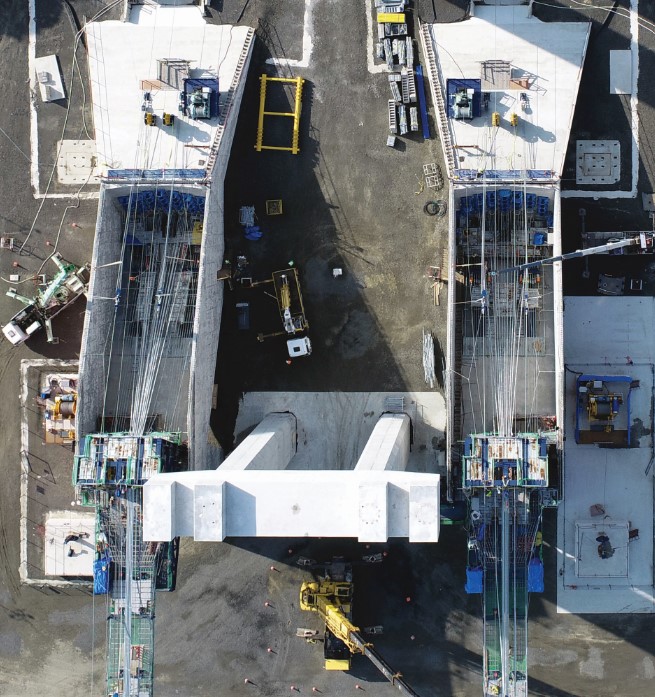 The anchor block/front chamber on the European side (DLSY)
With the last tower block placed installed on 16 May last year and catwalk mesh installation completed on 10 January, the pull-back of the towers was performed in preparation for the main cable. For the tower on the European side, a force of 756kN was applied to the pull-back cables, creating a displacement at the tower top of 1.76m. On the Asian tower, 1,124kN was applied and a movement of 2.6m was obtained at the tower top. These pull-back operations will be offset by the installation of the entire self-weight of the bridge (the main span is heavier than the side spans), with the towers returning to a vertical position upon completion of the works. The final adjustment of pull-back towers was undertaken on 13 January, 2021.
The ongoing critical path activity is the installation of prefabricated parallel wire strands (PPWS). In the main span, 144 PPWS strands are to be placed, while in the side spans there will be 148 PPWS. Each strand is made up of 127 wires with a 5.7mm diameter. Once completed, including the wrapping wire, the main cable will have a designed compacted diameter of 888mm in the side span and 876mm in the main span. The longest continuous PPWS are nearly 4,370m. After main cable installation is finished, cable bands and hanger installation will be performed, before proceeding to the lifting and installation of the main deck blocks. As on the towers, the main cables will be installed with a dehumidification system.
Following completion of compaction and wrapping works, along the length of each of the two main cables will be installed 11 dry air injection sleeves and 12 exhaust ports. The typical spacing between inlets and outlets will be 200m. The dry air, processed at deck level, will travel through pipes installed around selected hangers, then along the main cables, carrying with it any eventual moisture or humidity and maintaining the wire strands in a corrosion-free environment. To protect the wrapping wire and wrapping bands against eventual bulging, injection pressure is kept to a maximum 2,500Pa (55m3/h).
In preparation for the upcoming deck installation, now targeted to commence in June 2021, fabrication of the deck blocks was started in August 2019. The typical deck block is 45.06m wide and 24m long, although different geometries were needed for the closing block, areas around the towers and around the two expansion joints, which will be located at the side span piers. Each typical deck block has a 9m-wide and 3.5m-tall cross girder. The deck will carry three lanes of traffic in each direction, with shoulders as well as a 3m-wide maintenance walkway on each side. The box section deck has an aerodynamic shape that allows it to deal with the high wind speeds that are common in the region.
To accelerate deck installation, it was decided early in the fabrication stage to join the factory deck blocks two-by-two, creating a double block, with the designation ‘mega-block’. This was done to reduce the amount of welding performed on site. Instead of 153 single blocks, the installation will be done with 66 mega-blocks and 21 single blocks, reducing the welded joints on site from 152 to 86. The heaviest deck block will be nearly 840t.
To lift and position the deck, two different methods will be used. The first 20 single blocks, five next to each expansion joint and five around the towers, will be lifted by a 5,000t-capacity floating crane. Following that, the mega-block segments will be raised by lifting gantries. Two lifting gantries will work at each back span, while four lifting gantries will be installed at the main span. The capacity of each lifting gantry is 530t, and they will all work in tandem to lift the mega-blocks. The final deck segments will be the closing elements, at the towers’ axes.
Two dynamic-positioning barges will feed the deck block segments to the floating cranes and lifting gantries. To further reduce the number of critical steps in the deck installation, the decks fabricated 300km away by Çimtas started to arrive in November 2020 in a temporary storage area at site, less than 5km away to reduce the potential impact of weather on deck transportation. To move the deck elements from factory to the barge and from barge to storage area, identical self-propelled modular transporters (SPMT), with capacities of 1,280t, are being used at the fabrication yard and on site.
After its full installation, the deck will create a navigation clearance profile of 1,600m in width and 70m in height, and will not impede waterborne traffic.
Because of the poor soil conditions next to the waterline around the bridge location, revetments were created where the Europe and Asia approach viaducts are being constructed. More than 11,500m3 of 1-3t and 0.5-2t of armour stone created the outer enclosure for the two locations, with over 40,000m3 of various granulometry basalt used as filler material. To further improve the bearing capacity next to the pier footings, more than 6,300 deep-soil mixing (DSM) columns were driven on the European side, with more than 14,400 DSM columns in Asia. Their diameter is 0.9m and they range in length from 19m to 23.5m.
The 680m-long deck at the Asia side was recently completed, having been cast and brought into position using the incremental launching method. The 11 spans, with a typical length of 64m, were completed with 46 separate casts and over 21 launching stages for each of the two decks. The box-girder decks are reinforced by internal longitudinal and transversal post-tensioning that is later grouted. The south- and north-bound decks are separated by a gap of 2.13m.
Although the main steel structures for the towers and deck were fabricated locally by Çimtas in Turkey, for this international project, permanent material was brought from all over the world. The PPWS main cable has been fabricated in China with the wire produced in South Korea. The vertical hangers are also produced in China. The expansion joints and the bearings are coming from Germany, while the post-tensioning strands for the approach viaducts are arriving from Spain. The splay and tower saddle, bearings of the main bridge and the approach viaducts are being supplied by multiple companies based in Italy. The post-tensioning material used in the anchorage block was fabricated in Malaysia. Experts in their fields from more than 20 countries have been – or are currently – involved in the direct construction of this project.
Thanks to quick decision making and the implementation of new rules, the work on site was not negatively impacted in a major way by the current pandemic. At the height of infection rates in Turkey and in direct collaboration with all the stakeholders, the contractor applied a lockdown protocol for site works. This consisted of limiting site access to people undergoing tests and following a period of one to two weeks’ quarantine at a designated location. In addition, all unwarranted travel was restricted. Work from home was implemented in the departments that did not require direct presence on site. Instead of direct participation in inspection at the many fabrication locations, local staff from international third-party companies were employed. Whenever possible, critical tests were viewed via online meetings n
Kemal Çetin is suspension bridge chief engineer and Seyma Serin Okur is suspension bridge engineer at KGM. Radu Verenciuc is quality manager at TTJV