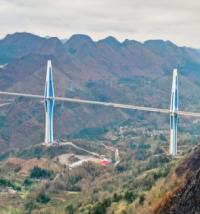
A new solution aimed at preventing ‘ice bombs’ on cable-stayed bridges which is under development combines passive and active technologies and at the same time virtually eliminates rain-induced vibration on cable stays, according to its promoters. But it comes too late to be considered for the Alex Fraser Bridge, and five years since the nearby Port Mann Bridge installed a system of mechanical collars for ice removal. Whether or not this system is the most effective way of addressing the issue is still under discussion between cable experts.
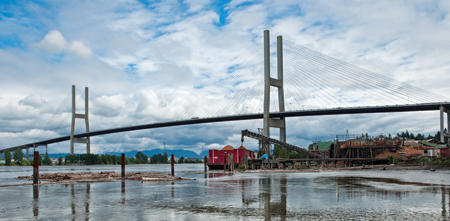
The Alex Fraser Bridge will shortly become the second bridge in Canada to be fitted with a system of collars intended to clear ice accretions from the cables
The disruptive and destructive consequences of falling ice have affected a number of cable-supported bridges in North America and Scandinavia, but in many cases the solution is simply to close the bridge to traffic until the ice has fallen off. This is not always an option for major bridges which carry large volumes of traffic; in December 2012, just weeks after the ten-lane Port Mann Bridge officially opened in British Columbia, Canada, a snowstorm caused sheets of ice to fall onto cars below.
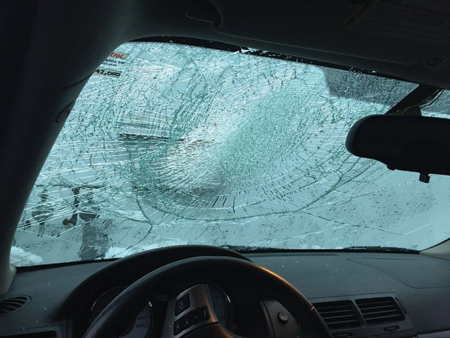
Before the collars were installed on the Port Mann Bridge, falling ice damaged cars and created hazardous conditions for drivers
Most accretions fall off cables due to the debonding of ice or snow from the surface of the cable, predominantly as a result of UV radiation from the sun penetrating through the snow and ice and hitting the surface of the cable, which results in a fine layer of water. On Port Mann Bridge, this debonding led to broken windshields, ripped side mirrors and at least one person injured; around 350 vehicles were damaged in total, according to the Insurance Corporation of British Columbia.
After various solutions were considered, a cable-collar system was installed on Port Mann Bridge in 2013. Each of the bridge’s 288 cable stays were fitted with 30 chain collars that are clustered together at the top and are released remotely, one by one. Each 10kg chain collar then slides down along the HDPE duct, removing snow and ice until reaching the bottom.
Last winter weather conditions were unusually severe around the Vancouver area, with 22 days of snowfall leading to a total of 25,000 collar drops on the Port Mann Bridge’s 288 cable stays. Conditions were so bad that for the first time since it was built in 1986, the Alex Fraser Bridge was completely closed for a total of 18 hours, and partially closed for a further four and five hours.
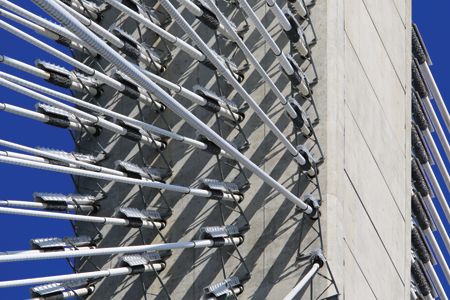
Close-up of the collars on the Port Mann Bridge cables (Klaus Johansson)
The Port Mann Bridge is currently the only bridge in the world to carry this ice collar system, however a second one is due to be installed on the Alex Fraser Bridge, around 20km away, by next winter and the winning bidder for this work was due to be announced as Bd&e went to press.
Ed Miska, executive director of engineering services for the Ministry of Transportation & Infrastructure, Province of British Columbia says that when looking at options for the Alex Fraser Bridge, the ministry reviewed those options previously considered for Port Mann and also whether there had been any developments since then: “At the end of the day the collar drop system that had worked so successfully was considered most appropriate for the Alex Fraser as well,” says Miska.
Prior to the issue of the tender several different weights of collars were tested on the cables of the Alex Fraser Bridge under dry conditions as well as during a snow event. Rope technicians configured different chains and an evaluation team observed how the chains travelled down the cables and how well they removed snow off them. “What we learned is that the concept works on the Alex Fraser just like it does on Port Mann. It did give us a bit more information about the weight of the chains because the difference in cables also affects the size of the collars,” says Miska.
But new technology currently being developed could provide alternatives for bridges that suffer this problem. This system is the result of ice shedding tests with different cable ducts carried out by the Technical University of Denmark and cable manufacturer VSL at the DTU/Force Technology Climatic Wind Tunnel in Lyngby, Denmark. In the tests, HDPE cable ducts with smooth and double-helical surfaces, as in common use today, were compared with innovative HDPE cable ducts bearing modified surfaces as regards their ability to retain ice during the melting process. In addition, the ice mass and particle size of the falling ice was also measured and compared.
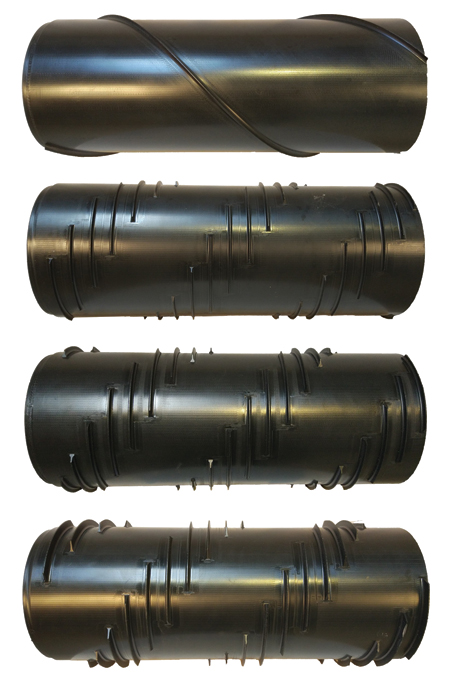
The surface innovations that were tested consisted of a continuous helical strake arrangement with a 45° pitch angle as well as three variations of a staggered arrangement of protruding ridges
The tests carried out in the climatic tunnel in Denmark compared the performance of six types of HDPE cable sheath, of which two were traditional cables and four featured modified surfaces. In contrast to the single continuous helical ridge found on conventional HDPE tubing, the modified surfaces bear transverse lines of protruding ridges, or strakes, that follow a helical line. In addition, the new ridges are trapezoidal in cross-section, with concave fillets at the base and sharp edges at the top. Three different sizes of protruding ridge were tested in the climatic tunnel, at 4.3mm, 6.5mm and 8.3mm in height. A fourth type of innovative duct carried the same helical ridge arrangement seen on a contemporary design, except with a pitch angle of 45°.
The ice-shedding patterns of the different ducts were determined after a series of icing sequences and ice-shedding simulations. The experiments found that the ducts with the highest protruding ridges retained the ice for longer. In addition, the tests also ascertained that the size of the falling ice sections also varied with the size of the ridges. The ice accretion that broke off the ducts with the highest ridges did so in multiple sections; these were also smaller than the ice accretions that fell off the traditional cable ducts.
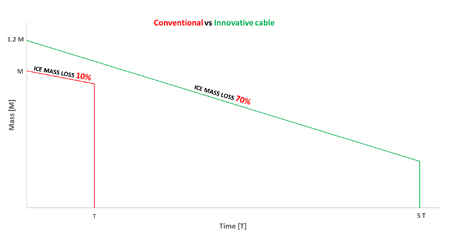
The difference between a conventional and a modified surface duct, in terms of time to fall off and mass of ice piece, is not small: “It takes five time longer for ice to fall off; so if it takes one hour on an existing duct, it takes five hours with the new. And there is a reduction of mass of 70% before the ice comes off, which shows how much a reduction in risk you can get,” explains Christos Georgakis, professor of structural dynamics and monitoring at Aarhus University, Denmark.
“What happens is you have the ridge, with ice on top, and underneath it looks like curling paper that has been perforated. So even when it breaks off in one piece, when it lands it breaks into lots of small pieces because it is already perforated. On a traditional cable sheath with a small fillet the ice is not perforated and so it drops as a big piece, and the amount of energy necessary to break it is much higher than with perforated ice,” says Georgakis.
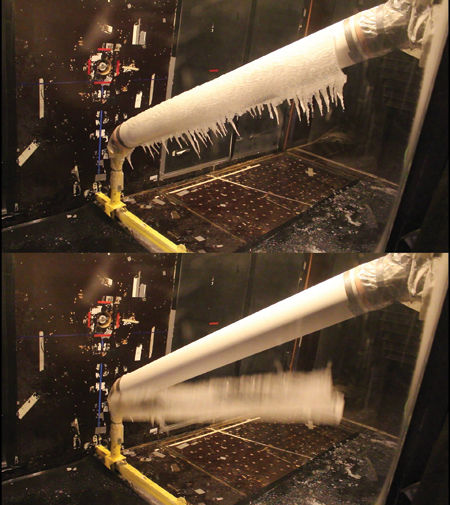
Ice sheds as a single large section from the cable with the smooth surface
To consider ice retention as a positive characteristic of cable ducts may sound counter-intuitive, explains Georgakis, but there is logic behind it. “The problem is when ice or snow accretes, when it sheds quickly the ice falls in large, heavy chunks. However, if you retain it then the ice melts [for a period of time] before falling off. The idea of retaining ice is not something completely new to the world of bridges, and some bridges have fencing to retain snow to allow it to melt. But I don’t think it has been implemented before on cables.”
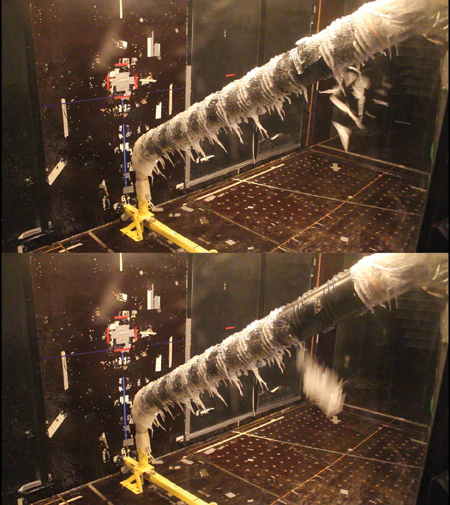
Ice sheds in small sections from the cable with 8.3mm-high ridges on its surface
The system has been developed with VSL, which has spent the last three years designing prototypes of the new cable sheath as well as working out how to manufacture its complex surface.
The potential use of the research findings in the field of ice management on cable-stayed bridges has been enhanced further with the proposal to add an active ice management system to this passive one. In this case, two heating cables run along the length of the main stay-cable which, when operated, introduce lines of separation along which the ice breaks.
The idea of combining the two systems is to provide flexibility to the bridge owner, who can use the passive system to first allow the snow or ice to accrete during the day and then, for example when bridge traffic is low at night, switch on the heat and begin ice shedding operations. “We have tested several different configurations and it all depends on what you are looking for, whether you want to break the ice into lots of different pieces or you can close the bridge off for a few hours and break off bigger ones. That is the idea and I think that this solution, combined with a monitoring solution, would greatly reduce the risk of ice and snow. It doesn’t completely eliminate it, however, because there will be events with large accretions,” explains Georgakis.
As a cable manufacturer and therefore a natural port of call for bridge owners looking for an answer to ice accretion management, VSL has been keeping an eye out for potential solutions for many years and technical director Andreas Schwarz says that all the technologies it had considered were found to have shortcomings of some sort or another. Surface coatings did not break the bond between ice and surface sufficiently to be effective in all conditions. In addition, there were concerns around the robustness of the coatings over time. Electrical pulse heating systems, which run along a stainless steel sheath on the outside of the pipe, were felt to require excessive power and were not manageable in practice. Mechanical systems could lead to permanent damage to the cable surface, which in turn could affect the durability of the cable and its aerodynamic performance, especially if the helical fillets were damaged and could no longer control rain-induced vibrations. “We were never in favour of mechanical removal systems because we considered the risk of causing damage too high,” says Schwarz. “On top of that, we have run analysis on the expected operational costs of such [mechanical] systems and it is clear, when we look at this over the lifespan of the bridge, that the annual operational costs of such a system is quite important,” adds Schwartz.
Georgakis, who acted as chief independent advisor assessing potential solutions for Port Mann bridge designer TY Lin and the bridge contractor – a joint venture of Peter Kiewit Sons and Flatiron Constructors Canada - is also not supportive of mechanical solutions.
“Besides working off the fillet over time, a mechanical system also changes the shape of the cable,” says Georgakis, who fears this may be happening in Port Mann Bridge. “And small changes in the shape of the cable also lead to aerodynamic instabilities. So you end up having large amplitude vibrations when you change the shape of the cable,” he adds. In a worst-case scenario, large vibrations in the cable could lead to bridge users feeling insecure and, in the long term, lead to cable fatigue and the premature ending of the lifetime of a cable.
Miska confirms that those concerns have also reached his department: “Our inspectors have looked at that and we are not seeing damage. We do bridge inspections on a very regular basis and certainly, we have heard that concern from others as well, so we are paying attention to that. Nevertheless, we do not see a problem at this point. But certainly it is something on our radar and we’ll be monitoring it closely.”
For Port Mann Bridge, Georgakis had originally suggested that a decent monitoring system be installed to forecast when snow and ice conditions would lead to extensive snow accretion, when the bridge should simply be shut down. “My position is that they didn’t have to use any technology at all. There are many bridges in Scandinavia that get ice and snow and as a result, once every eight years or so they close the bridge for a few hours and that’s it. Of course there is a cost, but it is small compared to what is in place now.”
Asked about the option of simply closing the bridge down when necessary, Miska highlights that the Alex Fraser and Port Mann are two very important bridges in the area, with traffic averaging 119,000 and 121,000 vehicles per day, respectively. More than US$3 billion of goods are trucked between the gateway ports and the rest of Canada every year, with a high portion being carried across these bridges. “Safety is always our number one priority and if at any time it was felt like safety was being diminished then we would close the bridge, as we did a few times last year. However, we do our best to keep them open all the time.”
The cost of operating the ice collar solution is unpredictable since it varies in proportion to the severity of the winter. Last winter the operational costs were US$5 million; the year before that, when the winter was mild, they were US$300,000.
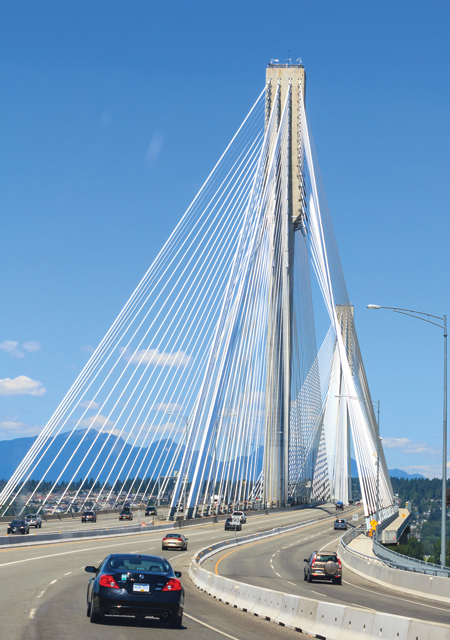
Each of the Port Mann Bridge’s 288 cables is fitted with 30 chain collars
These costs are mainly related to the labour-intensive work that has to be carried out to ensure the system is ready for operation at all times. “We monitor the forecast and we always want to be ready. When a snow event finished [last year] we started reloading collars straight away ready for the next event, so it was really a continuous process,” says Miska. While the collars can be carried up the tower in the elevator, the final step of the process has to be done by rope technicians working on the outside of the towers.
On the issue of costs, Schwarz claims that the installation of a combined passive-active solution is financially favourable in the context of an overall structure, particularly when taking into account the savings made by not installing a mechanical ice removal system with the accompanying annual operation costs. “We have done calculations for a typical concession over 25 or 30 years and can demonstrate it is a global saving compared to alternative systems of de-icing pipe. Of course, in a concession, it is relatively easy to run these sorts of lifetime costings but in a pure build project every dollar counts and you have the initial capex costs during the construction period. That is why we have decided to continue the research and look at what additional benefits the new technology can bring.”
Here Schwarz is referring to cable aerodynamics and drag, which was the subject of the original research being carried out by Georgakis and his team. The ice-retention capabilities of the modified surfaces and their potential use in ice accretion only became the focus later: “We were alerted to the research into alternative surface profiles as a way of controlling induced vibrations, where the classical sate of the art in industry were helical-shaped fillets or dimpled surface profiles,” recalls Schwartz.
In this research it was found that the fillets virtually eliminated rain-induced vibrations by not allowing the rain rivulets to form in the first place “The strakes are shaped like windshield wipers, jettisoning the rivulets that would normally form on
the outside,” explains Georgakis. “We started playing with the height of the fillet because the taller it is the longer ice is retained, and then started looking at increasing the height to see the effect on aerodynamics. And we saw no change in aerodynamics or change in drag, but with the increase we can retain ice and snow for much longer.”
Next year will see a new research project by Aarhus University and VSL with the aim of testing the new surfaces with snow rather than ice. In addition, testing will be carried out to determine exactly how much damping would be needed for a bridge that carried this technology. “We suspect it is very low, but the research will also serve to determine what is needed to avoid buffeting-induced vibrations, which is something we can’t avoid,” explains Georgakis.
It is hoped that the next round of research will confirm the initial technical findings and prove that the increased structural damping of the cable will reduce requirements for damping devices and therefore bring costs savings. Schwarz points out that very little research has been carried out into how a cable behaves dynamically once snow and ice accretion is present on the surface. “This is dealt with today by allowing for very large safety margins in damping requirements, so I also want to cover extreme case where the aerodynamic characteristics of my cable change due to accumulation. We are aiming to find calculation models validated by testing that allow us to determine more accurately what amount of additional damping I need to put in the system to stay on the safe side,” says Schwarz. So far, VSL feels that it has finally found a technology that it can confidently recommend and for which it holds the licence. Ownership of the patent is split between the DTU and the technology inventors Kenneth Kleissl and Christos Georgakis.
The feedback has been positive so far, says Schwarz, with much interest shown by bridge consultants and owners: “But we have not yet had the opportunity to install it on an actual bridge. That is the hurdle to overcome, a client prepared to install a prototype and, in a sense, be at the cutting edge of innovation. There is always a concern that whatever is placed on a bridge has to be there for 100 years, so many people do not want to be the first to put an innovative solution in the field.”
As regards new bridges in Canada, Georgakis is of the opinion that a solution consisting of a monitoring system is still the best, but one that is accompanied by the new dual system: “They should be prepared in extreme cases to shut down the bridge, for example if there is a super extreme ice or snow accretion event that is beyond what systems can handle.” In such cases, the pieces of ice or snow fall off not due to the debonding effect of UV radiation, but simply because the ice and snow is too heavy.
For bridge owners facing similar ice challenges as British Columbia, and who may be considering an ice collar system too, Miska has some practical words of advice. “Do some testing based on the diameter of the cables and the cable angles. In addition, field-testing should be carried out under snow conditions too, because if the collars are released with very light snow you will go through the whole supply of collars. But if snow becomes very heavy, and starts to freeze on the cables then it is very difficult for the system to get it off as well. It is important that a weather technician is monitoring the weather and the cables, looking at the snow accumulation so that the collars are released at the optimal time to get all the snow off.”
For now, the Ministry of Transportation of British Columbia is happy with its mechanical solution: “The beauty of this system is really its simplicity. You put the chain collar on top and let it go and gravity takes it away. It’s a very simple concept and when you are working under extreme conditions the simpler the system the less things there are to go wrong,” concludes Miska.