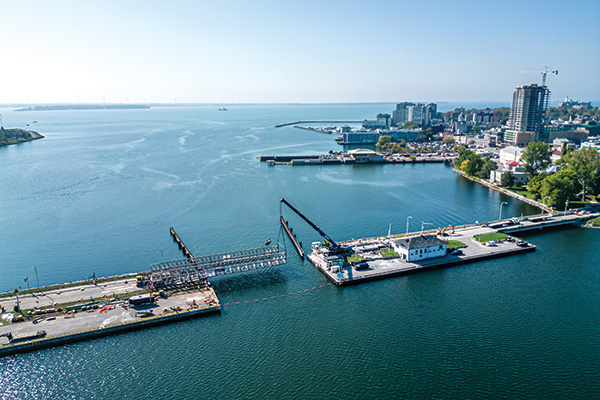
 A 48.5m modular bridge span was installed to restore key access after the failure of a historic Canadian bridge located mid-causeway (Acrow Bridge)
La Salle Causeway in Kingston, Ontario was constructed in 1917 at the mouth of the Cataraqui River. It is considered part of Highway 2 and is a vital link to the city’s eastern suburbs for more than 20,000 vehicles per day. The causeway includes three bridges, two fixed and one a historically significant single-leaf Strauss heel-trunnion bascule bridge that was operated during the navigation season to provide marine access to Kingston’s Inner Harbour. The latter was designed by Joseph Strauss, the designer of the Golden Gate Bridge in San Francisco.
Over the years, the bridge was renovated several times, including a significant rehabilitation in 2010 and repair of the mechanical systems a decade later. Additional repair work has been needed each year since, contributing to steadily increasing maintenance costs and closures of the causeway. In late 2023, the causeway’s owner and operator, Public Services and Procurement Canada (PSPC) began a project to replace the bridge deck and rehabilitate the structure’s trunnion steel and counterweight to improve the condition and operation of the bridge and significantly extend its service life.
The restoration work was under way on the evening of 30 March 2024, when a steel truss supporting the counterweight was damaged during construction activity (Bd&e issue 116). A scheduled traffic closure was in place at the time and, fortunately, no one was injured.
For safety reasons, PSPC announced the structure would remain closed until further notice. Motorists, cyclists and pedestrians were detoured to alternate routes, but the closure caused significant traffic backups. The damaged bridge also trapped boats in the Inner Harbour, including commercial and non-commercial vessels which were stored for the off-season at a dry dock. Downtown businesses reported a sharp drop in traffic and delayed emergency response was a concern.
After an initial assessment of the damage, a plan to stabilise, repair and strengthen the structure was launched. A further analysis, however, showed key elements of the bridge structure were displaced and misaligned. As these would substantially reduce the bridge’s service life, following discussions with the City of Kingston, PSPC determined the best course of action was to demolish and remove the entire structure. The plan included using a temporary modular bridge as an interim solution to allow vehicles, pedestrians and cyclists to cross the causeway outside of the marine season until a permanent replacement was constructed.
The bridge was demolished in June, opening the channel for marine traffic until construction began on the temporary bridge in September. PSPC announced that the installation of a modular bridge would enable the causeway to open, and that its design would allow it to be removed and reinstalled for marine access windows. During these scheduled channel openings, the causeway would be closed.
A modular bridge from Acrow was selected for the project and was provided to Priestly Demolition, who was responsible for installing the structure. The single-span bridge is 48.8m long and has a two-lane width of 7.3m. A 1.5m-wide cantilevered footwalk separates pedestrians and cyclists from vehicular traffic.
Components began arriving at the site in mid-August and the bridge was assembled on rollers. To ensure its stability, extensive preparation was required on the approaches, and the existing seats were modified to suit the modular structure. The bridge was launched with the assistance of a crane on 20 September and opened to traffic on 3 October.
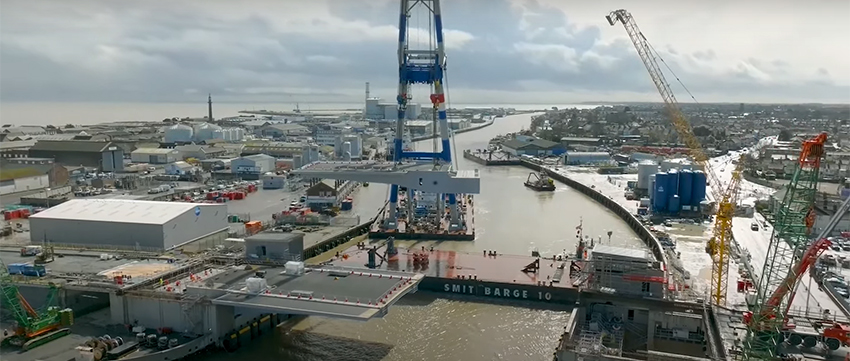
In preparation for creating a navigable channel for marine traffic, Acrow liaised with the lifting specialist to ensure that the correct pick points on the bridge would be used. Additional plates were added to the underside of the bridge at these points to allow the bridge to tie into the lifting system on a floating barge.
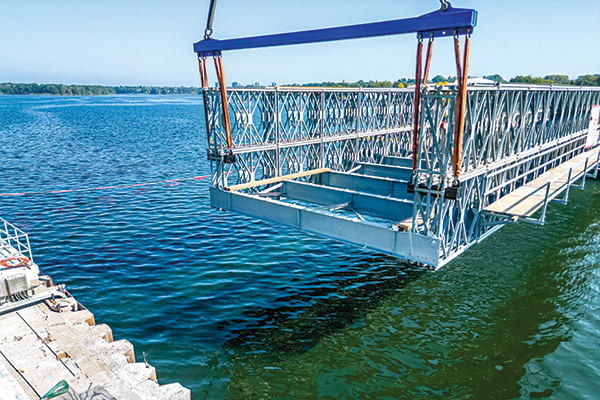
Additional steel plates were fixed to the span’s crane pick-up points (Acrow Bridge)
The first removal and reinstallation sequence took place on 15 October 2024, opening the marine channel for a nine-hour window. This unique approach was accomplished by de-ballasting the barge and allowing the buoyancy of the vessel to raise the bridge off its bearings. Once clear, the barge could float the bridge out of the navigation channel. The process was reversed for reinstalling the structure and reopening the crossing. The removal and reinstallation processes each take around three hours.
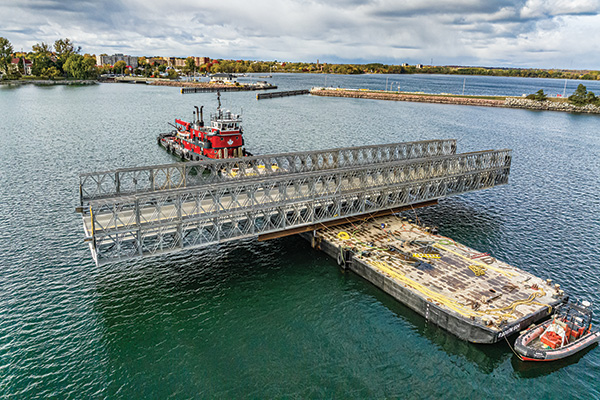 Temporary span removal and reinstallation is carried out according to a fixed timetable (Acrow Bridge)
The second and last opening of 2024 took place on 16 November and, in mid-December, PSPC announced a proposed schedule of openings for 2025. This includes removing the bridge once every two weeks, beginning in mid-April, and increasing the frequency to once per week from June to August, then returning to once every two weeks until mid-November.
Over the past several decades, Acrow has created numerous temporary bascule and vertical lift detour solutions for moveable bridge rehabilitation or replacement projects. The emergency at the La Salle Causeway, however, required a faster resolution than the lengthy construction time required for of one of these complex structures. Fortunately, PSPC’s innovative approach of adapting a standard modular steel bridge for the unique application proved an ideal solution to address the needs of causeway and marine traffic.
Bill Killeen is CEO of Acrow Bridge